Ministry of Foreign Affairs Summons Acting Japanese Ambassador to Korea
Protests Forced Labor Claims Excluding Coercion and Dokdo's Unfounded Assertion
On the 28th, the Ministry of Foreign Affairs summoned the Charg? d'Affaires of the Japanese Embassy in Korea regarding the results of the Japanese elementary school textbook review. This was to protest the history textbooks that omitted the coerciveness of forced mobilization during the Japanese colonial period and included unfounded claims of sovereignty over Dokdo.
Cho Hyun-dong, the First Vice Minister of Foreign Affairs, summoned Kumagai Naoki, the Charg? d'Affaires of the Japanese Embassy in Korea, to the Ministry of Foreign Affairs that afternoon.
The term 'summon' refers to the act of a country's diplomatic authorities calling in the ambassador, minister, or consul of a foreign country stationed in their country to their diplomatic office for diplomatic reasons related to bilateral relations. Although it is not as severe as recalling one's own ambassador, expelling the other country's ambassador, or designating a diplomatic persona non grata, it is a negative diplomatic response.
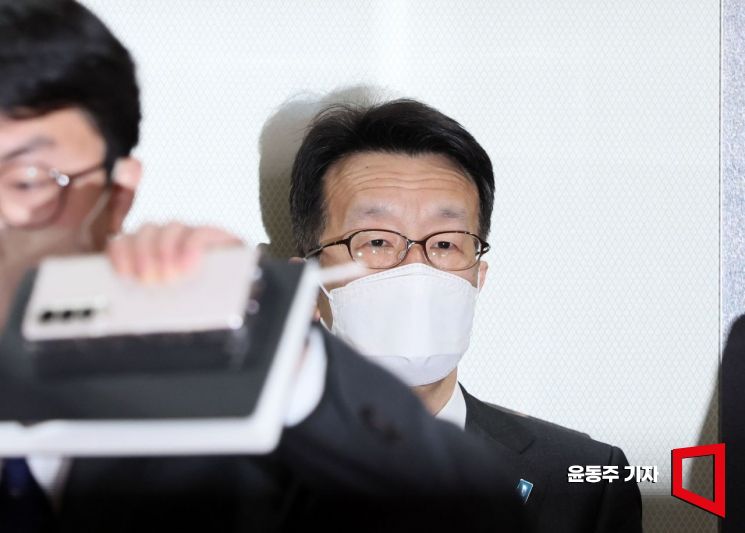 On the 22nd, in relation to the attendance of a senior official from the Japanese central government at the 'Takeshima Day' event hosted by Shimane Prefecture, Japan, Naoki Kumagai, the Consul General of the Embassy of Japan in Korea, is being summoned. Photo by Dongju Yoon doso7@
Initially, Vice Minister Cho was scheduled to summon Aiboshi Koichi, the Japanese Ambassador to Korea. However, since Ambassador Aiboshi was temporarily back in Japan, Kumagai, the Charg? d'Affaires, was summoned in his stead. The Korean government expressed "deep regret" regarding the results of the Japanese textbook review through a statement issued by the Ministry of Foreign Affairs spokesperson.
The government stated, "We strongly protest the Japanese government's approval of textbooks containing unjust claims over Dokdo, which is clearly our inherent territory based on history, geography, and international law," and "We express strong regret over the changes in expressions and descriptions related to forced mobilization that dilute its coercive nature." Furthermore, the government urged "the Japanese government to sincerely implement the spirit of apology and reflection on past history that it has previously acknowledged."
Prior to this, Japan's Ministry of Education, Culture, Sports, Science and Technology announced the results of the review of social studies textbooks and teacher's guides for grades 3 to 6 of elementary school to be used from next year.
These textbooks replaced the previous descriptions of Korean conscription during the colonial period with non-coercive terms such as "volunteering," and regarding Dokdo, included the statement that "Takeshima (竹島, the name Japan claims for Dokdo) is Japan's inherent territory." Some textbooks even marked Japanese territorial waters and Exclusive Economic Zones (EEZ) on maps around Dokdo.
© The Asia Business Daily(www.asiae.co.kr). All rights reserved.
![Clutching a Stolen Dior Bag, Saying "I Hate Being Poor but Real"... The Grotesque Con of a "Human Knockoff" [Slate]](https://cwcontent.asiae.co.kr/asiaresize/183/2026021902243444107_1771435474.jpg)
















