Among December Fiscal Year-End Listed Companies, 18 Receive 'Adverse' Audit Opinions
Large Operating Losses Until Previous Q3, Companies with Quarterly Sales in the Billions at Risk
Late if Audit Opinion is 'Disclaimer'...Must Detect 'Signs' in Q3 Financial Statements
Every year in March, some listed companies fail to receive an audit opinion of 'unqualified.' Listed companies that submit audit reports without such an opinion have their stock trading suspended until a decision is made on whether to delist them. Regulatory authorities advise caution when investing in companies with poor management stability or financial conditions, as unexpected investment losses may occur during the settlement period. In particular, it is best to avoid stocks of listed companies that ▲have recorded large operating losses up to the previous third quarter or ▲have quarterly sales around 1 billion KRW in March. Additionally, investors should carefully examine separate financial statements as well as consolidated financial statements, as relying solely on consolidated statements can lead to losses. There are quite a few companies that perform well on a consolidated basis with affiliates but are individually in poor condition.
One in Four Delisted Companies Receives 'Adverse' Audit Opinion
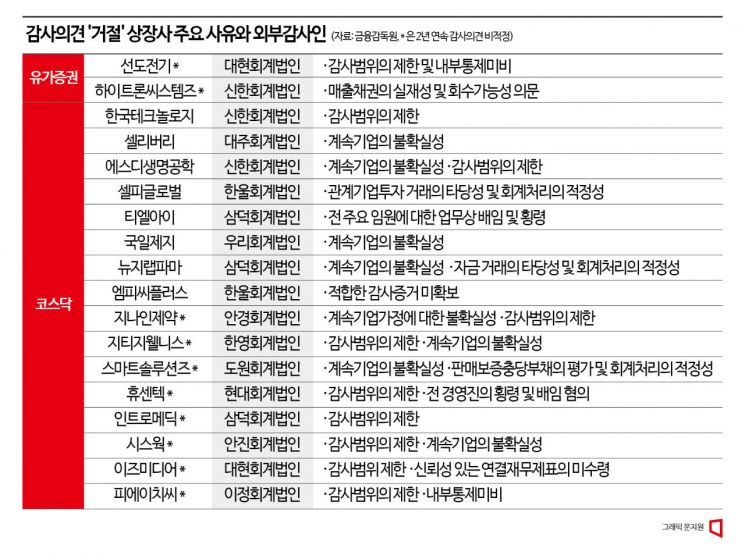
According to the Financial Supervisory Service on the 29th, among KOSDAQ-listed companies with December fiscal year-end, 18 companies including Jinain Pharmaceutical, Hanguk Technology, GTG Wellness, Smart Solutions, Selfie Global, TLI, PHC, Gukil Paper, Newgelab Pharma, and MPC Plus received an 'adverse' audit opinion. Considering that 37 KOSDAQ-listed companies did not submit audit reports, the number of listed companies failing to receive an 'unqualified' audit opinion is expected to increase further. According to the External Audit Act and disclosure regulations, external auditors must submit audit reports at least one week before the regular shareholders' meeting. Listed companies must disclose the audit report to the Korea Exchange on the day they receive it.
Adverse audit opinions such as disclaimer, adverse, or qualified opinions are grounds for delisting. About one-quarter of companies delisted from the domestic stock market in the past five years were due to settlement-related reasons. An analysis by the Korea Exchange of 171 delisted companies over the past five years showed that 48 companies (28.1%) were delisted due to settlement-related reasons. Among these, 'adverse audit opinions' accounted for the largest share at 91.7%.
Among the 44 companies delisted last year, 11 (25.0%) were delisted due to settlement-related reasons. A Korea Exchange official said, "As the settlement period for the 2022 fiscal year approaches, listed companies must disclose audit reports immediately upon receipt from external auditors," adding, "Investors should be cautious when investing in companies with poor management stability or financial conditions, as unexpected losses may occur during the settlement period."
Deteriorating Performance and Poor Financial Condition Revealed in Quarterly Reports

Failing to receive an audit opinion does not mean immediate expulsion from the stock market. However, prolonged trading suspension can lock up assets as shareholders cannot sell their stocks. Experts in the financial investment industry advise that most companies receiving adverse audit opinions show signs beforehand, so caution is needed when selecting new investments at the beginning of the year. The majority of disclaimers were due to 'uncertainty about the company's ability to continue as a going concern.' It is important to carefully consider investment decisions for companies that have recorded large losses or whose liabilities exceed assets.
Most listed companies that failed to receive an 'unqualified' audit opinion this year revealed deteriorating performance and poor financial conditions in their quarterly reports. Special caution is required for companies that have been in deficit for several years. A financial investment industry official explained, "Every March, the risk for marginal companies peaks," adding, "Once an audit report without an opinion is submitted, stock trading is suspended immediately, locking up funds for about a year."
SD Bioengineering, which failed to receive an opinion from Shinhan Accounting Corporation, recorded operating losses of 34.8 billion KRW and 38 billion KRW in 2021 and 2022, respectively. SD Bioengineering, engaged in cosmetics and health food businesses, had a high proportion of selling and administrative expenses relative to sales over the past two years. While the ratio of selling and administrative expenses to sales was about 40% in 2020, it rose to 57% in 2021 and 64% in 2022. This was due to increased commissions and advertising expenses after entering home shopping.
Cellivery was also hampered by consecutive losses. Cellivery recorded sales of 23.2 billion KRW and an operating loss of 66.9 billion KRW last year. Its operating loss in the third quarter alone was 15.4 billion KRW, with cumulative losses reaching 42.9 billion KRW. The loss was more than twice the cumulative sales of 17.6 billion KRW for the third quarter. Daeju Accounting Corporation, the external auditor, explained that Cellivery's current liabilities exceeded current assets by 25.6 billion KRW, and the early redemption period for 35 billion KRW in convertible bonds will arrive in October this year. They judged there was significant uncertainty about the company's ability to continue as a going concern and issued a disclaimer.
SD Bioengineering and Cellivery recorded cumulative operating losses of 22.7 billion KRW and 42.9 billion KRW, respectively, up to the third quarter last year. This shows that listed companies with large operating losses relative to sales face significant audit opinion risks.
Investors should also be cautious with listed companies that have small quarterly sales. Trading of Hanguk Technology's stock, which received a disclaimer, was suspended from the 16th of last month. The KOSDAQ Market Headquarters of the Korea Exchange stated that internal settlement revealed that Hanguk Technology's separate financial statements showed quarterly sales below 300 million KRW and half-year sales below 700 million KRW, leading to the suspension of trading. According to separate financial statements, the company recorded sales of 1.3 billion KRW and an operating loss of 7 billion KRW. Compared to sales of 15.2 billion KRW in 2021, sales decreased by over 90% in one year.
On a consolidated basis, Hanguk Technology recorded sales of 305.9 billion KRW and an operating loss of 14.4 billion KRW last year. Unlike 2021, when sales were 353.1 billion KRW and operating profit was 5.7 billion KRW, sales decreased and operating profit turned negative. Investors relying solely on consolidated financial statements may suffer losses, so separate financial statements must be carefully reviewed.
Shinhan Accounting Corporation, which conducted the external audit of Hanguk Technology, explained that they could not perform audit procedures on key accounts such as sales and financial assets because they did not receive essential documents required for the audit. They rejected the audit opinion because they could not conduct the audit at the level required by auditing standards.
Failure to Receive Audit Opinion Due to Embezzlement and Breach of Duty
Some listed companies fail to receive audit opinions due to embezzlement and breach of duty. Samduck Accounting Corporation pointed out that TLI could not obtain sufficient and appropriate audit evidence to support the audit opinion. A complaint regarding breach of duty and embezzlement by former executives was filed, and the impact on consolidated financial statements was uncertain, which significantly affected the external audit. TLI filed a lawsuit against the former CEO and directors for breach of duty.
The Korea Exchange classifies listed companies that receive an 'adverse' audit opinion from external auditors as having formal grounds for delisting. Regulatory authorities decide on delisting based on the audit opinion in the following year. If a company receives an 'unqualified' opinion through a designated auditor, it undergoes a substantial review of listing eligibility to determine whether to maintain its listing. This means that after about a year of trading suspension, a company may either be delisted or resume trading.
Most of the Principal Lost if Disclaimed for Two Consecutive Years
Eight listed companies that failed to receive an 'unqualified' audit opinion in both 2021 and 2022 are highly likely to be delisted from the stock market. Jinain Pharmaceutical, GTG Wellness, Smart Solutions, Huscentech, Intromedic, Syswork, Izmedia, and PHC were all disclaimed last year and again this year.
Jinain Pharmaceutical's stock trading has been suspended since February 17 last year. Shareholders have been unable to sell their shares for over a year, waiting for trading to resume. Jinain Pharmaceutical recorded sales of 700 million KRW and an operating loss of 7.7 billion KRW last year. An external auditor, Ankyung Accounting Corporation, evaluated that the company's mobile phone camera lens manufacturing activities have been halted and payments to suppliers are delayed, making it highly uncertain to assume the company as a going concern.
Failing to receive an audit opinion for two consecutive years constitutes grounds for delisting under Article 54 of the KOSDAQ Market Listing Regulations. The listed company can file an objection within 15 days of receiving the delisting notice. The Korea Exchange explained that it plans to review and decide on delisting by combining the audit opinions for the 2021 fiscal year and delisting reasons for the 2022 fiscal year. Not only do shareholders lose opportunity costs due to prolonged trading suspension, but if they sell their shares through liquidation sales, they are unlikely to recover most of their principal.
© The Asia Business Daily(www.asiae.co.kr). All rights reserved.
![Clutching a Stolen Dior Bag, Saying "I Hate Being Poor but Real"... The Grotesque Con of a "Human Knockoff" [Slate]](https://cwcontent.asiae.co.kr/asiaresize/183/2026021902243444107_1771435474.jpg)


















