As the banking crisis that erupted simultaneously in the United States and Europe has passed its peak, concerns are emerging that commercial real estate could become a new trigger for the spread of the crisis. Although loan delinquencies and vacancy rates are soaring to levels of concern, it is expected that the situation will not escalate into a systemic financial crisis.
On the 27th (local time), Adam Posen, president of the Peterson Institute for International Economics (PIIE), a think tank in Washington, said, "The commercial real estate market is heading toward serious turmoil, but I do not expect it to escalate into a financial catastrophe."
As the deterioration of banks' commercial real estate assets becomes a reality, the asset soundness of financial institutions with a high proportion of real estate financing may surface, but it is forecasted that a severe threat on the scale of the 2008 financial crisis will not occur.
However, Posen pointed out that the negative impact on local government tax revenues based on rents and the real economy will be unavoidable.
Posen stated, "Since the COVID-19 pandemic, office occupancy rates have decreased by an average of 30 to 40 percent due to the expansion of remote work and economic recession." Accordingly, there are also forecasts that vacancy rates will not escape an upward trend until 2024.
In particular, the fact that small and medium-sized banks, which have relatively weak financial structures, have high loan exposure to commercial real estate is also a growing concern. According to JP Morgan, thousands of small and medium-sized banks in the U.S. have about 70% of their loans in commercial real estate.
Shadow banking, such as private equity funds, which operate in regulatory blind spots, is also a wild card. Posen said that while the impact of private equity firm failures on the economic system may be less than that of banks, the future risk is uncertain because they are outside the scope of financial supervision and have lower risk management compared to banks.
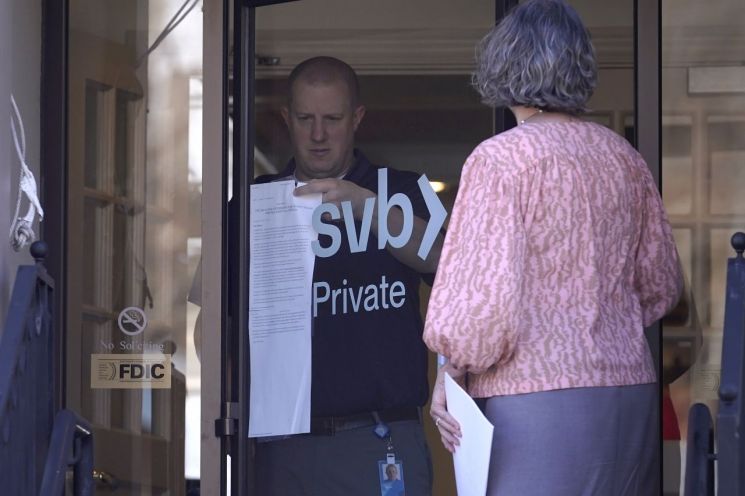 On the 27th (local time), an employee at the Wellesley branch of Silicon Valley Bank (SVB) in Massachusetts, USA, is removing a notice attached to a glass door. Seventeen days after SVB entered bankruptcy proceedings following a bank run on the 10th, it was acquired by First Citizens, a U.S. regional bank based in North Carolina. From this day, 17 SVB branches nationwide will operate under the name First Citizens branches. [Image source=AP Yonhap News]
Authorities are also aware of these risks. Martin Gruenberg, chairman of the Federal Deposit Insurance Corporation (FDIC), pointed out, "If poor borrowing conditions such as low returns and high funding costs in commercial real estate persist, the deterioration of commercial real estate loans could lead to bank failures."
Meanwhile, earlier on the 10th, Silicon Valley Bank (SVB) in the U.S. was acquired by First Citizens, a small and medium-sized bank, due to a liquidity crisis triggered not by loan defaults or asset losses but by a bank run (mass withdrawal of deposits) caused by anxiety.
© The Asia Business Daily(www.asiae.co.kr). All rights reserved.

















