Starting from the second quarter of this year, the frequency of trains on Seoul Metropolitan Subway Lines 2, 3, and 5 will increase. Lines 9 and the Gimpo Goldline will each add 8 and 5 train sets respectively by next year. Additionally, the related manual will be revised to allow railway operators to decide whether to skip stops when congestion reaches congested or severe levels.
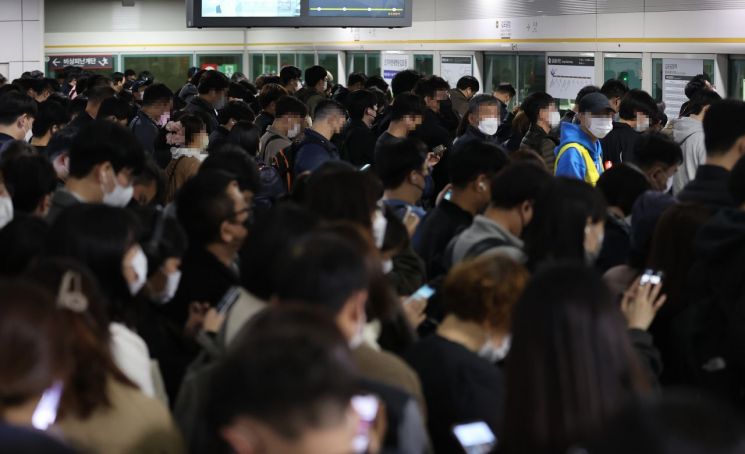 Gimpo Urban Railway (Gimpo Gold Line) Gimpo Airport Station is bustling with transferring passengers. / Photo by Yonhap News
The Ministry of Land, Infrastructure and Transport’s Metropolitan Transportation Committee announced on the 28th that it will begin managing congestion on the metropolitan subway to prevent safety accidents caused by crowding and to create a more comfortable commuting environment.
The risk of accidents due to congestion on the metropolitan subway has been consistently pointed out, and the need for improvements has been emphasized from the perspective of user convenience during peak hours. The government explained that although measures such as shortening intervals between trains and adjusting stopping stations have been taken on highly congested lines like the Gimpo Goldline, congestion has worsened as the average daily number of passengers continues to increase every year.
In particular, Lines 4, 7, and 9 have an average congestion rate exceeding 150% during the busiest time (8:00 AM to 8:30 AM), and stations with heavy boarding, alighting, and transfers such as Sindorim (215,000 passengers), Jamsil (187,000 passengers), Express Bus Terminal (169,000 passengers), and Gangnam (165,000 passengers) have also been confirmed to be congested.
Accordingly, the Ministry of Land, Infrastructure and Transport plans to strengthen congestion management within trains and stations by improving the overall railway safety system. First, transportation capacity will be expanded by increasing the number of trains during peak congestion times. In the second quarter of this year, reserve trains will be deployed on Lines 2, 3, and 5 to increase frequency, and 8 additional train sets will be introduced on Line 9 by next year. Especially for the Gimpo Goldline, which has the highest congestion rate, 5 additional train sets will be deployed to improve congestion levels. Temporary trains will also be deployed to prepare for sudden increases in demand on metropolitan railways due to heavy snow warnings or alerts.
Technical standards for continuous monitoring and management of congestion risks will also be strengthened. A revised technical standard will be announced within the first half of this year to establish a quantitative measurement and management system for congestion in stations and trains. The revision defines the ratio of actual passengers to the train’s boarding capacity as "train congestion," and the number of passengers relative to the appropriate capacity of platforms, passageways, and stairs within stations as "station congestion." Additionally, a measurement method will be established for quantitative management of congestion. The stages are defined as Normal (~130%), Caution (130~150%), Congested (150~170%), and Severe (170%~). Railway operators must analyze potential accident factors caused by congestion in advance and prepare countermeasures.
Through this, the Ministry will identify vulnerable points where safety accidents may occur by line and station, such as bottleneck areas and stairs within stations during peak commuting hours (time) and crowded spaces (space).
In cases of severe congestion, the relevant local governments will send disaster safety messages to prevent crowding-related accidents. They will provide specific guidance on congested sections and stations where accidents are a concern and recommend using alternative transportation such as buses. Based on congestion standards within stations and trains, specialized crowd management personnel (safety staff) will be deployed on platforms and transfer areas. Seoul City plans to deploy 855 on-site management personnel, including transportation corporation employees, across 275 stations to carry out route separation, guidance, and emergency response. Railway operators must mandatorily review whether to skip stops when congestion reaches congested or severe levels. The "Standard and Practical Manual for Crisis Response to Major Urban Railway Accidents" will be revised in the first half of this year.
When establishing new railway lines, planners must proactively review transfer convenience such as transfer times and distances at metropolitan transfer stations during the basic planning stage to simplify passenger flow. This year, lines such as the Daegu EXCO Line and the Gangdong-Hanam-Namyangju Line (Line 9 extension) will be reviewed.
Minister of Land, Infrastructure and Transport Won Hee-ryong said, "Discomfort and safety risks caused by congestion on the metropolitan subway have been consistently raised, but an appropriate institutional foundation was lacking. Through the revised railway safety standards to be announced in the first half of this year, we expect to establish a systematic congestion management framework and improve crowd management efficiency through enhancements in station facilities and transfer convenience."
© The Asia Business Daily(www.asiae.co.kr). All rights reserved.

















