Import Price Index Rises for the First Time in 3 Months
Due to the sluggish IT economy and a decrease in exports such as semiconductors, South Korea's export value index fell by nearly 7% compared to a year ago last month. The import value index rose by 3%, marking an increase after three months, driven by increased imports of chemical products related to eco-friendly electric vehicle exports. As export prices fell more than import prices, the terms of trade deteriorated for the 23rd consecutive month.
According to the 'February Trade Index and Terms of Trade' (based on the dollar) statistics released by the Bank of Korea on the 28th, the export value index last month fell 6.9% compared to a year earlier. The export value index has been declining for five consecutive months following decreases in October last year (-6.6%), November (-11.5%), December (-12.3%), and January this year (-18.1%).
By item, transportation equipment (36.1%) and coal and petroleum products (12%) increased, but computers, electronics, and optical devices (-36.2%) and chemical products (-6.1%) sharply decreased.
The export volume index rose 1.1% year-on-year, marking an increase after five months. Although computers, electronics, and optical devices (-18.3%) decreased, transportation equipment (33.5%) and coal and petroleum products (16.9%) rose significantly.
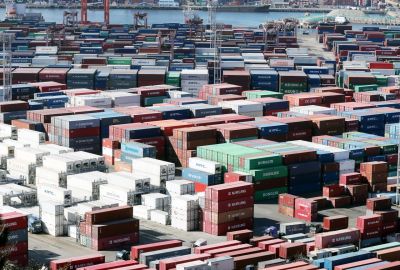
The import value index and import volume index in February rose 3.0% and 6.7%, respectively, compared to a year ago. Both indices turned upward after three months.
The import value index decreased for computers, electronics, and optical devices (-7.7%) and primary metal products (-10.7%), but increased for mining products (16.7%) and chemical products (9.6%), resulting in a 3.0% rise compared to the same month last year.
The export-import value index is an indicator calculated by dividing the export-import value at the given time (in dollars) by the export-import value at the base period (2015), and the export-import volume index is calculated by dividing this export-import value index by the export-import price index.
The net commodity terms of trade index fell 4.5% compared to a year ago, declining for the 23rd consecutive month. This is the longest period of decline since the 28 consecutive months of deterioration from December 2017 to March 2020. Export prices (-7.9%) fell more than import prices (-3.6%), worsening the terms of trade.
The net commodity terms of trade index is the ratio of the price of one unit of export goods to the price of one unit of import goods, indicating how much import volume South Korea can obtain per unit of export.
The income terms of trade index fell 3.5% over the same period, declining for 13 consecutive months. This is because although the export volume index rose (1.1%) last month, the net commodity terms of trade index (-4.5%) declined. The income terms of trade index shows the total volume of goods that can be imported with South Korea's total export value.
Seo Jeong-seok, head of the price statistics team at the Bank of Korea, explained, "The rise in the import value index in February was due to increased imports of chemical products for manufacturing secondary batteries such as lithium related to eco-friendly electric vehicle exports, and increased imports of natural gas for heating. The number of working days in February this year increased by two days compared to last year, and exports of transportation equipment reached a record high due to the strong performance of eco-friendly vehicle exports, leading to an increase in the export volume index in February."
© The Asia Business Daily(www.asiae.co.kr). All rights reserved.
![Clutching a Stolen Dior Bag, Saying "I Hate Being Poor but Real"... The Grotesque Con of a "Human Knockoff" [Slate]](https://cwcontent.asiae.co.kr/asiaresize/183/2026021902243444107_1771435474.jpg)
















