In 2021, the average loan amount for office workers surpassed 50 million KRW for the first time in history. For those aged 20 and below, the average loan amount increased by 15% compared to the previous year due to a significant rise in non-housing collateral loans.
According to the '2021 Job Administrative Statistics: Wage Workers' Debt' released by Statistics Korea on the 28th, as of the end of 2021, the average loan amount for wage workers was 52.02 million KRW, an increase of 3.4 million KRW (7.0%) from the previous year. The delinquency rate based on the outstanding loan balance of wage workers was 0.41%, down 0.09 percentage points from the previous year.
By loan type, unsecured loans increased from 12.4 million KRW in December 2020 to 13.01 million KRW in 2021, up 610,000 KRW (4.9%). Housing mortgage loans rose by 5.6% to 19.53 billion KRW during the same period, and non-housing collateral loans increased by 11.4% to 17.31 million KRW.
By age group, workers in their 40s had the highest average loan amount at 76.38 million KRW. Those in their 30s followed with 71.68 million KRW, 50s with 60.57 million KRW, and 60s with 38 million KRW. Although the average loan amount for those aged 20 and below was the lowest at 16.91 million KRW, their growth rate compared to the previous year was 15.4%, higher than that of those in their 30s (10.7%) and 40s (7.2%).
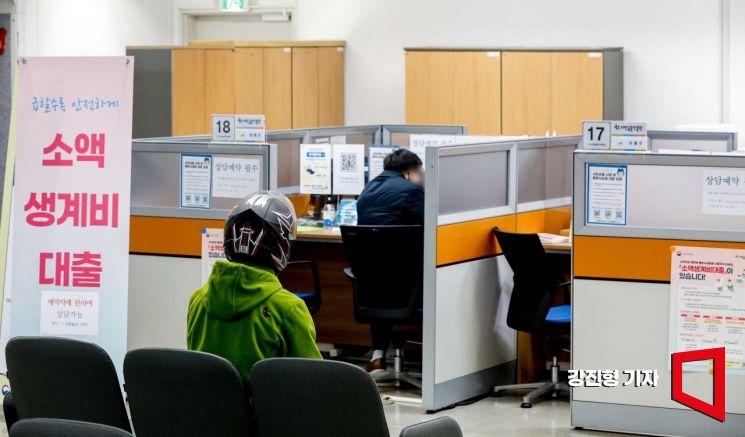 On the 27th, citizens visiting the Jung-gu Central Microfinance Integrated Support Center in Seoul applied for loans from a small living expense loan product offering up to 1 million won with an annual interest rate of up to 15.9%. Photo by Kang Jin-hyung aymsdream@
The loan type that increased the most among those in their 20s was non-housing collateral loans, which rose by 22.8% (1.65 million KRW) compared to the previous year. Housing mortgage loans and unsecured loans also increased by 15.8% and 5.4%, respectively.
By industry, workers in the finance and insurance sector had the highest average loan amount at 101.24 million KRW. Workers in the accommodation and food service industry had the lowest average loan amount at 21.02 million KRW. The accommodation and food-related service industry also showed the highest average loan growth rate compared to the previous year at 10.7%, followed by public administration at 10.6%, professional, scientific, and technical services at 9.5%, and arts, sports, and leisure at 8.6%.
By income bracket, the higher the wage worker's income, the higher the average loan amount and the greater the proportion of bank loans. At the end of 2021, wage workers earning less than 30 million KRW had an average loan amount of 24.96 million KRW, showing the highest growth rate of 4.6% compared to the previous year. Wage workers earning 100 million KRW or more had an average loan amount of 172.37 million KRW, which increased by only 0.6% during the same period.
© The Asia Business Daily(www.asiae.co.kr). All rights reserved.

















