Jeju Air, T'way Air, and Air Busan have received business improvement orders from the Ministry of Land, Infrastructure and Transport. VietJet Air and AirAsia were fined.
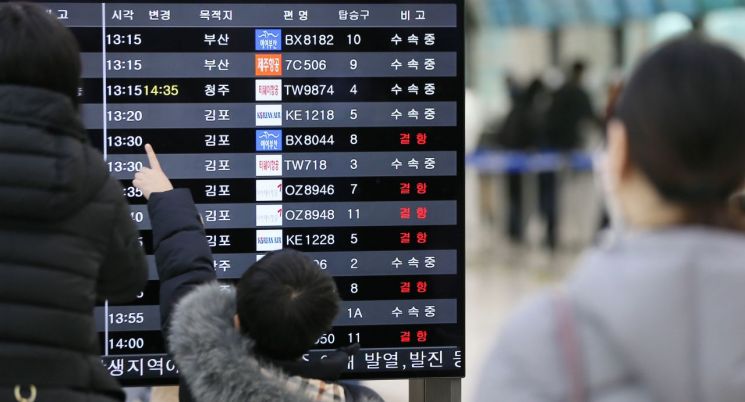 On the afternoon of January 27, flights at Jeju International Airport were consecutively canceled due to deteriorating weather conditions. / Photo by Yonhap News
On the 28th, the Ministry announced that it decided to take administrative action against five airlines that failed to fulfill their duty to protect air traffic users. This decision came after investigating the operational practices of domestic and international airlines and cases of passenger damage.
Jeju Airport experienced a large-scale cancellation incident during the Lunar New Year holiday period in January, causing confusion among passengers trying to find alternative flights. Accordingly, the Ministry conducted a special inspection in February targeting domestic airlines operating Jeju routes. They particularly focused on whether the improvement measures established after the congestion caused by consecutive heavy snow and strong winds at Jeju Airport in January 2016 were properly implemented during this large-scale cancellation.
The Ministry’s inspection confirmed that all airlines sent explanatory text messages to passengers immediately after flight cancellations were decided.
However, Jeju Air, T'way, and Air Busan did not properly notify passengers of future boarding plans or the timing of re-notification via text messages for canceled flights. Passengers came to the airport without clear guidance and waited for long hours. To alleviate complaints from waiting passengers, these airlines prioritized boarding for those waiting on-site, violating established principles.
According to the improvement plan, airlines must inform passengers of canceled flights about boarding plans that assign seats on additional flights in order. This is to ensure passengers can board in an orderly manner without unnecessary waiting. The Ministry decided to issue business improvement orders to these three airlines, requiring them to prepare measures to prevent recurrence of boarding principle violations and to improve their notification systems.
Air Seoul, Fly Gangwon, and Aero K were also found to have inadequate responses. They did not have operational manuals capable of handling large-scale cancellations. However, considering that these airlines started operations after the 2016 improvement plan was established, the Ministry issued administrative guidance to improve their notification systems for large-scale cancellation situations.
The Ministry also investigated compliance with air traffic user protection standards for the top three airlines with the highest number of damage relief requests submitted to the Korea Consumer Agency last year. AirAsia, VietJet, and Jeju Air accounted for 25% of all complaints.
The investigation found no separate violations by Jeju Air. However, AirAsia failed to clearly inform customers of cancellation, refund, or change conditions before contract conclusion when selling tickets via e-commerce. Additionally, both VietJet and AirAsia did not post changes to flight schedules on their websites, leading the Ministry to impose fines of 4 million KRW each.
Kim Young-guk, Director of Aviation Policy at the Ministry, said, "We expect this airline inspection and administrative action to serve as a wake-up call to domestic and international airlines showing a lukewarm attitude toward protecting air traffic users. We will continue to closely supervise airlines and impose strong measures such as fines or business suspension if improvements are not implemented."
© The Asia Business Daily(www.asiae.co.kr). All rights reserved.
![Clutching a Stolen Dior Bag, Saying "I Hate Being Poor but Real"... The Grotesque Con of a "Human Knockoff" [Slate]](https://cwcontent.asiae.co.kr/asiaresize/183/2026021902243444107_1771435474.jpg)
















