Japanese Rice Paddle Gifted to Examinees as a Symbol of Success
Controversy Over Political Use of Manju with G7 Logo
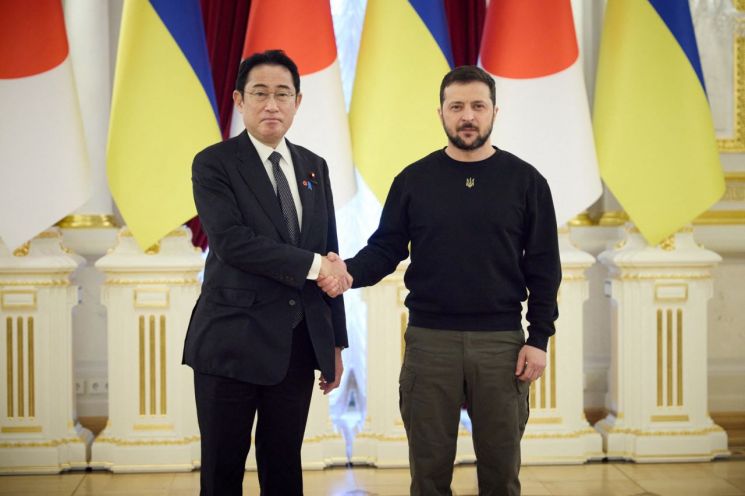
Japanese Prime Minister Fumio Kishida recently visited Ukraine and met with President Volodymyr Zelensky, where he reportedly gifted a 'rice paddle,' sparking criticism within Japan. The Japanese government explained that giving a rice paddle as a gift dates back to 1904 during the Russo-Japanese War, when it was given to generals heading to battle as a symbol of wishing for victory. However, many have criticized the gift as inappropriate for a country in a wartime situation.
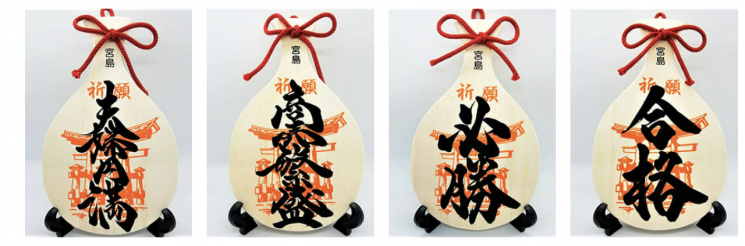
According to NHK and others on the 28th, Prime Minister Kishida presented a victory rice paddle, one of Hiroshima's famous souvenirs, during his meeting with President Zelensky in Ukraine. The paddle bears the characters for 'Victory' (必勝) and Kishida's signature.
The victory rice paddle originated from a play on words in Japanese: 'to serve rice' (飯をとる, meshiotoru) sounds similar to 'to take (an enemy's) life' (召し取る, meshitoru). It was originally used before going off to war as a talisman. Nowadays, it is given as a charm to athletes before competitions or students before exams. The Sankei Shimbun analyzed, "Because it was used before deployment in the Russo-Japanese War to pray for a safe return, it carries the meaning of fighting and defeating Russia."
However, controversy arose over whether it was appropriate to gift a rice paddle to a country at war, not in peacetime. At the Upper House plenary session the previous day, opposition parties strongly criticized Prime Minister Kishida. Izumi Genta, leader of the main opposition Constitutional Democratic Party, criticized the gift, saying, "Sending a gift used for cheering on students or sports players to a head of state during wartime shows a lack of seriousness."
Nobuyuki Baba, leader of Japan Innovation Party, also said, "In a word, no sense," adding, "President Zelensky is fighting a life-or-death battle every day and seeking necessary support. Bringing a rice paddle as a local specialty gift seems too casual."
In response, Prime Minister Kishida said, "I conveyed encouragement to President Zelensky and the people of Ukraine who are resisting Russian aggression and expressed my wish for peace," adding, "In addition to the victory rice paddle, I also presented a lamp inspired by a paper crane as a symbol of peace."
Moreover, the rice paddle was delivered inside a box of the Japanese snack 'Umaibo,' which led to cynical reactions in Japan, such as "Are we going to support Ukraine with snacks?"
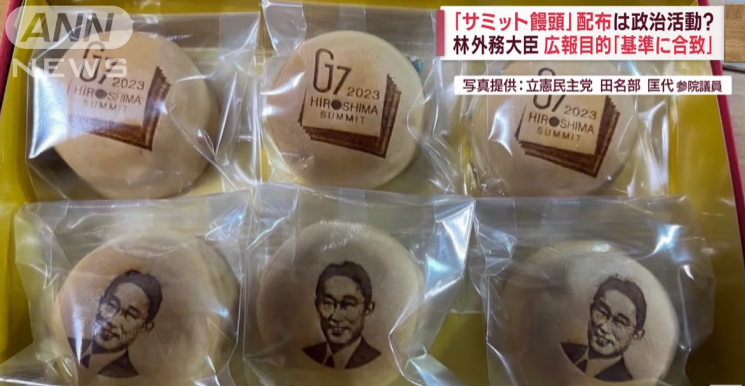 A set of manju believed to have been distributed by Japanese Prime Minister Fumio Kishida. (Photo by ANN News Channel)
The gift controversy did not end there. Next came manju (Japanese steamed buns). According to the Tokyo Shimbun and others, on the 19th, Prime Minister Kishida distributed sets of six manju featuring the G7 logo and his own face at a political fundraising party held in his Hiroshima electoral district.
This sparked controversy over whether it was appropriate to use the G7 logo for political activities. The Ministry of Foreign Affairs prohibits using the summit logo for political purposes. To use the summit logo, one must submit a usage approval application to the Ministry of Foreign Affairs, which holds the copyright, and there are eight complex approval conditions. One of the conditions states that "use for specific political, ideological, or religious activities is not permitted." Opposition parties criticized this as "inappropriate." However, the Ministry of Foreign Affairs defended Prime Minister Kishida, saying, "It is essential to raise the atmosphere of the summit in the host city Hiroshima," and "the usage application meets the criteria."
Nonetheless, amid ongoing civilian casualties in the Ukraine war, there are criticisms that the G7 chairperson distributing manju bearing his face and the G7 logo appears frivolous. Japanese political commentator Koichi Kakutani pointed out, "There are still people suffering from the war. This is not a time to be happily handing out manju with logos in one's hometown," adding, "What is important is finding a way to stop the war between Russia and Ukraine. Prime Minister Kishida missed the mark."
© The Asia Business Daily(www.asiae.co.kr). All rights reserved.
![Clutching a Stolen Dior Bag, Saying "I Hate Being Poor but Real"... The Grotesque Con of a "Human Knockoff" [Slate]](https://cwcontent.asiae.co.kr/asiaresize/183/2026021902243444107_1771435474.jpg)


















