'2024 Budget Drafting Guidelines' Confirmed
Yoon Seok-yeol Administration's First Drafting Guidelines
"Thorough Prevention of Fiscal Leakage"
The government has decided to thoroughly block fiscal leakages such as indiscriminate cash support projects in the welfare sector while supporting the revitalization of the economy centered on the private sector through the activation of exports, which are the backbone of the Korean economy. In particular, it pledged not to engage in populist acts of spending money ahead of next year’s general election.
On this day, the government finalized and approved the "2024 Budget Draft Preparation and Fund Operation Plan Guidelines" containing these details at the Cabinet meeting.
Yoon Seok-yeol Government’s First Budget Guidelines Uphold Sound Fiscal Policy
This budget guideline is the first one established since the inauguration of the Yoon Seok-yeol government on May 10 last year. Last year, the budget guidelines were finalized at the end of March, and additional guidelines were notified to each ministry on May 13.
A government official said, "Next year’s budget will maintain a sound fiscal policy reflecting the Yoon Seok-yeol government’s national philosophy and governance direction," adding, "This is an expression of the determination not to engage in populist spending ahead of next year’s National Assembly election."
The government forecasted that the Korean economy next year will show a better growth trend than this year due to the recovery of exports and investment following improvements in the global economy and semiconductor industry conditions. However, structural problems that hinder sustainable development of the economy, such as demographic shocks, regional imbalances, and delays in economic restructuring, still persist. Regarding national tax revenue, it is expected that revenue conditions will gradually improve next year compared to this year due to economic recovery trends, but the time lag between economic improvement and tax revenue and global economic uncertainties are seen as downside risks.
Choi Sang-dae, Vice Minister of Strategy and Finance, explained, "The increase in mandatory expenditures such as welfare statutory spending and national debt interest continues, making fiscal management more rigid, so fiscal conditions next year are expected to remain challenging," adding, "To promote national tasks such as parental allowances and military pay increases, youth-tailored housing, and strengthening the coverage of the Basic Livelihood Security System, strenuous efforts such as expenditure efficiency are necessary."
Boosting Economic Vitality by Increasing Exports... Discretionary Spending to be Cut by Over 10%
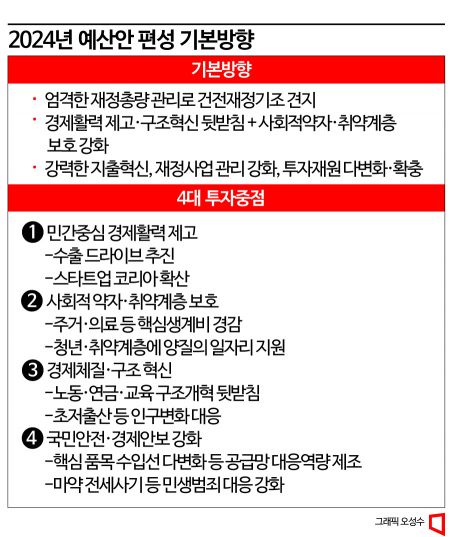
The government cited "strict management of total fiscal volume" as the basic direction for next year’s budget formulation. It plans to actively support economic revitalization and the three major structural reforms in labor, education, and pensions, strengthen protection for socially vulnerable and disadvantaged groups, while implementing strong expenditure innovation including cutting discretionary spending by more than 10%, strengthening fiscal project management, and diversifying and expanding investment resources.
The main means to enhance economic vitality is export activation. The government will support the export transformation of small and medium-sized enterprises through trade finance and overseas marketing, and focus investment on expanding new export engines such as nuclear power, defense, and plants. It also plans to secure tourism competitiveness through policy finance and customized export support for K-content, large-scale tourism hub development, and digital tourism transformation. The agriculture, forestry, and fisheries sectors will also seek to strengthen competitiveness through convergence with advanced technologies and export activation.
The budget responding to demographic changes will be significantly expanded. Support across the entire life cycle including marriage, pregnancy, childbirth, and childcare will address ultra-low birth rates, and tailored care and old-age income security will back the aging society.
The government intends to block fiscal leakages to prevent unfair waste of taxpayers’ money. Cash support projects, subsidies executed fraudulently or opaquely, and welfare projects where moral hazard has occurred are the main targets for intensive verification. Furthermore, projects with poor execution or unsatisfactory performance will be thoroughly reviewed to reorganize, reduce, or abolish them, aiming to cut discretionary spending by more than 10%.
Vice Minister Choi said, "A sound fiscal policy does not mean unconditional spending cuts," adding, "While thoroughly reducing unnecessary expenditures to prevent waste of taxes, it means boldly promoting investments in future generations, improving the economic structure, and innovating social structures to enhance the growth potential of our economy and ensure fiscal sustainability."
With the confirmation of these budget guidelines, the 2024 budget formulation process will officially begin. The Ministry of Strategy and Finance plans to compile the government budget draft by September 2 after consultations with related ministries and local governments and public opinion gathering from June to August, based on budget requests received from each ministry by the end of May.
© The Asia Business Daily(www.asiae.co.kr). All rights reserved.


















