Strengthening National Competitiveness in Advanced Strategic Industries through Infrastructure Development
Production of 1.92 Million Tons of Secondary Battery Materials Including Lithium and Precursors
Pohang City is solidifying its position as South Korea's leading secondary battery hub and the optimal city for specialized complexes by clustering large-scale secondary battery companies based on the establishment of a differentiated secondary battery industrial ecosystem and infrastructure of the highest domestic standards.
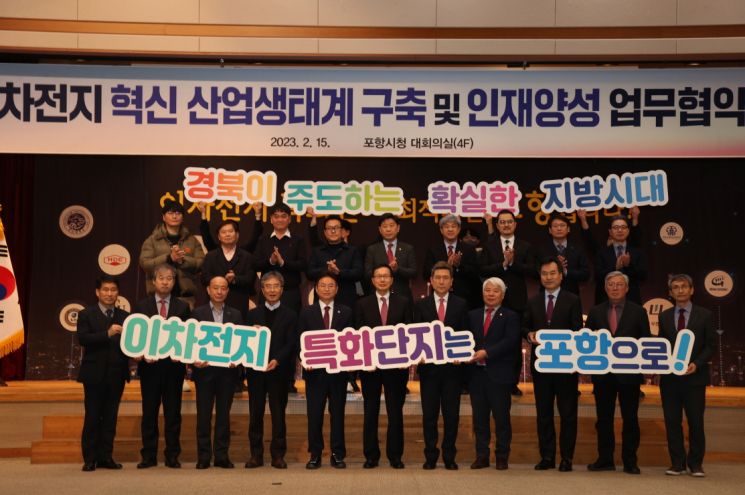 The business agreement ceremony for establishing an innovative secondary battery industrial ecosystem and fostering talent held last February.
The global secondary battery market is expected to grow at an ultra-fast pace over the next 10 years, expanding from $46.1 billion (approximately KRW 58.7 trillion) in 2020 to $351.7 billion (approximately KRW 449.1 trillion) by 2030, representing more than an eightfold increase over the decade. Accordingly, securing key raw material supply chains and reducing dependence on China have emerged as major challenges for countries worldwide.
As such, secondary batteries are a core industry of national advanced strategic industries where securing national competitiveness is urgent. Pohang, equipped with an innovative raw material and material supply chain, is evaluated as the optimal site for the national advanced strategic industry specialized complex for secondary batteries to secure cutting-edge secondary battery technology and economic sovereignty.
Pohang completes the value chain from raw materials to precursors and cathode and anode materials through the clustering of global leading secondary battery companies such as EcoPro and POSCO Future M, alongside world-class secondary battery research infrastructure including POSTECH, the Accelerator Research Institute, and the Secondary Battery Integrated Management Center, driving the global growth of South Korea's secondary battery industry.
Designated in 2019 as a battery recycling regulatory free zone, Pohang has attracted large-scale corporate investments and secured follow-up national projects worth KRW 100 billion, achieving the best results among 29 special zones nationwide for three consecutive years and gaining attention as a K-battery innovation role model.
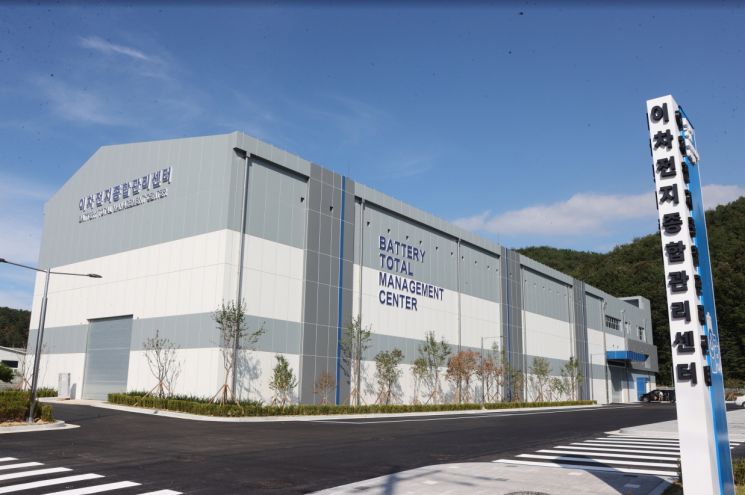
The Secondary Battery Integrated Management Center, completed in 2021, serves as an incubator that transforms used batteries into new business opportunities, leading technology development and institutional improvements. Starting this year, Pohang is sequentially establishing R&D demonstration infrastructure such as the Ministry of Industry's high-safety and commercialized (LFP) support project, the Ministry of Environment's used battery resource circulation cluster, and an inline automatic evaluation center, steadily laying a sustainable growth foundation for the secondary battery industry.
Furthermore, through the large-scale investment attraction of secondary battery companies and the clustering of enterprises, Pohang is rapidly emerging as the largest domestic cluster for mass production of secondary battery raw materials and materials.
Leading companies in the cathode material sector, such as EcoPro, which has a complete cathode material ecosystem from recycling to raw materials, precursors, and cathode production, POSCO Future M producing both anode and cathode materials, and Energy Materials, along with small and medium enterprises like SoluM, Mirae Ceratech, and Haedong Engineering, are accelerating Pohang's market dominance from materials to components in the secondary battery sector.
Pohang currently boasts the largest domestic cathode material production capacity of 150,000 tons per year and is expected to expand production facilities continuously to reach a production capacity of 1 million tons by 2030, accounting for 16.5% of the global cathode material market. The total production volume of secondary battery materials, including lithium and precursors along with cathode materials, is expected to exceed 1.92 million tons, positioning Pohang as a key hub for mass production of cathode materials and raw material supply.
With successive successes in attracting large-scale companies, Pohang has established the largest and highest-level production base in the country. Companies are actively negotiating for large-scale additional expansions and new investments, with the total investment amount expected to reach a staggering KRW 12.65 trillion.
These large-scale corporate investments are revitalizing the regional economy and creating new jobs. Currently, employment numbers have reached approximately 2,000, and direct employment is expected to exceed 10,000 by 2027.
Anticipating a surge in demand for related specialized personnel, Pohang plans to accelerate customized secondary battery professional workforce training in collaboration with five universities including POSTECH, two Meister high schools, and related companies.
Mayor Lee Kang-deok stated, “The designation of Pohang as a secondary battery specialized complex will be an opportunity to secure South Korea’s secondary battery competitiveness, a core of national competitiveness, and further solidify the status of a global battery powerhouse.” He added, “Pohang will lead the global ultra-gap and secure a definitive leadership position to realize South Korea as a strong secondary battery nation.”
© The Asia Business Daily(www.asiae.co.kr). All rights reserved.
![Clutching a Stolen Dior Bag, Saying "I Hate Being Poor but Real"... The Grotesque Con of a "Human Knockoff" [Slate]](https://cwcontent.asiae.co.kr/asiaresize/183/2026021902243444107_1771435474.jpg)

















