"Increasing working hours is not the solution; productivity must be increased."
On the 27th, at a press conference held at the Press Center in Jung-gu, Seoul, Professor Jang Ha-joon of the Economics Department at the University of London, UK, conveyed this message during the launch event of his book "Jang Ha-joon's Economic Recipe" (Bookie). Regarding the recently controversial 69-hour workweek system, he stated, "Trying to compete by increasing working hours or lowering wages is an anachronistic idea. No matter how much you increase working hours or lower wages, there are countries in the world that go even further. You cannot compete with them," and emphasized, "It is more important to increase productivity than to increase working hours."
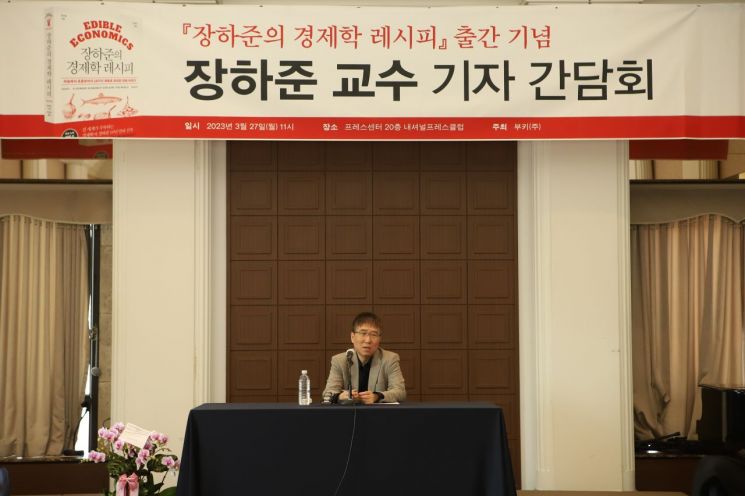 Professor Jang Ha-joon of the University of London, UK, is speaking at a press conference commemorating the publication of "Jang Ha-joon's Economics Recipe" held on the morning of the 27th at the Press Center in Jung-gu, Seoul. Photo by Buki
At this time, Professor Jang referred to the coconut story included in his book, saying, "It is commonly said that people in hot countries are lazy because resources are abundant. There is a saying that they just wait for coconuts to fall under the coconut tree, but this is incorrect. They actually work more. The problem is low productivity," he stressed.
He then expressed a negative opinion regarding the so-called 'freedom to work' advocated by some. He said, "Freedom must first consider the structure that defines the situation before considering the situation itself. For example, is the choice between 'Do you want to die or give me money?' really a choice? It is not," and explained, "In reality, there are people who make choices that those who can afford to live would never make. Calling that freedom is a pre-modern concept."
He pointed out that increasing working hours is also detrimental to raising the low birth rate. He said, "You need time to raise children. If everyone goes to work, who will give birth to and raise the children?" and added, "Looking at countries with higher incomes and higher birth rates than Korea, their social systems are well established. Among them, the Netherlands has a high birth rate, and it has more quality part-time jobs that are favorable for women giving birth compared to other countries. Practical measures like these are needed more than exemptions from military service for having three children before age 30."
He also touched on the international economic situation. Regarding the bankruptcy of Silicon Valley Bank (SVB) in the United States, he regarded it as a sequel to the 2008 financial crisis. He explained that structural improvements should have been made at that time, but instead, temporary measures such as quantitative easing and interest rate cuts targeting the financial sector were focused on. He said, "Maintaining interest rates at 0% for over 10 years after the 2008 financial crisis is unprecedented in 400 years of capitalist history," and added, "Asset bubbles were inevitable. With an overflow of funds in the market, it was impossible to distinguish between good and bad assets."
However, he warned that although the possibility of a situation like 2008 occurring again is low due to measures such as strengthening banks' capital adequacy ratios, risks still remain.
 Professor Jang Ha-joon of the University of London, UK, is speaking at a press conference commemorating the publication of "Jang Ha-joon's Economics Recipe" held on the morning of the 27th at the Press Center in Jung-gu, Seoul.
 [Photo by Buki]
Regarding Asian economic security, he expressed concern about the situation being skewed towards the US and Japan. Professor Jang said that the US always prioritizes practical interests and, although conflicts with China seem to be intensifying, cooperation is maintained where necessary. Completely excluding China, which possesses formidable productive capacity, goes against US interests, so the US maintains pragmatism. He warned, "Although the two countries seem to be growling at each other, it is not like the past US-Soviet split. Economically, they cannot separate, so one should not rashly side with either."
Regarding the recent atmosphere of reconciliation with Japan, he said, "We should not be hastily drawn into Japan. Japan's trade dependence is 15%, while ours is over 50%. Japan can abandon one side for political gain, but we cannot," emphasizing, "We must carefully balance the US-China relationship."
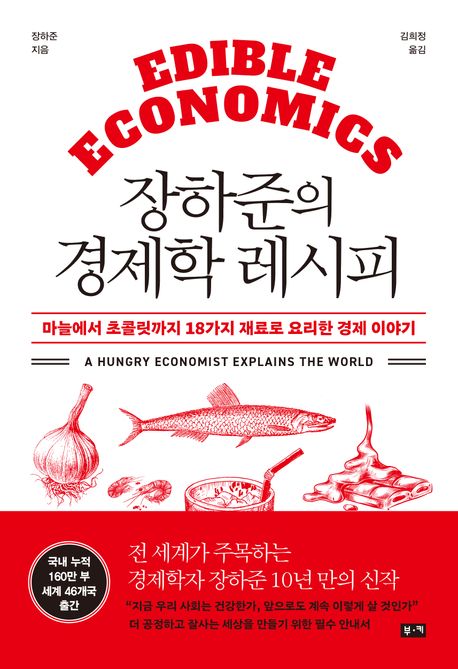
The book is an economic explanation book published by Professor Jang after 10 years, using 18 food ingredients, including the aforementioned coconut, as materials to easily explain economics aimed at creating a world where people live well together.
© The Asia Business Daily(www.asiae.co.kr). All rights reserved.
![Clutching a Stolen Dior Bag, Saying "I Hate Being Poor but Real"... The Grotesque Con of a "Human Knockoff" [Slate]](https://cwcontent.asiae.co.kr/asiaresize/183/2026021902243444107_1771435474.jpg)


















