ChatGPT Blending into Daily Life, 1 in 3 Citizens Have Experienced ChatGPT
Used by Retail Investors for Stock Trading... "But Still Not 100% Trustworthy"
The artificial intelligence (AI) chatbot ‘ChatGPT’ has become integrated into citizens' daily lives just four months after its launch. While institutions such as companies, governments, and universities continue to deliberate on policy responses to ChatGPT, ordinary individuals have already naturally begun using ChatGPT as a daily tool.
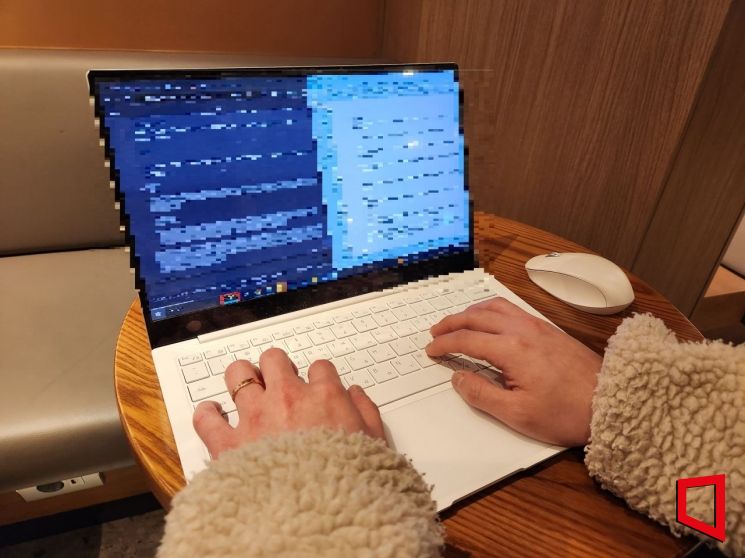 Job seeker Choi (28) is writing a self-introduction letter using ChatGPT at a cafe in Jung-gu, Seoul on the 27th./Photo by Taewon Choi skking@
A survey shows that more than one in three Koreans have already used ChatGPT. According to a survey conducted by the Korea Chamber of Commerce and Industry from the 22nd to the 28th of last month targeting 1,016 adults nationwide, 35.8% of respondents said they had used ChatGPT at least once.
The typical early adopters of ChatGPT are job seekers. They use ChatGPT to prepare materials required by numerous companies they apply to.
On the afternoon of the 27th, Choi (28), a job seeker met at a cafe in Jung-gu, Seoul, said he was using ChatGPT to help prepare for the CJ CheilJedang entry-level recruitment that opened that day. Choi entered the search term ‘Hetbahn Ottogi rice comparison’ into ChatGPT. Within seconds, ChatGPT displayed on the screen the manufacturing methods, taste, aroma, price, features, and comparative advantages of the two products. Choi said, “It’s very useful when checking the strengths, weaknesses, directions, and flagship products of the companies I’m applying to.”
Choi added, “After roughly setting the direction through ChatGPT, I verify the facts by searching myself. Last year, I had to search for every piece of information one by one and then select and compare what I needed. Since using ChatGPT, the time spent gathering information for writing self-introductions or preparing for interviews has been reduced by more than half.”
Office workers also said that although ChatGPT’s accuracy is not yet perfect, it is a great help as a work assistant.
Lee (38), a developer in the IT industry, mainly uses ChatGPT to find errors in source code he has written or to assist in report writing. Lee said, “Often, an error occurs because of a single mistyped character in a long source code. Previously, I had to carefully check each character to find the mistake. Now, when ChatGPT points out the error, I just need to verify if the solution is correct. I think my work efficiency has improved by about 30-40% in error situations.” He added, “I use ChatGPT about 10 times a day, and its accuracy rate is around 50-60%.”
In tasks such as report writing that process raw data, ChatGPT works like a personal assistant or subordinate employee. When all the work done during the week is input, ChatGPT summarizes it and drafts a weekly report. Lee expressed satisfaction, saying, “The quality is high enough to submit immediately after minor edits.” He also mentioned that training junior employees has become easier. “In the past, junior employees would hesitate to ask seniors questions, but nowadays they solve simple questions themselves through ChatGPT,” he said. “Since simple questions are resolved through ChatGPT, seniors’ work efficiency improves, and juniors feel more comfortable,” he added.
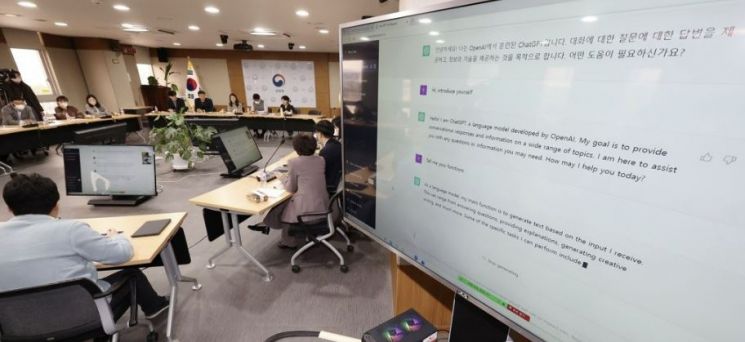 On the 13th of last month, participants are experiencing the conversational AI ChatGPT at the 2nd Digital Guerrilla Public Debate held at the Ministry of Education in the Government Complex Sejong, Sejong City. [Image source=Yonhap News]
Kim (31), a general office worker, also expressed satisfaction, saying, “Not only can I find information, but I can also ask ChatGPT to organize the searched content into tables or display it as images,” adding that “work efficiency has greatly increased.”
Kim, CEO of a medical PR agency (49), said, “When I asked ChatGPT to write a press release on the latest treatments for arthritis, it produced a basic draft at the level of an intern,” adding, “Thanks to ChatGPT, I think we won’t need to hire interns anymore, which will save labor costs.”
Stock investors, who need to review vast amounts of data, have also started using ChatGPT. Individual investor Lee (34) said, “I upload disclosure documents to ChatGPT and ask it to find which content is on which page or to draft simple emails,” adding, “It’s not 100% perfect, but it’s quite helpful. I expect ChatGPT will soon be able to analyze disclosure documents as well.”
Of course, concerns about ChatGPT’s reliability have also been raised. This is because ChatGPT sometimes fabricates plausible answers or presents incorrect information as if it were true. Hong (33), an office worker, said, “I asked ChatGPT to recommend good restaurants near the company, but it suggested places that don’t even exist,” adding, “While ChatGPT can be used for fun, considering issues of reliability and security, I don’t think it’s ready for work use yet.”
Experts predict that ChatGPT will permeate every corner of our society much faster than expected. Go Kyung-chul, a research professor at KAIST’s Robot Intelligence Research Center, said, “Despite ChatGPT’s Korean language ability being relatively weaker than its English ability, it is already being used in various fields of society,” adding, “As ChatGPT’s Korean language and AI capabilities improve, it will be utilized in more areas such as culture and the arts.”
Professor Go predicted, “The development of AI like ChatGPT will help resolve the information polarization problem in our society.” He explained that anyone can easily access high-level information through ChatGPT even without foreign language skills or strong information processing abilities. He said, “AI technologies like ChatGPT suit Korean characteristics well,” adding, “Koreans have excellent mathematical abilities to create raw data but relatively lack skills in processing and expressing data, and AI technologies like ChatGPT will complement these areas.”
© The Asia Business Daily(www.asiae.co.kr). All rights reserved.
![Clutching a Stolen Dior Bag, Saying "I Hate Being Poor but Real"... The Grotesque Con of a "Human Knockoff" [Slate]](https://cwcontent.asiae.co.kr/asiaresize/183/2026021902243444107_1771435474.jpg)












