From AI Speakers Equipped with Parents' Voices to Increasing AI Requests Incorporating Founders' Experiences and Mindsets
In Japan, technology that creates a 'digital clone'?an AI trained on one's own speech patterns and way of thinking to closely resemble oneself?is gaining attention. This is a personalized version of the so-called Chat GPT, a customized AI technology for specific individuals. The trend seems to be driven by the desire for others to remember oneself even in situations where one is absent, such as when going out or after passing away.
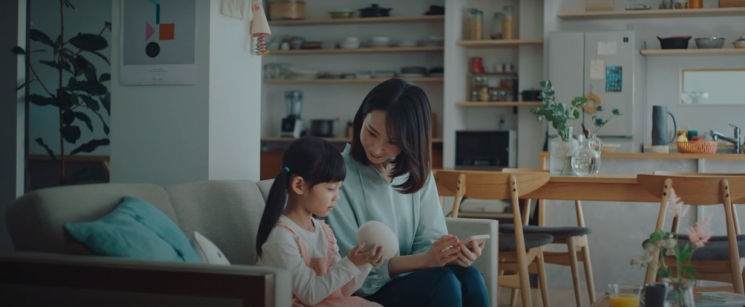 A scene from a KoeMo advertisement. An AI speaker recorded with a parent's voice is being played for a child. (Photo by KoeMo website)
On the 27th, Asahi Shimbun introduced popular customized AI products such as the AI speaker 'KoeMo.' First, KoeMo, released last year by toy manufacturer Takara Tomy, was created with situations in mind where parents leave their children to go to work. Parents read prepared example sentences for about 15 minutes and train the AI through an application (app), completing the setup. The AI then analyzes characteristics such as the parent's voice and speech patterns. The trained AI reads fairy tales and old stories that the parent has not read, using the parent's voice to the child.
Because it provides familiarity and comfort to children even when parents are absent, it has become known as a 'parenting must-have' in Japan. Customers who purchased it left reviews saying, "Compared to other people's voices in YouTube videos, my child falls asleep faster," and due to its popularity, it won the grand prize in the educational toy category at last year's Japan Toy Awards.
AI that preserves not only voice but also way of thinking is also gaining popularity. AI company Altz, which creates digital clones, told Asahi Shimbun that requests to create digital clones that closely resemble founders of companies and others are increasing. Although costly, it is especially popular among wealthy individuals who want to leave their ideas to future generations even if it requires spending money.
According to Altz, in the case of a 'founder grandfather' clone of a company, the AI is trained with the grandfather's experiences, information about books he read, and his way of thinking based on that, and stored in the cloud. After his passing, when the grandson who inherited the management wants advice asking, "What would grandfather think?" he inputs a question to the grandfather clone, and the AI produces an answer based on deep learning that reflects the grandfather's experiences.
Hitoshi Nishikawa, CTO of Altz, said, "Through digital clones, you can have an experience as if the person has come back to life," adding, "We are focusing on developing AI with individuality because the way of thinking of people with wisdom based on experience itself has value."
Of course, Asahi also noted that such customized AI technology could be misused for impersonation crimes and fraud. According to The Wall Street Journal, there was a case where UK energy companies received a phone call requesting 20 million yen (190 million won) from the German parent company's CEO, and transferred the money, but it was later revealed to be a fraudulent call manipulated by deep learning of the CEO's voice.
However, experts raised their voices that since AI misuse is ultimately carried out by human hands, legislation considering this must be created as soon as possible. Yutaka Matsuo, a professor at the University of Tokyo, said, "Whether or not emotions are included, AI operates as programmed by humans," and added, "Regulations should be created based on the point that it is not AI doing bad things, but humans making AI do bad things."
© The Asia Business Daily(www.asiae.co.kr). All rights reserved.

















