Deutsche Bank Shares Plunge 15% Intraday on 24th
Rising AT1 Proportion Becomes Worthless Despite Financial Soundness
Fear Spreads Rapidly Due to Digitalization
The global banking crisis fear, which started with the Silicon Valley Bank (SVB) in the United States and brought down Credit Suisse (CS), is raising warnings that it could be prolonged. Over the past weekend, the banking crisis spread to Deutsche Bank, Germany's largest investment bank (IB), causing its stock price to plunge sharply. The Wall Street Journal (WSJ) reported that the fear of bank failures is spreading worldwide at a rapid pace like the COVID-19 pandemic, coining the term "Bankdemic" (a combination of bank and pandemic).
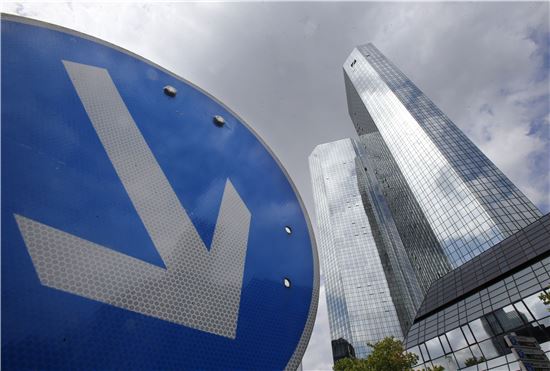 ▲Frankfurt Deutsche Bank Building Headquarters (Photo by AP Yonhap News)
On the 24th (local time), Deutsche Bank's stock on the Frankfurt Stock Exchange in Germany fell as much as 14.8% intraday compared to the previous day's closing price.
This is the largest drop since March 2020, when the COVID-19 pandemic occurred. Deutsche Bank's stock price has plummeted nearly 30% in two weeks since the SVB bankruptcy, wiping out 7 billion euros (about 9.8 trillion KRW) in market capitalization. Currently, Deutsche Bank's market cap stands at 16.5 billion euros (about 23 trillion KRW).
The surge in Deutsche Bank's credit default swap (CDS) premium, which indicates default risk, dragged down its stock price. The CDS premium for Deutsche Bank's 5-year bank bonds rose from 1.34 percentage points on the 22nd to 2.2 percentage points on the 24th. A high CDS premium means a higher risk of default on the bonds.
The crisis rumors around Deutsche Bank were ignited by Additional Tier 1 (AT1) capital securities. When CS was acquired by UBS, the Swiss financial authorities fully wrote off the AT1 securities, rendering them worthless, which raised concerns about losses on other bank bonds. The trading price of Deutsche Bank's AT1 securities fell from 95 cents at the beginning of this month to around 70 cents currently. Due to the relatively large issuance of AT1 and ongoing distrust toward Deutsche Bank, which has undergone restructuring crises, investors are believed to have targeted Deutsche Bank as the next victim following CS.
However, experts analyze that the possibility of Deutsche Bank following CS's path is low. Deutsche Bank's total assets amount to 1.337 trillion euros (about 1,870 trillion KRW), which is seven times that of the collapsed SVB and 2.5 times that of CS. Although it has undergone restructuring crises in the past, it has been regarded as a financially sound bank since 2019. While some analyses point to a high proportion of U.S. commercial real estate loans and investments, experts believe this is not a level of concern. Niklas K?mmer, an analyst at fund information company Morningstar, said, "There is nothing that can make Deutsche Bank a problem child," and added, "The market is watching who will be next." He also noted, "What drives this is fear, not rational judgment."
German Chancellor Olaf Scholz also moved to dispel the Deutsche Bank crisis rumors after the European Union (EU) summit held in Brussels on the 24th. He explained, "Deutsche Bank is a very profitable bank, and there is no need to worry about its future," adding, "It has undergone thorough organizational improvements and modernized its business model, making it a very profitable bank."
The fact that even Deutsche Bank, which has relatively strong financial soundness, is caught up in crisis rumors is interpreted as a sign of the great fear investors have about the banking crisis. Moreover, there are growing concerns that as digitalization accelerates, the fear could spread faster and more intensely. Just as the ultra-fast bank run via mobile banking brought down SVB, the fear of a banking crisis could also spread rapidly.
The WSJ pointed out, "Global market concerns about banks are spreading like a pandemic," and noted, "In the era of online banking and social media, investors' anxiety and sudden shifts in trust show how vulnerable banks can become."
© The Asia Business Daily(www.asiae.co.kr). All rights reserved.
















