Concerns are growing that the economic downturn will become more visible following a credit crunch triggered by the financial sector, as key central bank officials from major countries, including the U.S. Federal Reserve (Fed), are set to speak this week. The fear of a banking crisis, which surged sharply after the collapse of Silicon Valley Bank (SVB), has now spread to Germany's largest investment bank, Deutsche Bank, drawing attention to their economic assessments. The International Monetary Fund (IMF) has also issued a warning that global financial stability is at risk due to the SVB-related incident.
◆Ongoing Market Concerns from SVB... U.S. Congressional Hearings This Week
According to the U.S. Congress on the 26th (local time), the Senate Banking Committee and the House Financial Services Committee will hold hearings on March 28-29 under the theme "Recent U.S. Bank Failures and Regulatory Responses." Regarding the banking crisis that spread after the SVB collapse, Michael Barr, Vice Chair for Supervision at the Fed, Martin Gruenberg, Chairman of the Federal Deposit Insurance Corporation (FDIC), and Nellie Liang, Treasury Department Deputy Secretary, are scheduled to testify. The U.S. Senate has also requested testimony from the CEOs of SVB and Signature Bank.
Although the banking crisis seemed to calm down immediately after authorities intervened following the SVB collapse, it has now spread to major European banks and shows little sign of subsiding. Following SVB and Credit Suisse (CS), Germany's largest investment bank, Deutsche Bank, has also been caught up in crisis rumors. Market concerns over Deutsche Bank's exposure to U.S. commercial real estate and derivatives on its financial statements have caused credit default swaps (CDS), which indicate default risk, to soar sharply.
These fears somewhat eased after German Chancellor Olaf Scholz stated, "There is no need to worry," but market analysts suggest that vague fears are searching for the next target. Despite insufficient grounds for the crisis rumors, irrational fear dominates the market, leading to panic selling.
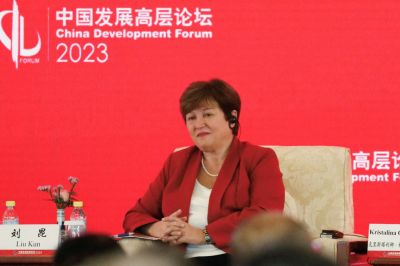
IMF Managing Director Kristalina Georgieva diagnosed that the SVB-related incident has increased risks to financial stability. Speaking at the China Development Forum held in Beijing, China, she said, "The rapid shift from a prolonged low-interest-rate environment to high interest rates has inevitably increased stress and vulnerabilities in financial markets."
Georgieva predicted that this year will be a challenging one for global economic growth, falling below 3% due to the COVID-19 pandemic, the Ukraine war, and the effects of monetary tightening policies. The IMF plans to release new growth forecasts in April. She added, "We are continuously monitoring the situation closely and assessing potential impacts on the global economic outlook and financial stability," emphasizing, "Particular attention is being paid to the economic conditions of low-income countries with high debt levels."
◆Officials Speak Out... Could Commercial Real Estate Become a Trigger? Growing Recession Concerns
With banking crisis concerns spreading to Deutsche Bank, numerous central bank officials from major countries are scheduled to speak this week. Accordingly, the market is expected to closely watch their assessments of the recent banking crisis and economic conditions, as well as whether authorities will consider additional support measures. This is expected to immediately affect market volatility.
At the Fed, in addition to Vice Chair Barr, who will testify at the U.S. congressional hearings due to the SVB incident, directors Philip Jefferson, Lisa Cook, Christopher Waller, John Williams, President of the Federal Reserve Bank of New York, Susan Collins, President of the Boston Fed, and Thomas Barkin, President of the Richmond Fed, will deliver speeches.
Christine Lagarde, President of the European Central Bank (ECB), will make public remarks on the 28th and 31st. Andrea Maechler, a director of the Swiss National Bank, which supported UBS's acquisition of CS, will speak on the 30th in Zurich, and Andrew Bailey, Governor of the Bank of England (BOE), which supported HSBC's acquisition of SVB's UK branch, will speak on the 27th at the London School of Economics.
There is a possibility that the SVB incident could further spread to small and medium-sized banks and banks in other countries. Currently, investors warn that the next trigger could be U.S. commercial real estate (CRE). Due to high interest rates and high vacancy rates following the pandemic, building prices have plummeted, and small and medium-sized banks, which hold a significant portion of CRE loans, are also facing difficulties. According to the FDIC, unrealized losses on commercial real estate debt securities reached $43 billion last quarter. The Wall Street Journal (WSJ) pointed out, "If the Fed slows the economy through rate hikes aimed at easing inflation, banks will face further losses," adding, "One risk is commercial real estate."
Concerns about a recession have intensified since the SVB incident. Neel Kashkari, President of the Federal Reserve Bank of Minneapolis, stated in an interview with CBS's Face the Nation that the recent SVB-related banking system crisis has increased recession risks. He said, "We are definitely closer to a recession. What is unclear is how broadly this banking stress is leading to credit tightening," and added, "The credit crisis will, as noted, slow the economy." However, he drew a line by saying it is too early to judge how these effects will impact the overall economy and monetary policy going forward.
Growing recession concerns have strengthened expectations that the Fed will hold interest rates steady in May. According to the Chicago Mercantile Exchange (CME) FedWatch tool, as of this afternoon, federal funds futures markets reflect an over 88% probability that the Fed will keep rates unchanged at the May FOMC meeting, up from 54% a week ago. This week, economic indicators such as the February Personal Consumption Expenditures (PCE) price index, the Fed's preferred inflation gauge, and the final U.S. GDP growth rate for Q4 of last year will also be released.
© The Asia Business Daily(www.asiae.co.kr). All rights reserved.
![Clutching a Stolen Dior Bag, Saying "I Hate Being Poor but Real"... The Grotesque Con of a "Human Knockoff" [Slate]](https://cwcontent.asiae.co.kr/asiaresize/183/2026021902243444107_1771435474.jpg)












