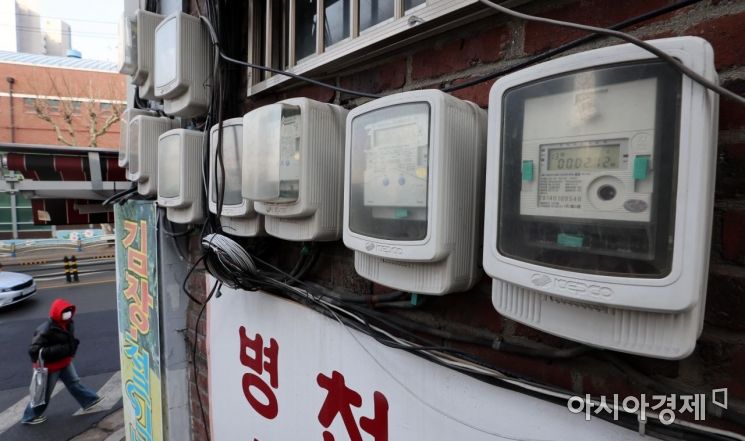
 An electric meter of a multi-family house in Seoul on the 30th, as the government is scheduled to announce the electricity and gas rate adjustment plan to be applied in the first quarter of next year. The Ministry of Trade, Industry and Energy will announce the electricity and gas rate adjustment plan for the first quarter of next year on this day. Photo by Kim Hyun-min kimhyun81@
The decision on whether to raise electricity rates in the second quarter of this year will be made by the end of this month. The Ministry of Trade, Industry and Energy insists that Korea Electric Power Corporation's (KEPCO) massive deficit must be resolved through gradual rate increases, while the Ministry of Economy and Finance explains that since public utility rate hikes could potentially prolong high inflation, it is necessary to comprehensively consider energy costs and other factors.
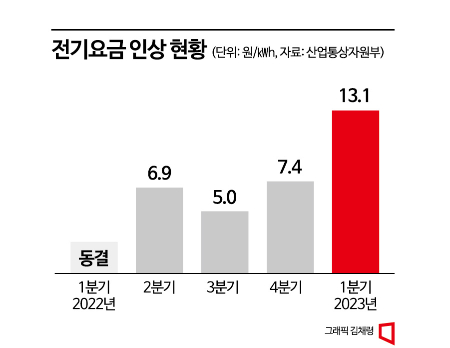
According to related ministries on the 26th, the Ministry of Trade, Industry and Energy will announce the decision on the second quarter electricity rate increase on the 31st. Earlier, KEPCO submitted the '2023 Q2 fuel cost adjustment unit price' to the Ministry of Trade, Industry and Energy on the 16th. The calculation details are a kind of proposal in which KEPCO requests the ministry to approve the rate increase amount determined by referencing the average trade statistical prices of bituminous coal, liquefied natural gas (LNG), and bunker C oil over the past three months. If the government raises electricity rates in the second quarter, it is expected to be around 11 to 12 KRW per kilowatt-hour (kWh), similar to the first quarter. Previously, the rate was increased by 13.1 KRW per kWh in the first quarter.
The Ministry of Trade, Industry and Energy holds the position that gradual rate increases are inevitable to reduce KEPCO's operating losses exceeding 30 trillion KRW last year. According to the Monthly Electricity Statistics Report, in January this year, KEPCO purchased electricity at 164.2 KRW per kWh and sold it at 147.0 KRW per kWh, incurring a deficit of 17.2 KRW per kWh. As the ministry previously stated that to eliminate KEPCO's record deficit by 2026, electricity rates need to be raised by 51.6 KRW per kWh this year, gradual adjustments are necessary.
However, there is concern that public utility rate hikes could act as a factor in domestic price increases. Deputy Prime Minister and Minister of Economy and Finance Choo Kyung-ho recently stated, "Since there were significant concerns about heating costs, we must deeply consider the burden on the public and carefully decide on the rates," emphasizing the need for a cautious approach to public utility rate increases. Even if an increase is decided, it is expected to be at a level that minimizes the burden on the public. This is based on the judgment that raising rates in the third quarter, when cooling demand surges, could trigger a cooling cost crisis following the heating cost crisis.
A variable is that international energy prices have peaked and entered a downward trend. If energy prices stabilize, there are plans to adjust the magnitude and timing of electricity rate increases. Experts explain that if energy costs continue to decrease, KEPCO's deficit will naturally shrink, providing an additional option to decide on rate increases from a long-term perspective. A government official said, "Considering the impact of energy rate hikes on inflation, related ministries will consult on an appropriate increase level and announce it."
© The Asia Business Daily(www.asiae.co.kr). All rights reserved.


















