Able to focus on creation without worrying about livelihood
2000 selected from over 9000 applicants
The Irish government is implementing a policy (pilot project) that provides artists with over 23 million won annually. This is to allow them to focus on their creative work without worrying about their livelihood.
On the 23rd (local time), the American daily The New York Times reported that the Irish government has launched an experiment to guarantee a certain income to artists, helping them concentrate on their creative work without financial concerns. It reported that 2,000 people from various fields such as music, literature, film, visual arts, theater, and circus were selected as pilot project participants.
It is known that there were over 9,000 applicants, and 8,200 of them submitted documents proving they are cultural workers. The quality of their work was not considered in the selection. They will receive 16,900 euros (23,642,000 won) annually for the next three years without any conditions.
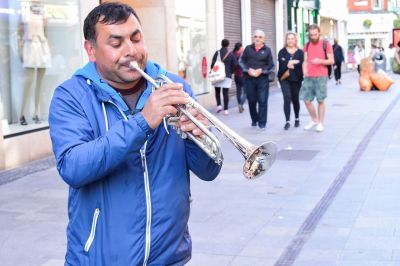
Catherine Martin, Ireland’s Minister for Tourism, Culture, Arts, Gaeltacht, Sport and Media, is said to have conceived this policy during the three-year COVID-19 pandemic. Minister Martin herself is a former busker with experience in street performances.
Minister Martin explained, “Worries about livelihood affect artists’ creativity,” adding, “This policy aims to provide them with a space to work.” The government plans to support them at the national level so they can focus on creative activities by covering basic needs such as food, clothing, and shelter without separate job-seeking activities.
The NYT introduced cases of artists who were able to focus on their creative work after being selected for the pilot project. Lydia Mulvey (47), a writer who quit her telecommunications job to focus on scriptwriting thanks to the livelihood support, said, “Three years is a short time, so I will establish myself properly while receiving the benefits.”
Photographer Mark McGinnis (31) also expressed satisfaction with the basic income policy, saying, “I have reduced commercial photography work to earn money and instead have the leisure to submit works to exhibitions twice a week.”
However, debates over this policy still remain. Opponents argue that “it is just giving free money to people who do not want to work.”
In this regard, the Irish government plans to set up a control group of 1,000 people who will not receive financial support separately from the 2,000 basic income recipients, to compare and analyze differences in livelihood and artistic activities.
Meanwhile, the NYT explained, “Early basic income experiments conducted in Finland, Germany, and California in the United States provided support regardless of occupation, but the focus is gradually shifting to cultural sector workers.”
Last year in New York, USA, a private program began providing 2,400 artists with $1,000 (about 1.3 million won) per month, and similar projects are underway in San Francisco and Minnesota.
© The Asia Business Daily(www.asiae.co.kr). All rights reserved.