Biden and Trudeau: "China, a Serious Challenge to the International Order"
On the 24th (local time), the United States and Canada agreed to strengthen cooperation within the North American economic alliance, including key minerals and semiconductor supply chains.
As the North American economic bloc confirmed in the Inflation Reduction Act (IRA), which provides subsidies only for North American electric vehicles, expands its scope to key minerals and semiconductors, it is expected to impact Korean industries as well.
U.S. President Joe Biden and Canadian Prime Minister Justin Trudeau issued a joint statement after their summit in Ottawa, Canada, stating, "The United States and Canada will jointly build a strong and resilient North American mineral supply chain," and pledged to "jointly develop the extraction and processing of critical minerals essential for electric vehicles, semiconductors, and defense sectors."
Accordingly, under the Defense Production Act Title III, the United States will invest $250 million in U.S. and Canadian companies to produce critical minerals used in electric vehicle batteries.
They also stated, "With the passage of the CHIPS Act, the United States and Canada will proceed with joint investments to secure semiconductor supply chain resilience," and announced IBM's investment in a production plant in Canada.
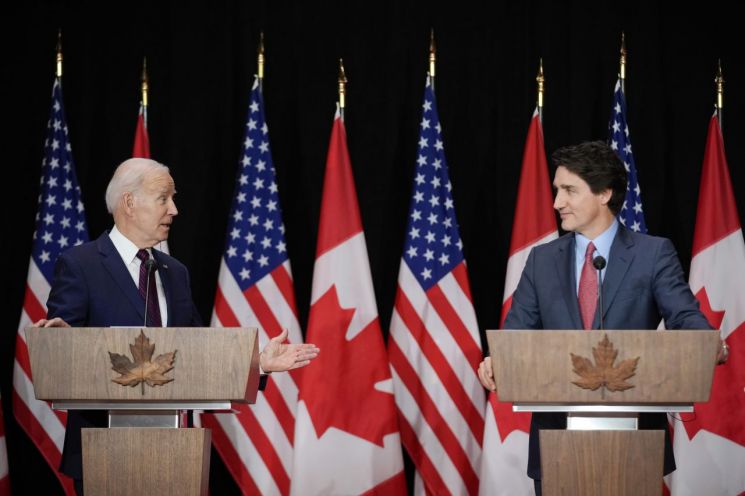 President Joe Biden of the United States and Prime Minister Justin Trudeau of Canada
 [Image source=AP Yonhap News]
Additionally, "To strengthen packaging for semiconductors and printed circuit boards in the North American region, the United States will provide $50 million in support under the Defense Production Act," and they agreed to "establish advanced technology, data, and security dialogues and enhance exchanges in cutting-edge technologies such as quantum science."
The two leaders condemned Russia's invasion of Ukraine and defined China as a major challenge to the international order.
They stated, "We condemn Russia for waging an illegal and unjust war against Ukraine," and pledged to "maintain unwavering support for Ukraine while continuously imposing economic costs on Russia."
They further noted, "We recognize that China poses a serious long-term challenge to the international order through economic coercion, non-market policies and practices, and human rights abuses," and said, "We will continue efforts to ensure the ability to effectively compete with China on a level playing field."
Regarding the Taiwan issue, they confirmed no change in their existing positions and recommended a peaceful resolution of cross-strait issues.
President Biden emphasized at the joint press conference, "We are transforming our hemisphere into a clean energy hub, including expanding subsidies for electric vehicles assembled in Canada," and added, "We will also strengthen cooperation in critical minerals and semiconductor sectors."
On the strengthening alliance between China and Russia, he said, "We have heard for three months that China would supply weapons to Russia, but it has not happened yet. That does not mean they will not, but not yet."
He also stated, "We have expanded alliances, and NATO is stronger than ever, with the G7, Quad, ASEAN, Japan, and South Korea all together," and mentioned the resilience of alliances including South Korea, saying, "If anything happens, the West is united more than ever. What about the Quad, and what about Japan and South Korea?"
Prime Minister Trudeau said, "The world can no longer rely on China and Russia in the critical minerals sector as before," and added, "Canada's dependence is increasing, including not only ores but also processed materials."
He pledged to strengthen bilateral cooperation, saying, "Securing critical mineral supply chains is essential for the production of batteries, computers, semiconductors, and more."
© The Asia Business Daily(www.asiae.co.kr). All rights reserved.

















