Crossing the Welfare Committee Threshold for Health Insurance Support
Safety Freight System Sparks Clash Between Ruling and Opposition Parties
Discussion on Additional Overtime Work Stalls
At the end of last year, three bills that were hotly debated in the National Assembly regarding 'sunset extension' ultimately failed to be passed. Sunset laws are bills that expire after a set period if not re-legislated. The three bills with sunset dates at the end of last year?the National Health Insurance Act involving government subsidies for health insurance, the cargo truck safety freight system, and the 8-hour additional extended work system?were not processed. These bills remain pending in the National Assembly this year, with only the National Health Insurance Act recently seeing renewed discussions.
According to political circles on the 25th, the National Assembly's Health and Welfare Committee passed a revision to the National Health Insurance Act on the 23rd during a plenary session, extending government subsidies for health insurance by five years. This reflects the ruling party and government's position to extend support for now, considering spending regulations surrounding health insurance finances, and to discuss amendments later.
The opposition party had demanded the abolition of the sunset provision and the permanent establishment of government subsidies for health insurance but has stepped back. This was due to confusion over the unclear direction of government subsidies ahead of this year's medical fee negotiations and the necessity of extension.
However, the revision includes an additional opinion stating, "The government shall strive to strengthen the state's responsibility for health insurance finances, including expanding government subsidies." Members of the Health and Welfare Committee from the Democratic Party held a press conference at the end of last year in the National Assembly, asserting that "government subsidies for health insurance are essential to clarify the state's responsibility for insurance finances and to secure the stabilization and sustainability of health insurance finances."
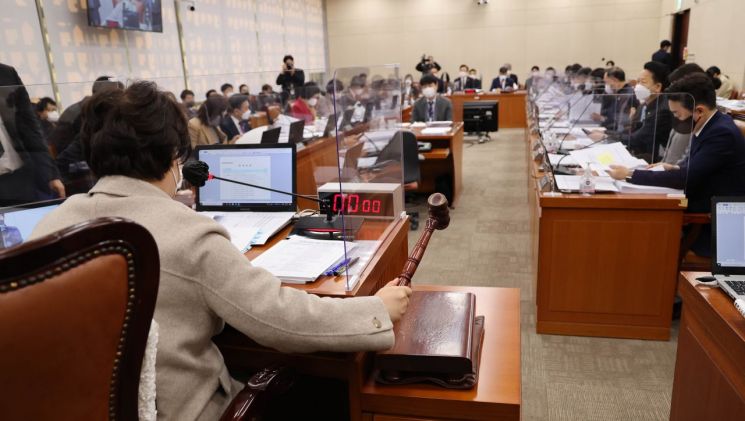
Even bills without partisan disagreement on extending government subsidies only passed the standing committee about four months after their sunset. However, the safety freight system and the 8-hour additional extended work system, which have significant partisan disagreements, remain uncertain in terms of processing.
Regarding the safety freight system, the Democratic Party advocates for a '3-year extension,' while the People Power Party calls for 'abolition and reconsideration from scratch.' The ruling party and government are pushing to reform the safety freight system into a 'standard freight system,' which, unlike the existing safety freight system, lacks enforcement provisions such as penalties for cargo owners. The People Power Party announced last month during a party-government meeting in the National Assembly that they plan to introduce a 'Cargo Transport Reform Bill' to implement the standard freight system. At that time, Seong Il-jong, who was the policy committee chairman, said, "The bill is being finalized and will be submitted as soon as possible."
In response, the Korean Confederation of Trade Unions Cargo Solidarity opposed the ruling party's standard freight system proposal, calling it a 'deterioration,' and the Democratic Party pulled out the 'direct referral' card. Following the direct referral of the Grain Management Act, which passed the plenary session on the 23rd, the plan is to directly refer bills including the Cargo Truck Transport Business Act, which contains the safety freight system, to the plenary session. Kim Seong-hwan, the policy committee chairman, said at a press briefing held at the National Assembly on the 21st, "Since the ruling party is not cooperating at all (on the bill), we will directly refer it according to the rule allowing direct referral with the agreement of three-fifths of the standing committee members."
The extension plan for the special 8-hour weekly extended work for businesses with fewer than 30 employees is losing momentum amid strong opposition, as the government's work hour reform plan is interpreted as a '69-hour workweek system.' At one point, there was a possibility of reaching a consensus, with some in the Democratic Party suggesting that "extending the sunset would give small and medium-sized enterprises a chance to hold on," but currently, related discussions are not even being raised within the ruling party. A ruling party member of the National Assembly's Environment and Labor Committee said, "Since the opposition is not accepting it, there is no need to discuss it further," adding, "The government announced a one-year grace period and exemption from labor supervision for workplaces with fewer than 30 employees, so I think it will pass like that."
With the sunset of the special extended work system, industries such as small and medium-sized enterprises are urging prompt system improvements. Kim Ki-moon, chairman of the Korea Federation of SMEs, recently pointed out in a media interview, "While the unfavorable Yellow Envelope Act for companies is being forcibly passed without bipartisan agreement, the 8-hour additional extended work system for small businesses is not even being discussed in the National Assembly." The Federation of SMEs also issued a welcoming statement on the government's flexible work hour plan on the 6th, saying, "With the sunset of the 8-hour additional extended work for workplaces with fewer than 30 employees last year, the small business field is in a state of confusion."
The additional work extension bills submitted by Assemblymen Kwon Myung-ho and Choi Seung-jae were referred to the bill subcommittee at the Environment and Labor Committee's plenary session on the 21st. Kwon's bill includes a sunset clause until 2024, while Choi's bill does not specify a validity period. Kim Won-mo, a specialist at the Environment and Labor Committee, stated in the bill review report, "Since there were opposing opinions in previous discussions and various opinions were presented by related ministries and stakeholders, it is necessary to discuss whether to establish new provisions and set a sunset period while considering each opinion in balance."
© The Asia Business Daily(www.asiae.co.kr). All rights reserved.
![Clutching a Stolen Dior Bag, Saying "I Hate Being Poor but Real"... The Grotesque Con of a "Human Knockoff" [Slate]](https://cwcontent.asiae.co.kr/asiaresize/183/2026021902243444107_1771435474.jpg)











