Constitutional Court Recognizes 'Disguised Party Defection'... "Violation of Deliberation and Voting Rights"
Min Hyung-bae: "Will Rejoin Party if Requested"
The Constitutional Court recognized procedural flaws in the legislative process of the 'Geomsu Wanbak Act' (the law for complete removal of prosecutorial investigative authority) but ruled that the law remains valid, effectively granting a victory to the Democratic Party of Korea.
Attention is focused on independent lawmaker Min Hyung-bae, who has been criticized as the main figure who undermined the National Assembly Act by leaving the party during the Geomsu Wanbak legislative process.
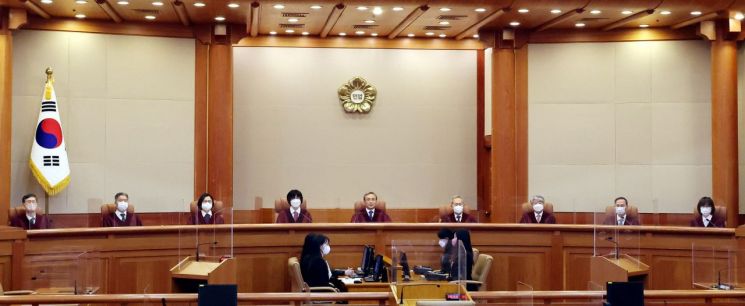 Chief Justice Yoo Nam-seok of the Constitutional Court and the justices are seated on the afternoon of the 23rd at the Grand Bench of the Constitutional Court in Jongno-gu, Seoul, for the ruling on the jurisdiction dispute regarding the legislation on the complete removal of prosecutorial investigation rights (Geomsu Wanbak). Photo by Yonhap News
On the 23rd, the Constitutional Court judged that the 'fake party withdrawal' and other trickery during the legislative process of the Geomsu Wanbak Act infringed upon the deliberation and voting rights of the People Power Party lawmakers. However, the court did not accept the claim that the announcement of the bill's passage in the National Assembly at that time was invalid.
On April 20 last year, when the Geomsu Wanbak bill was being actively processed, Min, who was a member of the Democratic Party's Legislation and Judiciary Committee (LJC), left the Democratic Party. This sparked controversy over 'fake party withdrawal' in political circles. It was alleged that Min left the party as a 'loophole withdrawal' to pass the bill referred to the LJC's agenda adjustment committee.
If two-thirds or more (4 out of 6) of the committee members approve, the agenda can pass. At that time, the Democratic Party placed Min, who had left the party and became independent, in the agenda adjustment committee to pass the agenda. The agenda adjustment committee is a procedure under the National Assembly Act where the committee is composed equally of three members from each party to review bills with significant differences between the ruling and opposition parties for up to 90 days, but Min's withdrawal effectively nullified this committee.
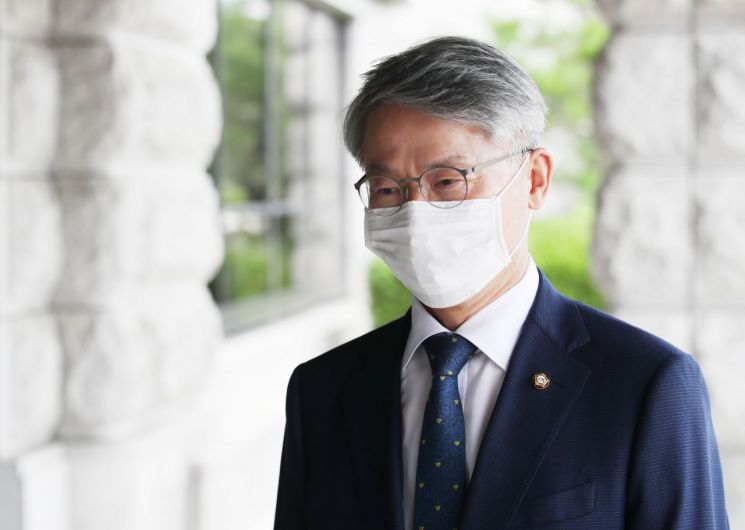 Independent lawmaker Min Hyung-bae is attending the public hearing on the "Complete Prosecution Reform" held at the Constitutional Court in Jongno-gu, Seoul, on July 12 last year. This public hearing is a constitutional dispute trial filed by the People Power Party against the Speaker of the National Assembly and the Chairperson of the Legislation and Judiciary Committee regarding the "Complete Prosecution Reform." The issue centers on Min Hyung-bae being assigned to the Judiciary Committee's agenda adjustment subcommittee as an independent member after leaving the Democratic Party. Photo by Yonhap News Agency
When criticism over the fake party withdrawal arose, Min repeatedly insisted that his withdrawal was inevitable because the People Power Party broke the 'Speaker's mediation agreement between the ruling and opposition parties.'
He later expressed his intention to rejoin the party. Even after the Constitutional Court's decision, Min stated in multiple media interviews, "If the party requests first, I will return."
Among the Democratic Party's first-term lawmakers, calls for Min's reinstatement were publicly voiced. Democratic Party lawmaker Jang Kyung-tae said on Facebook in June last year, "Min's reinstatement is not a reward for sacrifice but a procedure to correct the situation," adding, "Lawmaker Min Hyung-bae regarded prosecutorial reform as a historic mission and did his best."
Democratic Party lawmaker Yoo Jung-joo also stated on Facebook, "Lawmaker Min Hyung-bae sacrificed himself to fulfill the mission of prosecutorial reform," and "All Democratic Party lawmakers agreed on prosecutorial reform and adopted it as party policy, and Min followed the proper procedure to withdraw from the party."
However, the Democratic Party's party regulations became an issue. According to Article 11, Paragraph 3 of the Democratic Party's regulations, a person who has left the party cannot rejoin until one year has passed since the withdrawal. However, there is a proviso stating, "This does not apply if the Central Party Membership Qualification Review Committee reviews and the Party Affairs Committee decides otherwise," meaning that with a special resolution within the party, rejoining is possible even if less than one year has passed since withdrawal.
© The Asia Business Daily(www.asiae.co.kr). All rights reserved.


















