Majority Opinion: "Temporarily and Provisionally Forced Measures Exceed Limits"
Opposing Opinion: "Cannot Exclude Possibility of Surge in Illegal Foreign Residents"
The Constitutional Court has ruled that the legal provision which does not set an upper limit on the protection period for foreigners subject to deportation orders violates the Constitution.
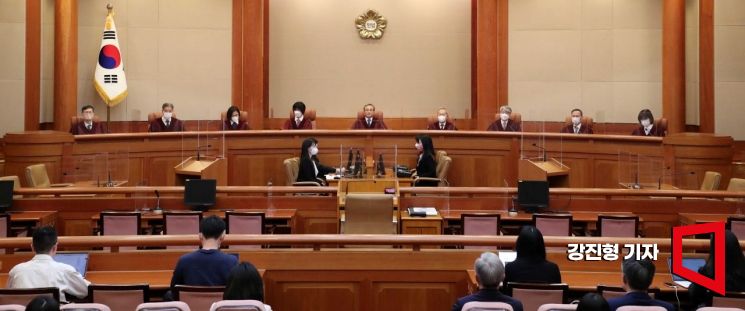 Yun Nam-seok, Chief Justice of the Constitutional Court, is seated with the constitutional justices at the Constitutional Court in Jongno-gu, Seoul. Photo by Jin-hyung Kang aymsdream@
The Constitutional Court issued a decision of constitutional inconsistency by a vote of 6 (unconstitutional) to 3 (constitutional) in the constitutional review requested by the Suwon District Court regarding Article 63, Paragraph 1 of the Immigration Control Act. However, to prevent a legal vacuum that could arise from a simple declaration of unconstitutionality and to allow legislators to consider various policy alternatives to remove the unconstitutionality, the current provision will be maintained until May 31, 2025.
The provision under review stipulates that if a person subject to a deportation order cannot be immediately repatriated outside the Republic of Korea due to reasons such as lack of a passport or unavailability of transportation, they may be protected in a protection facility until repatriation is possible, without setting an upper limit on the protection period.
Mr. A, an Egyptian national, entered the country in July 2018 with a tourist visa and overstayed. In October of the same year, he was caught by immigration enforcement officers in Anseong-si, Gyeonggi-do, and received a deportation order and protection order. Subsequently, Mr. A filed a lawsuit seeking cancellation of the protection order and, during the trial, requested a constitutional review of the law, which the court accepted.
The Constitutional Court stated, "Allowing indefinite protection of deportees without setting an upper limit on the protection period exceeds the limits of temporary and provisional compulsory measures of protection," and added, "By specifying an upper limit on the protection period in the law, it should be possible to prevent damages caused by unreasonable prolongation or uncertainty of the protection period. Allowing protection without a time limit for administrative purposes emphasizes administrative convenience and uniformity excessively, thereby unduly restricting the physical freedom of the protected person."
Furthermore, the Court pointed out, "Considering that protection under the provision restricts physical freedom to a degree comparable to 'arrest or detention' in criminal procedures, an independent and neutral institution should review and control the validity of protection at the initiation or extension stage." It also noted, "Currently, under the Immigration Control Act, there is no control procedure by an independent neutral institution separate from the enforcement agency at the initiation or extension stage of protection, nor is there a procedural opportunity for the party to submit opinions before issuing a protection order."
On the other hand, Justices Lee Eun-ae, Lee Jong-seok, and Lee Young-jin dissented, stating, "Although the Immigration Control Act does not set an upper limit on the protection period, the system is supplemented to ensure protection is provided only for the minimum necessary period through objection to protection orders, approval by the Minister of Justice for extension of the protection period, and temporary suspension of protection."
They further argued, "Countries such as the United States, Japan, and China still do not regulate an upper limit on the detention period for deportees, so if South Korea sets an upper limit on the protection period, it cannot be ruled out that the number of foreigners illegally staying in South Korea will increase rapidly." They added, "Discussions should be based on a policy foundation grounded in social consensus on how much administrative cost to bear due to management of deportees, what employment opportunities to provide to foreigners subject to deportation, and what level of humanitarian support to offer."
© The Asia Business Daily(www.asiae.co.kr). All rights reserved.
![Clutching a Stolen Dior Bag, Saying "I Hate Being Poor but Real"... The Grotesque Con of a "Human Knockoff" [Slate]](https://cwcontent.asiae.co.kr/asiaresize/183/2026021902243444107_1771435474.jpg)
















