"The Chinese Communist Party could use 'TikTok' to manipulate the entire United States."
"ByteDance (TikTok's parent company) is not owned by the Chinese government."
At the so-called 'TikTok hearing' held on the 23rd (local time) in the U.S. House of Representatives, concerns were raised that the Chinese video-sharing platform 'TikTok' could be exploited as a tool for the Chinese Communist Party to manipulate the U.S. CEO of TikTok, Shou Zi Chew, who came forward to clarify security threat concerns, emphasized that ByteDance is a private company not owned by the Chinese government, but still acknowledged that ByteDance employees currently have access to TikTok data of Americans. As tensions between the U.S. and China over TikTok escalate, there are fears it could lead to a 'second Huawei incident.'
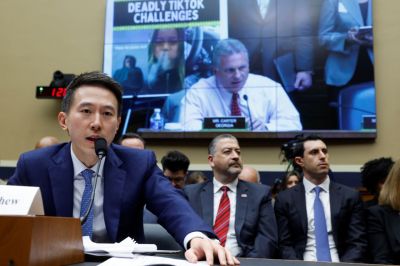
◆Flood of Security Threat Concerns... TikTok CEO Sweats to Explain
At the hearing of the U.S. House Energy and Commerce Committee, lawmakers from both parties expressed widespread concerns about TikTok's security threats. Republican member Cathy McMorris Rodgers directly stated, "Americans need to know the truth about the threats TikTok poses to our national and personal security." She warned, "TikTok collects almost every imaginable piece of information, including people's locations, what they say, and biological data," adding, "The Chinese Communist Party could use TikTok to manipulate the entire United States."
TikTok, with over 1.5 billion users worldwide, is China's leading social media platform that sparked a craze for short videos lasting 3 seconds to 1 minute. It is estimated that there are about 150 million users in the U.S. This is the first time TikTok's CEO has appeared before the U.S. Congress. The hearing took place amid growing efforts within the U.S. to ban TikTok on national security grounds.
In response, CEO Chew said, "We do not promote or delete content at the request of the Chinese government," and promised the committee and all users that TikTok would be protected from manipulation by any government. He emphasized, "(ByteDance, TikTok's parent company) is not an agent of China or any other country," and "Data of U.S. users is managed by a U.S. company within the United States." He also stated, "We do not take concerns about TikTok lightly," and added, "We have acted to address these concerns and will continue to build trust."
Concerns that China collects information on U.S. users through TikTok and manipulates algorithms for propaganda have been raised since 2019, mainly by the U.S. Congress and intelligence agencies. CEO Chew appeared at the hearing to dispel these concerns, but it was insufficient to counter the bipartisan political consensus pushing for a ban on TikTok in the U.S.
When asked whether TikTok provided location data collected in the U.S. to the Chinese government, Chew clearly answered, "No." However, Representative Rodgers responded, "I do not trust your claim that ByteDance and TikTok are free from the influence of the Chinese Communist Party at all." Democratic ranking member Frank Pallone also condemned TikTok, saying, "TikTok continues to collect data and will continue to sell it," and "It will continue to operate under the protection of the Chinese Communist Party."
The hearing also confirmed that some information is still accessible from China. When asked if ByteDance employees currently have access to U.S. data, CEO Chew replied, "Once Project Texas is completed, the answer will be 'No'." TikTok is currently transferring all U.S. user data to servers owned by Oracle located in Texas amid controversy over data leaks. However, he acknowledged that at this point, access to U.S. data from China is still possible. He added, "Some data that needs to be deleted remains as of now," and assured that all U.S. user data will be moved beyond the reach of Chinese law.
◆U.S.-China Tech Hegemony War... Will TikTok Follow Huawei's Path?
Some analysts say the aggressive questioning by U.S. lawmakers reflects the recent deterioration in U.S.-China relations. The U.S. Congress included a provision banning TikTok on government devices in the 2023 fiscal year (October 2022 to September 2023) budget bill. Recently, the U.S. Senate introduced a bill (Information and Communications Technology Risk Management Act) that would allow banning foreign information technology posing security threats. The bill aims to give the U.S. government discretionary power to identify and sanction risks embedded in services and technologies from companies linked to adversarial countries such as China and Russia. If this bill takes effect, TikTok is expected to be effectively expelled from the U.S. market.
Recently, the Committee on Foreign Investment in the United States (CFIUS) under the U.S. Treasury Department reportedly pressured TikTok to sell the shares held by its Chinese founders, threatening to ban its use in the U.S. if they refuse. Additionally, the U.S. Department of Justice and the Federal Bureau of Investigation (FBI) have launched full-scale investigations into allegations that ByteDance used TikTok to collect personal information of U.S. journalists.
Former White House advisor Lindsey Gorman stated, "The era when U.S.-China business relations could continue without geopolitical considerations is over." Accordingly, there are growing assessments that TikTok could follow the path of Huawei, which was previously identified as a security threat and became the center of the U.S.-China trade war.
In the U.S. Congress, bills aimed at countering China have been introduced one after another, including banning loans to China from the World Bank (WB). Republican Senator John Barrasso announced that he had introduced a bill to prohibit loans to China from multilateral development banks such as the World Bank and the Asian Development Bank (ADB). Earlier, Republican Senator Josh Hawley introduced a bill on the 21st to suspend so-called Most Favored Nation (MFN) status for China.
On the same day, the U.S. Department of Commerce added 14 Chinese companies, including ECOM International and HK P&W Industry, to the Unverified List for national security reasons. This is a preliminary step before the export control blacklist. If these companies fail to pass a 60-day verification process, they will be placed on the blacklist. Deputy Secretary of Commerce Don Graves stated in a press release, "Export controls are a critical part of protecting U.S. national security," and emphasized, "We are committed to using every tool at our disposal to verify how U.S. advanced technology is being used worldwide."
© The Asia Business Daily(www.asiae.co.kr). All rights reserved.

















