Chairman Choi Yoon-beom "Rapidly Completing the Hydrogen Value Chain"
Korea Zinc announced on the 23rd that it has invested 30 million dollars (approximately 39 billion KRW) in Amogy, a U.S. ammonia decomposition technology company. Korea Zinc and Amogy plan to accelerate a joint green ammonia supply project in Australia over the next 10 years through a Letter of Intent (LOI).
Korea Zinc plans to mass-produce green hydrogen and green ammonia by 2030 based on investments in renewable energy infrastructure in Australia. It intends to produce liquefied ammonia directly in Australia and supply it domestically through maritime transport. Amogy possesses core technology that converts green ammonia into hydrogen. Leveraging a strategic partnership with Amogy, Korea Zinc aims to become a major seller of green ammonia and hydrogen within Korea in the future.

This investment is significant in that Korea Zinc has acquired essential technology for the 'intercontinental transportation' segment of its hydrogen value chain. Hydrogen is transported in a compressed gaseous state. Due to its low energy density, it is economically inefficient, so hydrogen must be transported in a liquefied form. Maintaining liquefied hydrogen requires extremely low temperatures (below minus 253°C), which is challenging. This means there are technical barriers to commercializing liquefied hydrogen maritime transport.
As an alternative to liquefied hydrogen maritime transport, converting hydrogen into ammonia and transporting it in liquefied ammonia form by sea is gaining attention. Ammonia gas molecules have 1.7 times the hydrogen storage capacity per unit volume compared to hydrogen gas molecules, resulting in higher energy density. To store ammonia in liquid form, it only needs to be kept below minus 33°C, so unlike liquefied hydrogen, it can be stored for long periods without difficulty. Ammonia already has well-established global transportation and distribution infrastructure. If ammonia decomposition technology is commercialized, it is expected to accelerate the use of hydrogen-based clean energy through liquefied ammonia storage and transport.
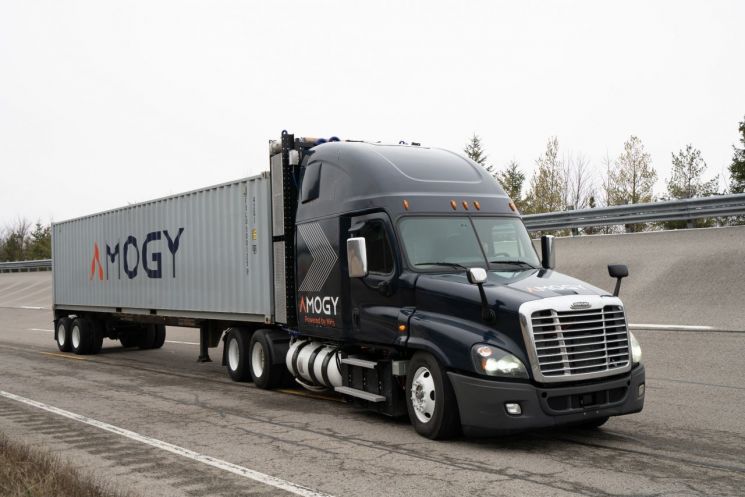
Amogy demonstrated the excellence of its ammonia decomposition technology by operating a 100kW-class ammonia fuel-based tractor in May last year and a 300kW-class large truck with an ammonia-based hydrogen fuel cell system in January this year. Amogy plans to develop and produce products that convert ammonia into power for all transportation sectors, including maritime transport. By the end of this year, it plans to conduct the world's first test operation of a tugboat powered by ammonia fuel with zero exhaust emissions.
Choi Yoon-beom, Chairman of Korea Zinc, emphasized the importance of renewable energy and green hydrogen businesses, stating, "Through this investment, we have secured core technology to utilize green ammonia produced in Australia domestically," and expressed confidence that "Korea Zinc's hydrogen value chain can be completed more rapidly."
Woo Sung-hoon, CEO of Amogy, said, "Korea Zinc's investment will be a great force in advancing ammonia maritime transport and the commercialization of ammonia fuel power generation," and added, "We will continue development and facility investments to launch the first commercial product in 2024."
© The Asia Business Daily(www.asiae.co.kr). All rights reserved.
![Clutching a Stolen Dior Bag, Saying "I Hate Being Poor but Real"... The Grotesque Con of a "Human Knockoff" [Slate]](https://cwcontent.asiae.co.kr/asiaresize/183/2026021902243444107_1771435474.jpg)

















