US NBC "Korea Has High Suicide Rate and Lowest Birthrate"
South Korea Ranks 4th in Average Annual Working Hours Among OECD Members
"Serious Intergenerational Debate on Work-Life Balance Occurs"
Foreign media reports continue to highlight the controversy in South Korea over the labor law amendment that sets the maximum weekly working hours at '69 hours.'
On the 22nd (local time), the US NBC network reported, "The plan to increase the weekly working hour limit from 52 to 69 hours in South Korea has sparked intense backlash from young workers."
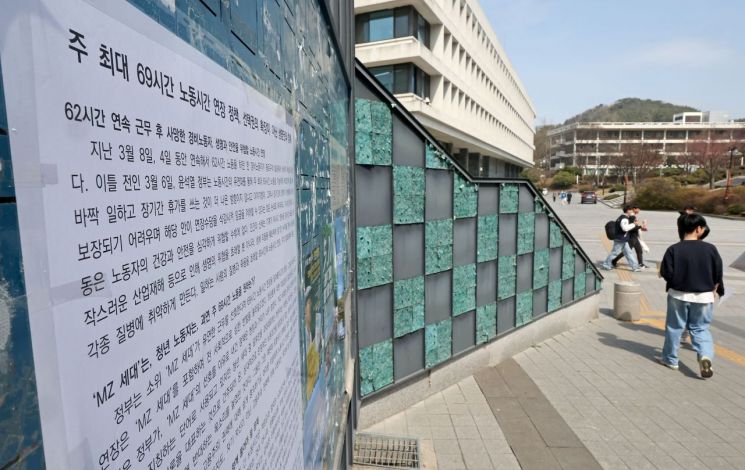 On the 22nd, a large poster demanding the complete withdrawal of the '69-hour Workweek Reform Plan,' written by the Seoul National University student group Non-Regular Workers-Free Seoul National University Joint Action, was posted on the wall of the Seoul National University Student Union building.
 [Photo by Yonhap News]
NBC noted that this process has also triggered an intergenerational debate about 'work-life balance (Wolabal),' diagnosing this phenomenon as part of a global trend emerging after the COVID-19 pandemic.
In the US, new terms such as 'Quiet Quitting,' referring to employees doing only the minimum required work, and 'The Great Resignation,' indicating a surge in voluntary resignations, are trending. In France, pension reform to raise the retirement age from 62 to 64 has faced strong public opposition and severe backlash.
In South Korea as well, movements calling for the withdrawal of the 69-hour workweek are emerging even among students, with related posters filling campuses.
On the 21st, the Joint Action for a Seoul National University Without Irregular Workers (Biseogong) stated through campus posters, "On March 8, a security worker who had been working 62 hours for four consecutive days collapsed and passed away in a building in Jongno-gu," adding, "The extension of working hours to 69 hours, which will cause illness and death among workers, must be immediately withdrawn."
NBC explained, "During the COVID-19 pandemic, many workers became accustomed to shorter working hours or remote work and are reconsidering whether they want to return to the past life dominated by labor to earn wages." However, it pointed out that in South Korea, which has a notorious culture of long working hours and workaholism, concerns about excessive labor are particularly severe.
Normalization of Overtime and Mandatory Attendance at Company Dinners... Workaholism Impacts Public Health
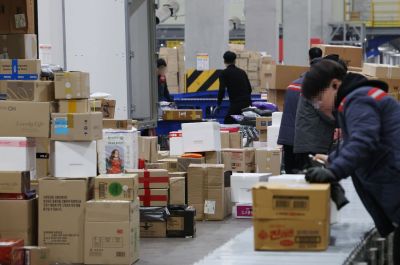 Delivery company personnel are sorting packages at the Seoul Southeast Logistics Complex in Songpa-gu, Seoul. The photo is not related to the specific content of the article. Photo by Yonhap News.
In fact, the average annual working hours of South Korean workers were 1,915 hours in 2021, ranking fourth among the 38 member countries of the Organisation for Economic Co-operation and Development (OECD). The average annual working hours for workers in the US and France were 1,791 hours and 1,490 hours, respectively.
Overtime is normalized, it is difficult to leave work before one’s boss even after finishing tasks, and employees often have to attend company dinners after work, leading to overwork. NBC pointed out that the recent popularity of 'nap cafes' for office workers in South Korea is not unrelated to this situation.
Additionally, NBC mentioned that South Korea’s suicide rate is 26 per 100,000 people, the highest among developed countries, and the total fertility rate, the average number of children a woman is expected to have in her lifetime, was 0.78 in 2022, the lowest in the world, explaining that "workaholism also raises concerns from a public health perspective."
However, NBC added that in South Korea, voices resisting this workaholic culture are growing stronger, especially among the MZ generation in their 20s and 30s, who make up about one-third of the total population. As a result, the South Korean government showed signs of retreat on the 21st by proposing to flexibilize the '52-hour workweek' system but setting an upper limit within 60 hours.
Meanwhile, the US CNN network also covered South Korea’s labor hour adjustment issue on the 20th, reporting that South Korean workers already suffer from some of the longest working hours in the world and that dozens of people die each year from 'karoshi' (death from overwork). It introduced the reasons why young South Koreans oppose the expansion of the working hour limit.
On the 14th, Australia’s ABC network also reported on the related controversy and even expressed 'karoshi' phonetically as 'kwarosa.'
© The Asia Business Daily(www.asiae.co.kr). All rights reserved.
![Clutching a Stolen Dior Bag, Saying "I Hate Being Poor but Real"... The Grotesque Con of a "Human Knockoff" [Slate]](https://cwcontent.asiae.co.kr/asiaresize/183/2026021902243444107_1771435474.jpg)

















