Etoos "Should Be Used to Check Mastery of Common Subject Learning"
In the nationwide high school joint academic assessment (March mock exam) conducted simultaneously across the country, the mathematics section was slightly easier compared to the previous CSAT.
According to the Etoos Education Evaluation Research Institute on the 23rd, the perceived difficulty of the 4-point questions in the mathematics section was analyzed to be easier depending on the students' level of study.
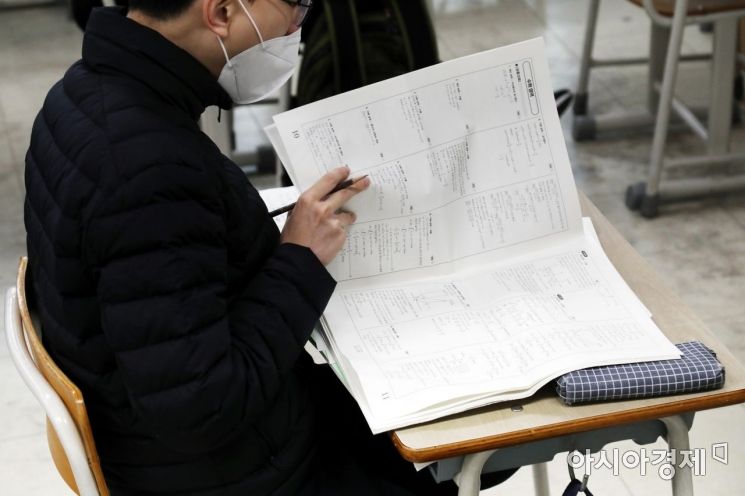 On the 24th, when the 2022 academic year March National Joint Academic Achievement Test was conducted for 950,000 high school students from grades 1 to 3 nationwide, three students at Yongsan High School in Seoul were preparing for the exam. This academic achievement test is being held simultaneously nationwide on the same day for the first time in three years since the COVID-19 pandemic.
 Photo by Joint Press Corps
First, in the common mathematics section, similar to last year's CSAT, no fill-in-the-blank inference questions were included, and the short-answer questions, which in the last CSAT appeared in question 14 asking about limits and continuity of functions, were this time presented in the integration unit, which has been frequently tested before, and were not difficult.
Among the multiple-choice questions, question 15, considered a killer question, was, as in the last CSAT, a problem asking about the regularity of a sequence defined inductively, and question 22 was from the differentiation unit, following the previous testing trend.
In the elective mathematics section, there were 8 questions each from Probability and Statistics, Calculus, and Geometry, and the difficulty level was moderate with little difference among the subjects.
Probability and Statistics questions were similar to previous exam types; question 28 involved circular permutations, question 29 involved permutations with identical elements, and question 30 required finding the number of functions using combinations with repetition. It is expected that students who practiced previous questions did not find these difficult, and since the difficulty between the quasi-killer and killer questions did not differ significantly, accurate calculation in questions 28, 29, and 30, which involved relatively large amounts of computation, was likely key.
Calculus did not include series in the test scope this time, so the type that applies geometric series to shapes, which is always tested, was not included. For question 29, students who had learned how to approach quadratic expressions inside radicals were expected to solve it without much difficulty. The killer question 30 involved a function defined using the limit of a geometric sequence, and given the nature of the test scope, this form was sufficiently predictable, so students' perceived difficulty was likely low.
In Geometry, questions 27 and 29 involved situations where a conic section and a rectangle or circle meet, solved using properties of the conic section; question 28 involved two ellipses intersecting, and question 30 involved an ellipse and a hyperbola intersecting, solved using properties of conic sections. Although all these problems involved diagrams with two or more overlapping shapes and conic sections, they were expected to be solvable without much difficulty if students had a good understanding of the definitions and properties of conic sections.
The March mock exam mathematics section covered the entire range for the common subject and a part of unit 1 for the elective subjects. Kim Byung-jin, head of the Etoos Education Evaluation Research Institute, stated, “It should be used as a tool to check the completeness of learning in the common subject rather than the elective subjects,” and explained, “It is important to divide the parts you have studied and those you have not yet studied in the common subject, check for correct and incorrect answers, and based on this, plan and implement your future study schedule.”
© The Asia Business Daily(www.asiae.co.kr). All rights reserved.
![User Who Sold Erroneously Deposited Bitcoins to Repay Debt and Fund Entertainment... What Did the Supreme Court Decide in 2021? [Legal Issue Check]](https://cwcontent.asiae.co.kr/asiaresize/183/2026020910431234020_1770601391.png)
















