Last Year Japan's Seafood Imports Amounted to 170 Million USD
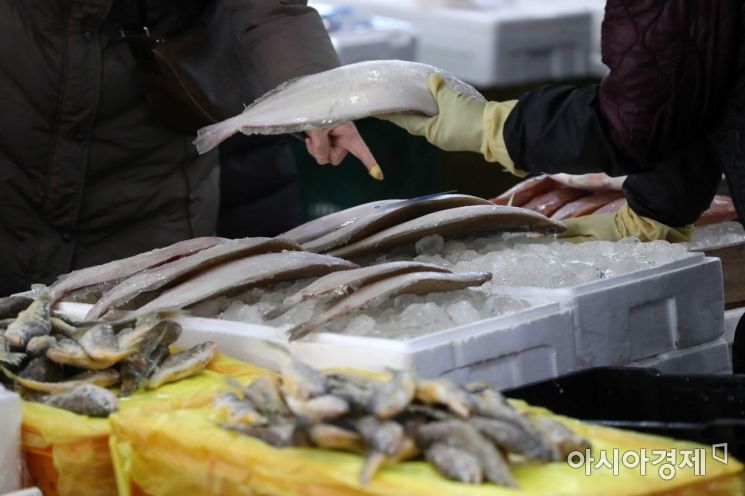
Last year, South Korea's imports of Japanese seafood reached approximately $170 million, marking the highest level since the 2011 Fukushima nuclear disaster.
According to trade statistics from the Korea Customs Service on the 23rd, last year's imports of live, chilled, and frozen fish, crustaceans, and mollusks from Japan increased by 12.2% compared to the previous year, reaching $174.15 million (226 billion KRW), the highest in 12 years since 2010 ($212.21 million).
The year 2010 was just before the Fukushima nuclear accident occurred.
On March 11, 2011, a magnitude 9.0 earthquake struck off the southeast coast of the Oshika Peninsula in Miyagi Prefecture, Japan, triggering a tsunami that flooded the Fukushima nuclear power plant, causing radioactive materials to leak.
In September of that year, the South Korean government implemented special measures banning the import of all seafood species from Fukushima and eight surrounding prefectures, including Aomori, Iwate, Miyagi, Tochigi, Gunma, Ibaraki, and Chiba.
Following the Fukushima nuclear accident, imports of Japanese seafood declined.
From about $210 million in 2010, imports dropped to $150 million in 2011, then to $100 million in 2012, $95 million in 2013, and $91 million in 2014.
However, the trend reversed afterward, rising to $120 million in 2019, slightly decreasing in 2020 due to COVID-19, then increasing again to $160 million in 2021, and further growing last year.
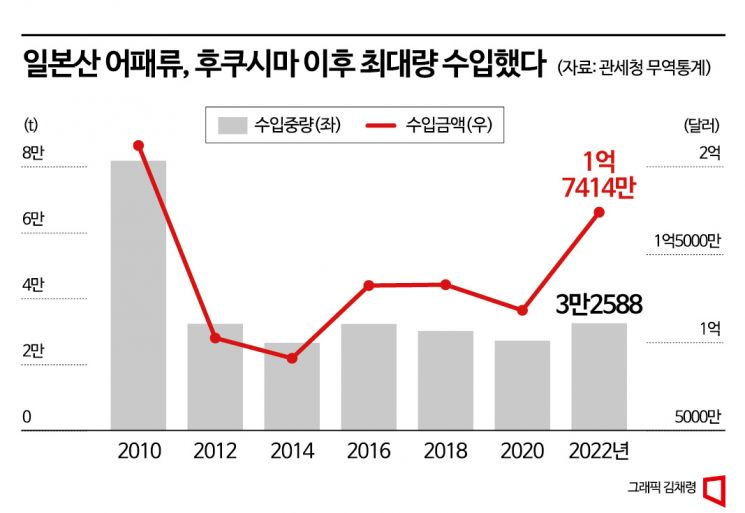
Compared to 2010, just before the Fukushima nuclear accident, last year's import value is still only at 82.1% of that level.
In 2010, Japanese seafood accounted for 7.6% of South Korea's total seafood imports, but last year it was only 3.1%. During this period, total seafood imports more than doubled, while imports from Japan actually decreased.
Half of the Japanese seafood import value was live fish. Japan ranks sixth in import volume after Russia, China, and others.
Last year, the country from which South Korea imported the most seafood was the Russian Federation, with $1.4157 billion, followed by China ($1.02563 billion), Vietnam ($676.81 million), Norway ($592.61 million), the United States ($224.98 million), and then Japan.
Canada ($130.78 million), Peru ($120.43 million), Taiwan ($119.64 million), and Hong Kong ($112.01 million) were also among the top ten.
Omakase Craze... 'Seugangsincheong' Despite Meals Costing Tens of Thousands of Won
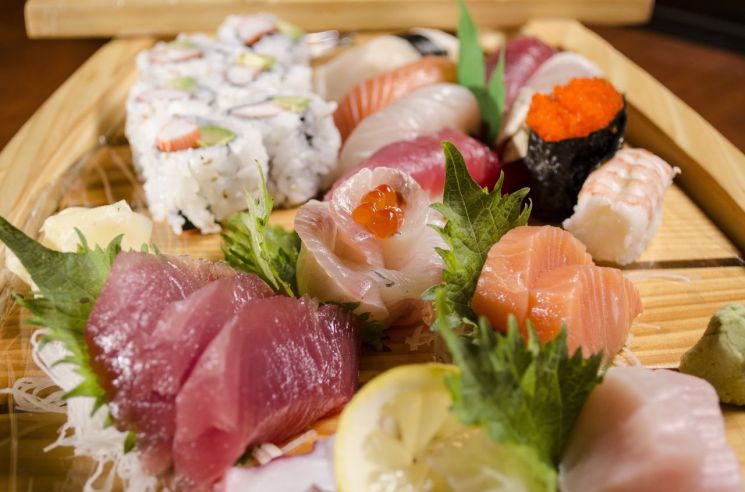
Meanwhile, in recent years, the 'Omakase' craze has been ongoing in South Korea, especially among the MZ generation.
Omakase is a Japanese term meaning 'to entrust,' referring to a Japanese-style course meal where the chef prepares dishes of the day without a menu.
A new coined term combining sushi and course registration, 'Seugangsincheong,' has also emerged. Although a single meal can cost tens of thousands of won, it is so popular that even making a reservation is difficult.
© The Asia Business Daily(www.asiae.co.kr). All rights reserved.



















