Japan's AI-Written Novel Wins Literary Award Last Year
US Halts Submissions Amid Surge of AI-Written Novels
The emergence of ChatGPT is causing significant changes in the literary world. This is because even ordinary people who are not writers can now easily create literary works using ChatGPT. As a result, the landscape of the literary world is being reshaped. In the United States, a famous monthly science fiction magazine has stopped accepting submissions altogether to prevent novels written by artificial intelligence (AI), while in Japan, the submission criteria for a science fiction literary award explicitly state that the author "does not have to be human," leading to AI-written novels winning awards.
On the 23rd, the Mainichi Shimbun reported an interview with Kamome Ashizawa, who won the Excellence Award in the general category of last year's Japanese SF literary award, the "Hoshi Shinichi Award." This is the first time since the award's inception in 2013 that a work created using AI has won. The Hoshi Shinichi Award is organized by Nihon Keizai Shimbun (Nikkei) and was established to commemorate the SF writer Shinichi Hoshi. A distinctive feature of the award is that it accepts works written by non-human entities, as AI-written novels are considered to bring "novel ideas and innovations."

According to Mainichi, Ashizawa, who works as a data analyst, produces and submits all his novels using ChatGPT. He claims that writing novels with AI enables mass production. Last year, including the winning work, a total of 100 short stories were submitted for the Hoshi Shinichi Award, and it took only about three weeks. Ashizawa said, "If you input well, AI continues writing even when humans are doing other things or even sleeping."
In fact, he has posted "How to write novels with ChatGPT" on social networking services (SNS). According to this guidebook, he uses a method of training ChatGPT by asking questions step-by-step and then having it write the novel. First, he asks ChatGPT, "I want to write a novel on this topic; please give me five ideas." After selecting a preferred idea from the suggestions, he instructs it to create the protagonist's name and profile, then to create other characters. Once all the details are decided, he asks ChatGPT to write the novel based on them. The final work is created through human editing.
Ashizawa told Mainichi, "AI is an assistant that helps thinking," adding, "If AI can copy my unique characteristics, even after I die, AI might write an ideal novel about me over a long period."
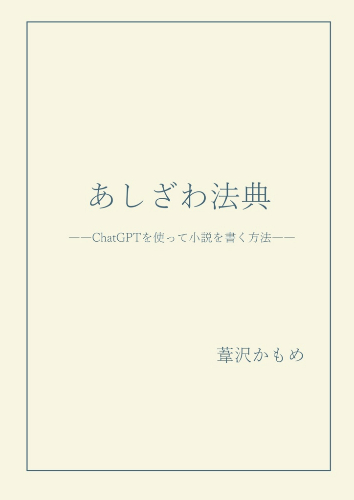 A guidebook titled 'How to Write Novels with Chat GPT' by author Ashizawa Kamome. (Photo by Ashizawa Kamome SNS)
However, there are also negative views on AI's entry into the literary world. Mainichi also reported an interview with Neil Clarke, editor of the famous US SF monthly magazine Clarkesworld Magazine, which recently stopped accepting submissions altogether. He said that the number of AI-written novel submissions surged rapidly, prompting the urgent suspension of submissions. In December last year, there were only 51 AI-written novels submitted, but after an influencer posted a video on TikTok saying, "Let's make easy money using ChatGPT," the number jumped to 116 in January. Last month, 512 submissions were received in just 20 days, leading to the decision to halt submissions.
Editor Neil Clarke referred to AI-written novel submissions as "spam submissions," saying, "We might have to create spam filters just like dealing with spam emails." He claims that AI-written novels are easier to distinguish because their quality is lower than human-written novels. The problem is mass production. Clarke expressed concern that "masterpieces by human newcomers might be buried under these spam novels," emphasizing, "Outstanding SF writers need imagination. This is something that cannot be taught to anyone."
© The Asia Business Daily(www.asiae.co.kr). All rights reserved.
![Clutching a Stolen Dior Bag, Saying "I Hate Being Poor but Real"... The Grotesque Con of a "Human Knockoff" [Slate]](https://cwcontent.asiae.co.kr/asiaresize/183/2026021902243444107_1771435474.jpg)












