"Procedural Legitimacy Issue"
"Suspected Political Repression Law"
Cho Eung-cheon, a member of the non-Myeong (非明) faction and a Democratic Party lawmaker, criticized the Democratic Party's decision to hold a party executive meeting on the day Lee Jae-myung, the party leader, was indicted, and to decide that Lee would retain his position as leader, calling it a "fortress-like stance" but also saying it was "too much."
On the 23rd, Cho said on MBC's "Kim Jong-bae's Focus" program, "Isn't our party becoming too entrenched in a bulletproof stance?"
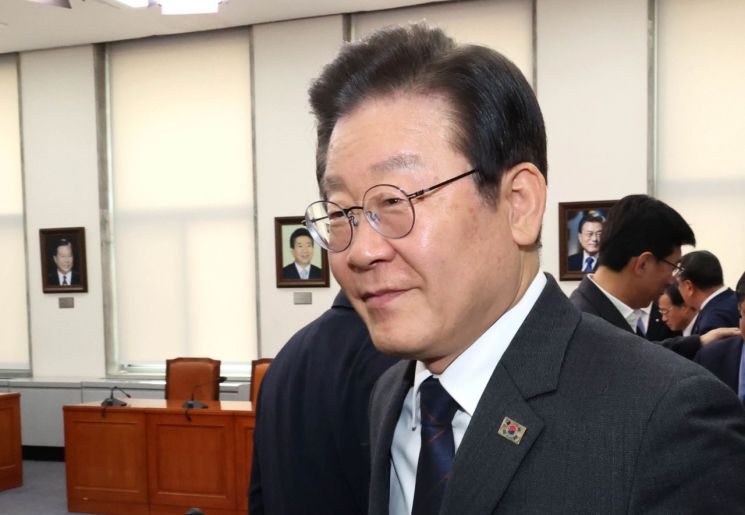
On the 22nd, the Democratic Party held a party executive meeting on the day Lee was indicted and decided not to suspend his duties, viewing the indictment as "political oppression" under Article 80, Paragraph 3 of the party constitution. Article 80 of the Democratic Party's constitution stipulates that party officials must be suspended from their duties if indicted for corruption-related charges, but Paragraph 3 of the supplementary provisions allows exceptions if there are unfair reasons such as political oppression. This supplementary provision was newly established after Lee was elected at last year's party convention.
Cho also pointed out procedural issues. He said, "Paragraph 3 states, 'Among those who have received the disposition under Paragraph 1, if political oppression or other unfair reasons are recognized...' So, who are the people who have received the disposition under Paragraph 1?" He added, "But no disposition has been made." The disposition under Paragraph 1 refers to suspension of duties, and Cho argued that Lee was exempted by applying Paragraph 3 directly without first going through the suspension procedure.
He also raised concerns about Kim Eui-gyeom, the party spokesperson, announcing the party executive meeting results the day before, saying, "The decision was made considering that the intention of political oppression is much more important than whether there is a charge or not." Cho said, "Then does that mean criminal charges are unnecessary?" He added, "Political oppression refers to cases where there are no criminal charges or the charges are very minor, and the prosecution changes its attitude depending on the party. But if it’s 'regardless of whether the criminal charges are serious or not,' then is political oppression completely subjective? Is it some kind of 'interest law'? These questions came to mind."
© The Asia Business Daily(www.asiae.co.kr). All rights reserved.
![From Bar Hostess to Organ Seller to High Society... The Grotesque Con of a "Human Counterfeit" [Slate]](https://cwcontent.asiae.co.kr/asiaresize/183/2026021902243444107_1771435474.jpg)
















