When are people most curious about their bodies? In South Korea, demand related to body composition increases every January as people start dieting as a New Year's resolution, while in India, demand rises in October, when the relatively mild "warm winter" begins.
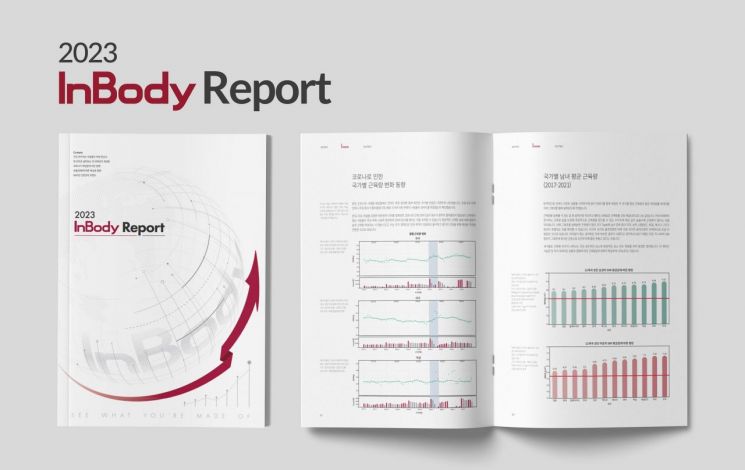
InBody announced on the 23rd that it has published the world's first body composition big data report, the ‘2023 InBody Report,’ containing these findings.
The 2023 InBody Report covers trends and patterns in body composition changes by country, gender, and age group based on InBody’s accumulated global body composition big data. The report is designed to serve as a reference guide for sports trainers, researchers, and medical professionals by analyzing body composition trends influenced by environmental factors such as COVID-19, social issues, and seasons. It also helps the general public check and compare their current body composition status to manage it systematically.
This report analyzes body composition data from 12 countries (Netherlands, Germany, Malaysia, Mexico, United States, United Kingdom, India, Japan, China, Canada, South Korea, Australia) with the largest accumulated data, based on five years of global InBody body composition big data collected from January 2017 to December 2021. As of this month, InBody has accumulated over 88 million body composition data records.
The report is structured around three main topics: ▲Global body composition trends by year ▲Impact of COVID-19 on body composition ▲Body composition trends by gender and age. In the chapter examining global body composition trends by year, it reviews average muscle mass by gender per country, the periods when InBody measurements are most frequently taken, health management seasons by country based on measurement timing, annual trends in body fat percentage by country, and seasonal body fat percentage trends in the Northern and Southern Hemispheres.
According to the report, the top six countries in average skeletal muscle mass index (SMI, calculated by dividing limb muscle mass by height squared) are all Western countries regardless of gender, including the United States, Australia, and the Netherlands. This indicates that Western countries generally have slightly more developed skeletal muscle mass compared to Asian countries. The timing of InBody measurements by country reflects lifestyle patterns influenced by cultural and environmental factors. For example, the number of InBody measurements among South Korean women spikes sharply every January, coinciding with New Year's resolutions such as dieting. In contrast, Indian women show a surge in measurements in October, which marks the start of a relatively warm winter season favorable for exercise and health management, lasting until February, while the rest of the year is characterized by extreme heat and monsoon seasons.
In the chapter on the impact of COVID-19 on body composition, the report analyzes global trends in InBody measurements after the pandemic, changes in muscle mass by country due to COVID-19, and characteristics of changes in muscle and body fat mass by gender and country during the prolonged pandemic. In April 2020, when the COVID-19 pandemic began, the number of InBody measurements worldwide dropped by 79% compared to January of the same year. Subsequently, changes in measurement frequency, muscle mass, and body fat mass varied by country depending on individual policies such as social distancing, shutdowns, and limits on indoor occupancy.
The section on body composition trends by gender and age discusses differences in the timing of muscle loss between Eastern and Western men and differences in body fat percentage changes among women from East and West. According to the report, South Korean men begin to lose muscle mass about 10 years earlier than American men. Muscle mass starts to decline at age 35 for South Korean men and at age 45 for American men. South Korean women have a high body fat percentage of 32% in their early 20s, which gradually decreases throughout their 20s. This is analyzed as a result of insufficient exercise during their teenage years due to academic pressures, followed by excessive dieting after becoming adults. Conversely, women in the United States and Germany experience an increase in body fat during their 20s. Various factors such as cultural differences, lifestyle patterns, and dietary habits among 20-something women across countries are presumed to contribute to these differences.
The 2023 InBody Report can be obtained at the InBody booth at the 38th International Medical Devices & Hospital Equipment Exhibition ‘KIMES 2023,’ held from the 23rd to the 26th at COEX in Gangnam-gu, Seoul. Starting from the 27th, it will also be available on the InBody website.
Lee Rami, CEO of InBody, stated, “We have introduced the 2023 InBody Report, which only InBody can provide, as a more valuable way to utilize global body composition data. As a global healthcare company leading body composition trends, InBody will publish the InBody Report annually to help people worldwide easily understand their body composition and better comprehend their bodies.”
© The Asia Business Daily(www.asiae.co.kr). All rights reserved.

















