Whether Opposition Lawmaker's Authority Is Violated and Validity of Vote Declaration Are Separate
Interest Grows Over Possible Ruling on Unconstitutionality of Revised Law
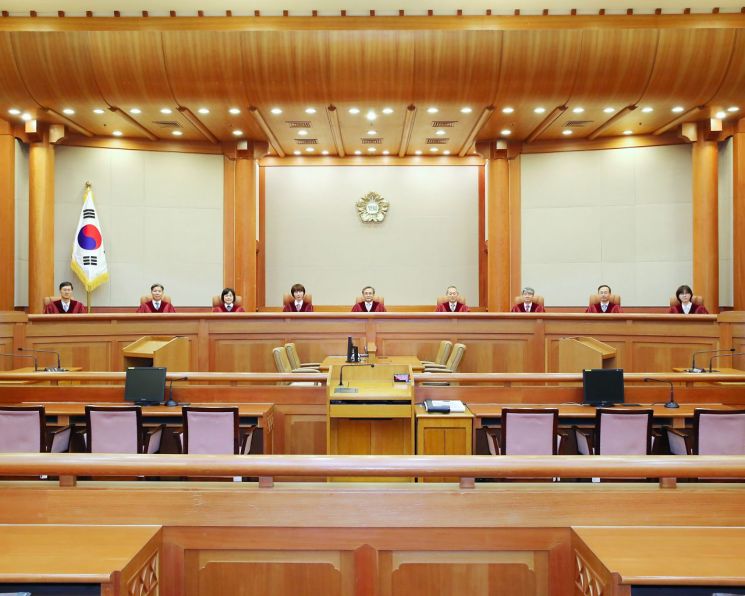
On the 23rd, the Constitutional Court will deliver its final ruling on whether there were any issues in the National Assembly's passage of the 'Complete Stripping of Prosecutorial Investigation Rights' law (commonly known as 'Geomsu Wanbak'), which was led by the Democratic Party of Korea last year, and whether the amended law infringes on prosecutors' investigation and prosecution rights, thus being unconstitutional.
Based on precedent, even if the Constitutional Court acknowledges some infringement of authority, it is highly likely that the proclamation of the law's passage will not be deemed invalid. However, if the Court rules the amended law ineffective, significant repercussions are expected.
The Constitutional Court will announce its decision at 2 p.m. at the Grand Bench of the Constitutional Court in Jaedong, Jongno-gu, Seoul, regarding two jurisdictional dispute cases filed by the People Power Party and the Ministry of Justice concerning the amended Prosecutors' Office Act and the amended Criminal Procedure Act.
This case concerns whether the deliberation and voting rights of the People Power Party lawmakers, who were the opposition at the time, were infringed during the passage of the amended Prosecutors' Office Act and the amended Criminal Procedure Act, and whether the passage of each amended law infringed on prosecutors' investigation and prosecution rights. Since the petitioners have requested confirmation of the invalidity of the National Assembly's proclamation of the amended laws' passage, the Constitutional Court is also expected to rule on the effectiveness of each amended law.
Article 66, Paragraph 1 of the Constitutional Court Act regarding jurisdictional disputes states that "The Constitutional Court shall determine the existence or scope of authority of the state organs or local governments subject to the adjudication." Paragraph 2 further stipulates that "In the case of Paragraph 1, the Constitutional Court may cancel or confirm the invalidity of the respondent's disposition that caused the infringement of authority, and when the Constitutional Court issues a decision accepting a claim for adjudication on inaction, the respondent shall take the disposition according to the decision." This allows for cancellation or confirmation of invalidity if authority infringement is recognized.
However, the Constitutional Court previously ruled in a 'rush passage (irregular processing of bills)' case that even if the rights of lawmakers were infringed during the legislative process, unless there was a clear violation of constitutional provisions regarding legislative procedures, the proclamation of the bill's passage should not be considered invalid.
Ultimately, the possible outcomes include: ▲the Court dismisses the petition, finding no infringement of rights of People Power Party lawmakers or prosecutors; ▲the Court acknowledges infringement but rules the proclamation of passage is not invalid, thus maintaining the law's effectiveness; ▲the Court recognizes infringement and deems it severe enough to confirm the proclamation of passage as invalid. However, in the jurisdictional dispute filed by the Ministry of Justice and prosecutors, there is also a possibility of dismissal if the Court determines that prosecutors' investigation and prosecution rights are not exclusive constitutional rights and can be regulated by law.
Earlier, lawmakers from the Democratic Party of Korea proposed partial amendments to the Prosecutors' Office Act on April 15 last year, just before former President Moon Jae-in's term ended. These amendments reduced the scope of crimes for which prosecutors could initiate investigations from six to two categories, including corruption and economic crimes. They also proposed partial amendments to the Criminal Procedure Act, including the introduction of a prohibition on separate investigations by prosecutors, reduction of prosecutors' supplementary investigation scope for cases transferred from the police, and removal of the complainant's right to object to the police's decision not to prosecute. These bills were passed in the plenary sessions on April 30 and May 3, respectively.
In response, the People Power Party and the Ministry of Justice each filed jurisdictional dispute petitions with the Constitutional Court, which has been hearing the two cases separately without consolidation.
People Power Party lawmakers Yoo Sang-beom and Jeon Ju-hye filed a jurisdictional dispute petition with the Constitutional Court on April 29 last year against the Chairperson of the Legislation and Judiciary Committee and the Speaker of the National Assembly. They claimed that during the passage of the amendments, the Democratic Party neutralized the agenda adjustment committee through the 'disguised party withdrawal' of lawmaker Min Hyung-bae and undermined unlimited debate (filibuster) in the plenary session by splitting the session, thereby infringing on the deliberation and voting rights of the opposition People Power Party lawmakers.
The two sought confirmation that the following acts were invalid as they infringed on their constitutionally and legally granted rights to deliberate and vote on bills: ▲the Chairperson of the Legislation and Judiciary Committee's proclamation of passage of the amended Prosecutors' Office Act as a committee-reviewed bill on April 27, 2022; ▲the same Chairperson's proclamation of passage of the amended Criminal Procedure Act as a committee-reviewed bill on the same day; ▲the Speaker of the National Assembly's referral of the amended Prosecutors' Office Act and the amended Criminal Procedure Act alternatives to the plenary session on the same day.
On June 27 last year, six prosecutors, including Minister of Justice Han Dong-hoon, Ministry of Justice Legal Affairs Director Kim Seok-woo, and Deputy Chief of the Supreme Prosecutors' Office Trial and Prosecution Department Kim Seon-hwa, filed a jurisdictional dispute petition with the Constitutional Court against the National Assembly. They argued that the amended Prosecutors' Office Act infringed on the essential parts of prosecutors' investigation and prosecution rights, violated the constitutional principles of majority rule and due process during the legislative process, and undermined the purpose of the multiparty system.
They sought confirmation of invalidity for the legislative acts of ▲the National Assembly's approval of the revised alternative to the amended Prosecutors' Office Act sent to the government after the plenary session vote on April 30, 2022, and ▲the approval of the revised alternative to the amended Criminal Procedure Act sent to the government after the plenary session vote on May 3, 2022, arguing these infringed on prosecutors' investigation and prosecution rights granted by the Constitution and laws, as well as the Ministry of Justice Minister's supervisory rights.
Typically, the Constitutional Court delivers rulings on the last Thursday of each month, but considering Justice Lee Seon-ae's retirement on the 28th, the ruling date was moved up by a week.
Previously, in the 1997 labor law and National Security Planning Agency law 'rush passage' case, the Constitutional Court recognized that the Deputy Speaker of the National Assembly, acting on behalf of the Speaker, infringed on the opposition lawmakers' rights to deliberate and vote by proclaiming the passage of amended laws in a rushed manner. While the Court accepted the jurisdictional dispute petition, it ruled that the proclamation of passage was not invalid because it did not clearly violate constitutional provisions.
This case mainly focuses on whether the procedural defects during the Democratic Party's push for the passage of the Geomsu Wanbak law infringed on the rights of the then-opposition People Power Party lawmakers and prosecutors. However, even if the Court acknowledges some infringement, it does not necessarily invalidate the proclamation of passage.
If the Court rules the proclamation of passage of the amended laws invalid, naturally those laws will lose their effect. If the proclamation is deemed valid, attention will turn to whether the Court will also issue a substantive ruling on the constitutionality of the amended laws.
There is academic debate on whether normative control over the constitutionality of related laws is possible in jurisdictional dispute cases, but the majority view is that it is generally possible. However, since there is no precedent, opinions differ on how many justices are required to declare a law unconstitutional due to procedural defects infringing on the petitioners' rights in such cases.
Unlike the Constitutional Court Act's requirement of six justices for decisions on unconstitutionality of laws, acceptance of constitutional complaints, or changes to previous rulings, acceptance of jurisdictional dispute petitions is not subject to this special quorum and is decided by a simple majority of justices.
Article 23, Paragraph 2 of the Constitutional Court Act states, "The bench shall decide on a case by the majority vote of the justices who participated in the final hearing," setting the general quorum as a majority of justices.
The same paragraph's proviso states that in certain cases, including ▲decisions on unconstitutionality of laws, impeachment decisions, political party dissolution decisions, or acceptance of constitutional complaints, and ▲changes to previous interpretations or applications of the Constitution or laws by the Constitutional Court, at least six justices must agree.
Therefore, if the Court judges on the infringement of rights of People Power Party lawmakers and the Ministry of Justice Minister and prosecutors, and also rules on the unconstitutionality of the amended Prosecutors' Office Act and Criminal Procedure Act, it may for the first time clarify whether five or six justices are required for an unconstitutionality ruling in such cases.
Meanwhile, the Constitutional Court is also reviewing a jurisdictional dispute case filed by the Democratic Party concerning the so-called 'Geomsu Wonbok' enforcement decree, which allows prosecutors to initiate investigations into crimes such as abuse of authority, election-related crimes, organized crime, and drug trafficking, contrary to the law's intent to reduce prosecutors' investigation rights. However, this case was excluded from the current ruling schedule.
© The Asia Business Daily(www.asiae.co.kr). All rights reserved.

















