Native Pay Alliances... A Turning Point for the Korean Pay Industry
Transaction Fees Unavoidable... Consumer Burden Expected to Rise
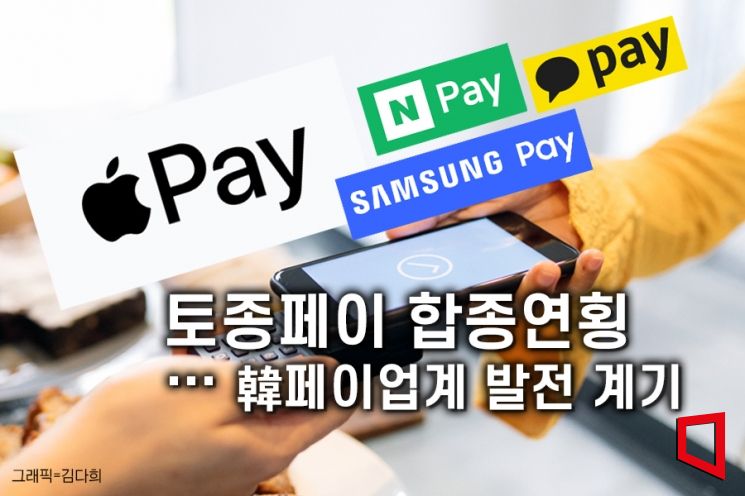
Apple's contactless payment service, Apple Pay, has been officially launched in South Korea. Although there were errors such as device registration delays, explosive popularity has been confirmed. The domestic simple payment industry, including online-based Naver Pay and Kakao Pay and offline-focused Samsung Pay, is also forming alliances, signaling a 'payment war.'
According to industry sources on the 23rd, Samsung Pay began mutual linkage services with Naver Pay from that day. Samsung Pay users can use Samsung Pay at 550,000 Naver Smart Store locations as well as Naver Pay online merchants. This marks a counterattack just two days after Apple Pay officially landed in Korea on the 21st. Kakao Pay is also reportedly discussing integration with Samsung Pay. The emergence of Apple Pay has led domestic 'native' payment services to even form alliances with former rivals.
A 'Major Newcomer' Appears After a Long Time... Challenges to Overcome
Credit card platform Card Gorilla viewed Apple Pay's arrival as a signal for the domestic simple payment market to escape the K-Galapagos (international isolation). They believe that native payment services can strengthen their competitiveness by joining forces against the 'foreign power' Apple Pay.
However, Apple Pay is not yet in a perfect state. While it is a 'traditional powerhouse' overseas, it is still only a 'major newcomer' domestically. Although its influence is significant, with over one million users rushing in, there remain inconveniences and areas for improvement.
First, there is the issue of the distribution of Near Field Communication (NFC) payment terminals, which has been controversial even before the launch. Among the 2.8 million domestic credit card merchants, only about 10% have introduced NFC terminals with EMV technology essential for using Apple Pay. Convenience stores, Homeplus, Costco, and major brands like Lotte and Hyundai Department Stores are rushing to install NFC terminals.
However, the Shinsegae group, which includes E-Mart, Shinsegae Department Store, and Starbucks, currently has no plans to adopt Apple Pay. Since Shinsegae has introduced 'Smile Pay' under Gmarket, a subsidiary of eBay Korea acquired in 2021, and its own 'SSG Pay,' it appears they are monitoring the market while organizing their payment services. Previously, Shinsegae also waited about a year after Samsung Pay's launch in 2015 before forming a partnership.
How is Apple Pay different from Samsung Pay?
However, the operating principles differ. Samsung Pay's MST transmits information using magnetic fields. If there is an existing card payment device, no separate payment terminal is needed. Apple Pay uses NFC chips embedded in devices to send and receive simple information. A dedicated terminal capable of communicating with the user's device is required. Transportation cards are a representative example.
Currently, NFC terminals compatible with Apple Pay display a contactless payment symbol resembling a sideways Wi-Fi icon. Most Apple Pay-supported merchants display this symbol or the Apple Pay logo. These terminals are mainly distributed among large franchises such as convenience stores and major supermarkets. However, adoption is still low in individually operated stores. Typically, payment terminal purchase and installation are handled through VAN (Value Added Network) companies. Large franchises can contract with VAN companies at the headquarters level to supply terminals cheaply or support installation costs for each store owner, but self-employed individuals must install them themselves. The installation cost of NFC terminals is about 200,000 KRW, plus various fees and maintenance costs, which discourages adoption.
Currently Only Hyundai Card is Supported... "Will Naturally Resolve Over Time"
Another limitation is that only Hyundai Card is currently supported. Earlier this year, Hyundai Card gave up exclusive rights to facilitate Apple Pay's domestic launch. However, Apple has not accepted partnership requests from other companies or has delayed them, effectively granting Hyundai Card 'priority,' allowing it to enjoy a near-monopoly.
There are also restrictions within Hyundai Card. Only Visa and MasterCard co-branded cards issued by Hyundai Card or domestic-only credit and check cards can be registered and used with Apple Pay. American Express co-branded cards issued by Hyundai Card are currently not supported.
Nevertheless, enthusiasm for Apple Pay is unlikely to fade quickly. According to a survey conducted by Card Gorilla, 57% responded that they would use Apple Pay first with Hyundai Card. More than half said they would obtain a Hyundai Card just to use Apple Pay.
Card companies are not in a hurry. Since usage locations are limited and early participation in Apple Pay partnerships could increase terminal distribution costs, they are cautious. The industry views the expansion of Apple Pay-compatible cards as a natural progression. A representative from a major card company explained, "From Apple's perspective, having more card companies willing to use the service means more fee revenue, so they will naturally lift restrictions limiting it to Hyundai Card. Eventually, it will move toward registering cards from multiple companies, like Samsung Pay or Naver Pay."
Escaping the 'K-Galapagos' vs. Playground for Giants
While consumers will have more choices, there are concerns that the cost may increase. Unlike Samsung Pay, Apple Pay charges a fee per transaction. In the U.S., a fee of about 0.15% per transaction has been applied, and in Russia, about 0.12%. Hyundai Card has not disclosed specific fee rates, but it is estimated that Apple demanded a fee of around 0.10?0.15% domestically.
According to the Korea Financial Telecommunications & Clearings Institute, as of February this year, the cumulative usage amount of personal credit, debit, and check cards from eight major domestic card companies (Lotte, BC, Samsung, Shinhan, Woori, Hana, Hyundai, KB Kookmin) was 129.8479 trillion KRW. Even a 0.10% fee would amount to about 13 billion KRW in fees.
If Samsung Pay also starts charging fees per transaction following Apple Pay's introduction, it will be a significant burden for card companies. Although the Financial Services Commission emphasized at the time of Apple Pay's approval that "card companies should not pass Apple Pay-related fees and costs onto customers (reflected in terms and conditions) or merchants (based on existing legal interpretations)," they may respond by reducing various benefits such as interest-free installments.
Seo Ji-yong, president of the Korea Credit Card Association and professor of business administration at Sangmyung University, pointed out, "Card companies may shorten or change benefit periods to avoid losses. Before such cost shifting occurs, the Financial Services Commission should supplement the Specialized Credit Finance Act, or the Fair Trade Commission should intervene to limit fee rates for foreign companies."
© The Asia Business Daily(www.asiae.co.kr). All rights reserved.
![Clutching a Stolen Dior Bag, Saying "I Hate Being Poor but Real"... The Grotesque Con of a "Human Knockoff" [Slate]](https://cwcontent.asiae.co.kr/asiaresize/183/2026021902243444107_1771435474.jpg)












