Sangmok Choi Senior Official "No Restrictions on Upgrades or Equipment Replacement"
Briefing to Korea Before Announcement Following Close Consultations with the US
The Presidential Office stated on the 22nd that it "judges there will be no disruption to the operation of manufacturing facilities held by our companies in China" regarding the detailed regulations of the semiconductor law (CHIPS Act) guardrail provisions of the U.S. government.
Choi Sang-mok, Senior Secretary for Economic Affairs, said at a briefing held at the Yongsan Presidential Office on the same day, "According to the detailed regulations announced by the U.S., advanced semiconductor manufacturing facilities in countries of concern such as China can expand up to 5% over 10 years based on wafer input, and there are no restrictions on technology upgrades. Legacy semiconductor manufacturing facilities can expand up to 10% over 10 years."
Choi added, "There are no limits on the number of very important technology upgrades and equipment replacements to secure market competitiveness," and "Through technology upgrades and increased integration, the number of chips produced per wafer can increase, so additional production capacity expansion is expected to be possible."
Regarding this, the Presidential Office judged that it is the result of close consultations between our government and the U.S. government since last year. Choi said, "Since August last year, President Yoon has actively requested sufficient support for our companies from the U.S. side during meetings with U.S. political figures such as President Joe Biden at the Korea-U.S. summit, Vice President Kamala Harris, and numerous members of Congress, along with cooperation in advanced industries between Korea and the U.S. At the same time, under President Yoon's strong directive, the Presidential Office has been conducting close consultations with the U.S. government through the White House National Security Council (NSC) channel. Even before this announcement, we received advance briefings on the key details of the regulations from the U.S. government, maintaining close communication," he explained.
Regarding trade issues such as the Inflation Reduction Act (IRA) electric vehicle tax credit guidance expected to be announced by the end of March, he said, "We will work closely with the U.S. to ensure that the interests of our companies are sufficiently reflected," and emphasized, "The government will carefully coordinate and cooperate with the U.S. government during the enactment and operation of U.S. laws and systems to minimize the burden on our companies and maximize their benefits with even more special and meticulous attention."
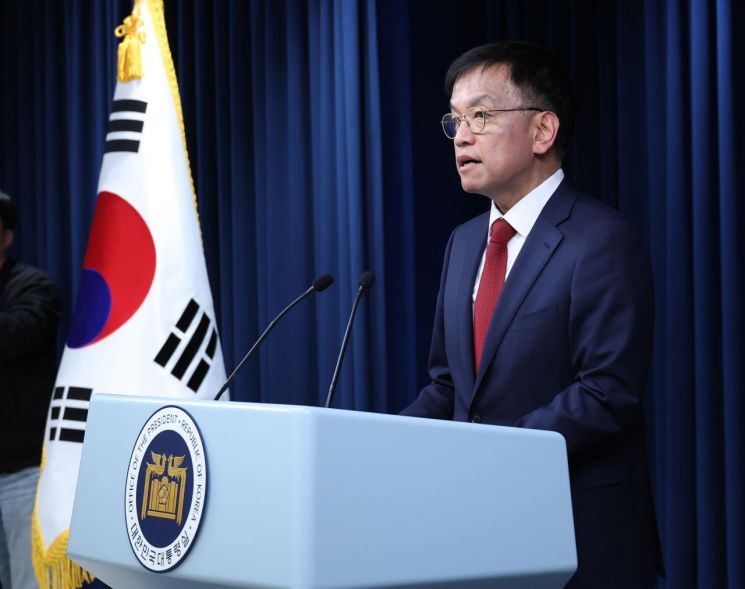
In response to a reporter's question, "'Regarding the guardrail provisions, advanced semiconductors are allowed to expand up to 5%, and the facility investment limit is restricted to $100,000, making investment practically difficult. Isn't this effectively a signal to exit the semiconductor business in China within 10 years?'" Choi replied, "I understand that the $100,000 is per case, and after inquiring with companies, we received answers that this part is not a big problem."
He continued, "In the mid to long term, it is clear that the U.S. made these regulations with certain purposes regarding countries of concern such as the Chinese economy. The idea is to share the benefits we share with allies together," and added, "I am saying this with the intention of minimizing damage to our companies and maximizing their benefits going forward."
© The Asia Business Daily(www.asiae.co.kr). All rights reserved.
![Clutching a Stolen Dior Bag, Saying "I Hate Being Poor but Real"... The Grotesque Con of a "Human Knockoff" [Slate]](https://cwcontent.asiae.co.kr/asiaresize/183/2026021902243444107_1771435474.jpg)
















