China Records Third 'Severe Pollution' in March Alone
Air Quality on Korean Peninsula Worsens Due to Yellow Dust Impact
As spring yellow dust originates, Beijing, the capital of China, has recorded the worst air quality three times this month alone, while recently the Korean Peninsula has also experienced consecutive days of hazy air due to fine dust.
On the 22nd, the worst yellow dust occurred in Beijing, prompting a yellow dust yellow alert. China's yellow dust alerts are divided into four levels: blue, yellow, orange, and red, with the red alert indicating the most severe pollution.
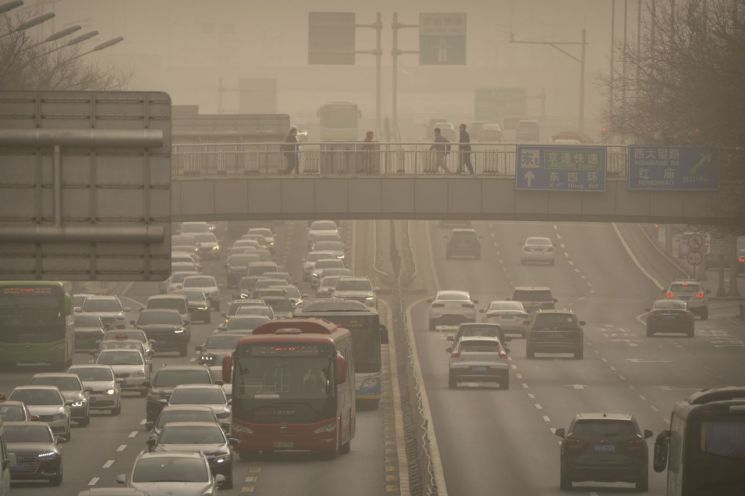 The central business district of Beijing, China, was shrouded in haze due to yellow dust on the 22nd. As of 8 a.m. that day, the Air Quality Index (AQI) across Beijing recorded the worst level, Grade 6 "Severe Pollution." The main pollutant was fine dust (PM 10). Photo by AP and Yonhap News.
According to the Beijing Environmental Protection Monitoring Center, the Air Quality Index (AQI) across Beijing on that day recorded the worst level, grade 6 'Severe Pollution.' This is the third time this month that the AQI has exceeded the maximum measurable level, following the 10th and 14th. The main pollutant was fine dust (PM 10).
China's AQI is divided into six levels: Excellent (0?50㎍/㎥), Good (51?100㎍/㎥), Light Pollution (101?150㎍/㎥), Moderate Pollution (151?200㎍/㎥), Severe Pollution (201?300㎍/㎥), and Severe Pollution (301?500㎍/㎥), with 500㎍/㎥ being the highest level currently displayable.
This yellow dust originated on the 21st from the Gobi Desert and the Inner Mongolian Plateau. The National Institute of Environmental Research forecasted that additional yellow dust would originate from the Manchuria region on the 22nd, and that the yellow dust would travel southeastward with the northwest wind, affecting South Korea. The institute stated, "On the 23rd, fine dust concentrations are expected to be high, especially along the west coast." However, the range, concentration level, and duration of domestic impact are variable depending on additional origins and air currents.
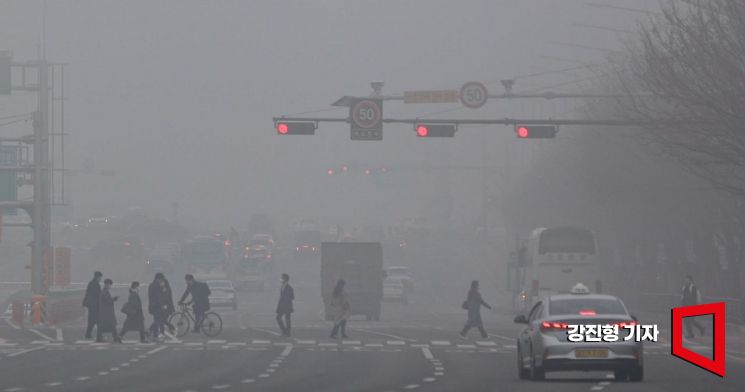 On the 20th, when the emergency fine dust reduction measures were implemented in the metropolitan area, Yeouido, Seoul was shrouded in fine dust accompanied by fog. Photo by Jinhyung Kang aymsdream@
Recently, South Korea's air quality has deteriorated due to the influence of yellow dust. Earlier, on the 10th, when China recorded its first AQI 'Severe Pollution' of the year, Seoul's fine dust concentration also temporarily rose to the 'Bad' level, causing the city to appear hazy with reduced visibility.
On the 15th, in Baengnyeongdo, after yellow dust originating from the Inner Mongolian Plateau and the Gobi Desert in China was observed, fine dust concentration rose to 127㎍/㎥. Later, around 9 p.m., yellow dust from China began to be observed in Seoul, causing the fine dust concentration in Seoul to surge from 50㎍/㎥ at 6 p.m. to 156㎍/㎥.
On the 20th, Seoul's ultrafine dust concentration (PM 2.5) recorded 'Very Bad,' leading to the issuance of an ultrafine dust crisis alert at the 'Interest' level for Seoul, Incheon, and Gyeonggi regions, and emergency reduction measures were implemented. On the 21st and 22nd, fine dust concentrations again recorded 'Bad.'
On days with high fine dust concentrations, outdoor activities should be minimized as much as possible, but if going outside is unavoidable, it is recommended to wear a health mask. Health mask packaging indicates particle blocking performance with ▲KF80 ▲KF94 ▲KF99. The higher the KF number, the higher the fine dust blocking rate: KF80 can filter out more than 80% of fine particles averaging 0.6㎛ in size, while KF94 and KF99 can block 94% and 99% or more of particles averaging 0.4㎛, respectively.
If the hazy air causes eye discomfort, it is advisable to frequently use artificial tears that can wash away fine dust. However, when using disposable artificial tears, microplastics may enter the artificial tears upon opening, so the first one or two drops should be discarded before use.
© The Asia Business Daily(www.asiae.co.kr). All rights reserved.
![Clutching a Stolen Dior Bag, Saying "I Hate Being Poor but Real"... The Grotesque Con of a "Human Knockoff" [Slate]](https://cwcontent.asiae.co.kr/asiaresize/183/2026021902243444107_1771435474.jpg)

















