Jang Hye-young "Investment for the Rich, Cost for the Poor?"
Shin Dong-geun "Wavering Attitude Fails to Inspire Trust in Economic Actors"
Bae Jun-young "Attention Needed for Semiconductor Talent Development"
After many twists and turns, the 'K-Chips Act (Amendment to the Restriction of Special Taxation Act)' to support national strategic industries such as semiconductors passed the National Assembly's Planning and Finance Committee on the 22nd. However, during the plenary session of the committee held that day, concerns were repeatedly expressed regarding issues such as the tax revenue shortfall caused by the bill's passage, talent development, and crises in the domestic semiconductor and electric vehicle industries.
The amendment to the Restriction of Special Taxation Act passed by the Planning and Finance Committee that day legally defines semiconductors, secondary batteries, vaccines, displays, hydrogen, and future mobility (electric vehicles) as national strategic technologies. The main point is to raise the tax credit rate for facility investments in these industries from the current 8% to 15% for large and medium-sized enterprises, and from the current 16% to 25% for small and medium-sized enterprises. Previously, the ruling and opposition parties agreed at the end of last year to raise the tax credit rate for large corporations from 6% to 8%, but following President Yoon Seok-yeol's related remarks and the semiconductor industry's downturn, additional support was requested from the National Assembly within three months.
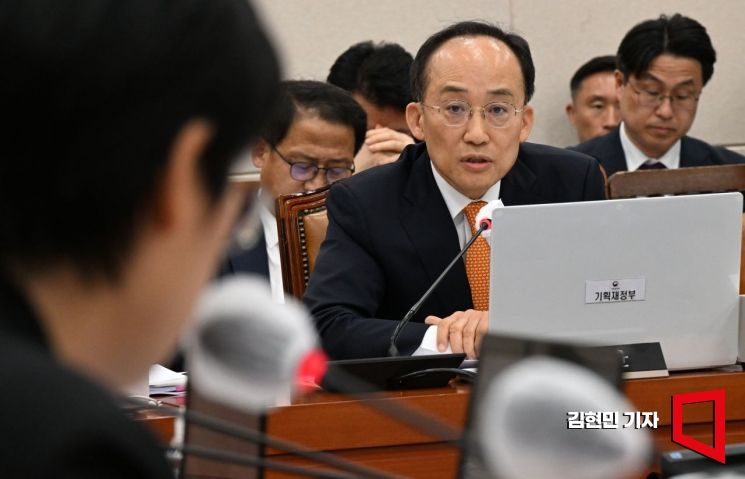 Deputy Prime Minister and Minister of Economy and Finance Choo Kyung-ho is responding to lawmakers' questions at the plenary meeting of the Planning and Finance Committee held at the National Assembly in Yeouido, Seoul, on the 22nd. Photo by Hyunmin Kim kimhyun81@
Jang Hye-young, a Justice Party lawmaker, pointed out the tax revenue shortfall before the agenda vote during the plenary session and questioned Deputy Prime Minister and Minister of Economy and Finance Choo Kyung-ho on the necessity of the amendment. Citing the Ministry of Economy and Finance's efforts to introduce fiscal rules, Jang said, "It is reasonable to worry about the tax revenue shortfall given the poor economic situation in South Korea. However, I have never heard a convincing explanation from the Ministry of Economy and Finance, which is trying to pass a semiconductor tax credit that definitely reduces tax revenue but whose effects are uncertain."
Earlier, the Ministry of Economy and Finance estimated that this measure would reduce additional tax burdens by about 3.65 trillion won in semiconductors and other sectors. It also forecasted that annual tax revenue would decrease by 1.37 trillion won in 2025 and 2026.
In response, Jang said, "I requested a budget increase of 1.3 trillion won related to mobility rights for the disabled, but the Ministry of Economy and Finance only reflected 10.6 billion won," raising issues of fairness. He added, "(Meanwhile) the semiconductor law is effectively cutting 7.3 trillion won over five years for Samsung Electronics and SK Hynix. Giving money to the rich is called investment, but giving it to the poor is called an expense, which is incomprehensible. I cannot accept this in good conscience."
Yang Kyung-sook, a Democratic Party lawmaker, also said, "We need to pay attention to criticisms that tax credits for conglomerates are excessive," and urged the government to prepare support measures such as introducing a 'windfall tax' on excess profits and supporting vulnerable groups.
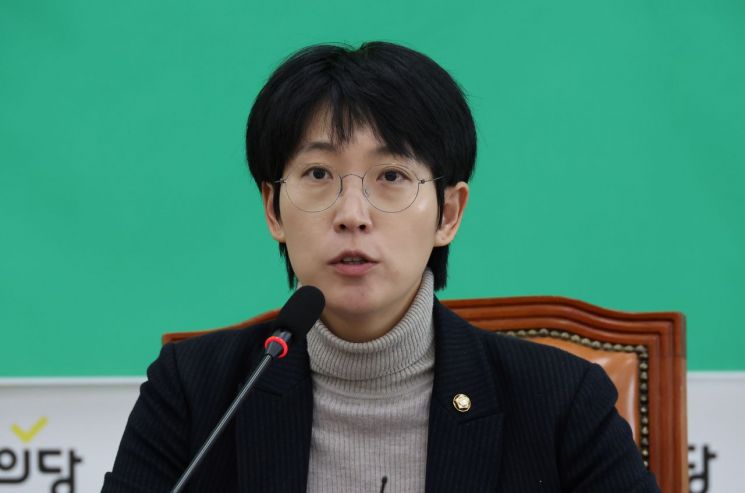
Shin Dong-geun, a Democratic Party lawmaker, criticized the confusion caused by the government's inconsistent policy implementation. He targeted the fact that the amendment to the Restriction of Special Taxation Act, passed with bipartisan agreement about three months ago, was brought back to the Planning and Finance Committee agenda following President Yoon's directive. Shin said, "Since the Yoon Seok-yeol administration took office, situations like the 69-hour workweek and policies for 5-year-old children have shown immature policies and miscommunication, causing confusion repeatedly. Can economic agents trust this? Although it was passed, special attention must be paid."
He continued, "Various legal aspects have been supported domestically, but now the government must bring solutions to this issue. We need measures on how to handle things during certain boom periods. The U.S. has a system to recoup profits, so we also need to create measures based on grounds for contribution," he expressed.
Kim Young-sun, a People Power Party lawmaker and chair of the National Assembly's Special Committee on Population Crisis, emphasized that the amendment should be linked to future low birthrate measures.
Kim said, "The tax credit is not a one-time event but a continuous investment for the survival of our country," and warned, "If this investment does not lead to systems such as fostering local talent and guaranteeing a free working environment for women, it could become an investment solely for companies, as some lawmakers worry."
Bae Jun-young, a People Power Party lawmaker, suggested that the Ministry of Economy and Finance needs to make more efforts to nurture talent, which is the foundation for the development of the semiconductor industry. Bae said, "Talent development and education are under the Ministry of Education's jurisdiction, but since the content to foster national strategic industries such as semiconductors is being finalized, inter-ministerial consultation is necessary from the perspective of talent development." Deputy Prime Minister Choo responded, "We are expanding incentives in local areas to avoid misunderstandings. While tax support is good, nurturing talent in advanced national strategic technologies is truly important."
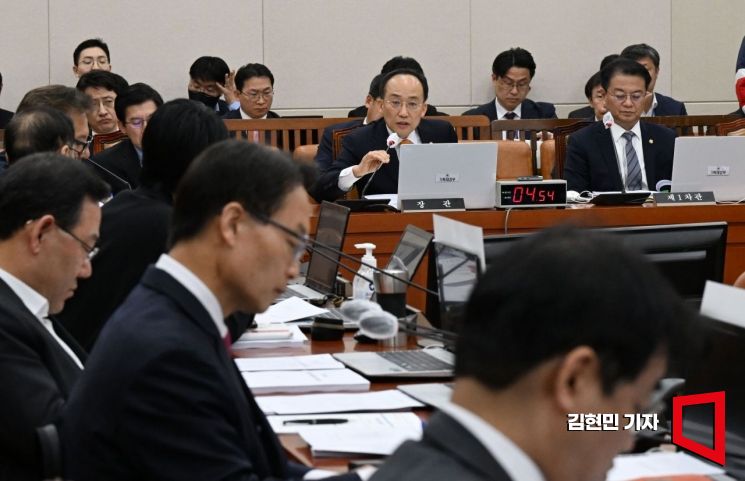 Deputy Prime Minister and Minister of Economy and Finance Choo Kyung-ho is responding to lawmakers' questions at the plenary meeting of the Planning and Finance Committee held at the National Assembly in Yeouido, Seoul, on the 22nd. Photo by Hyunmin Kim kimhyun81@
Questions also followed regarding the inclusion of future mobility (electric vehicles) in the amendment from the Democratic Party's perspective. Hong Young-pyo, a Democratic Party lawmaker, pointed out, "The amendment does not apply when existing internal combustion engine factories assembling finished vehicles are converted to electric vehicles or eco-friendly future mobility," and warned, "If factories close, thousands of workers will lose their jobs."
In response, Deputy Prime Minister Choo said, "I think it is difficult to apply national strategic technology status to simple electric vehicle assembly," explaining, "This is because the technology is recognized as important for national security and has an impact on the overall national economy." Hong reiterated, "I am raising this out of concern," and argued, "The U.S. Inflation Reduction Act (IRA) grants benefits when production plants are newly built or facilities are upgraded."
Hong Sung-guk, a Democratic Party lawmaker, also emphasized, "We cannot rely on past standards or practices and think that time will solve everything," urging, "I hope we change our mindset to a wartime footing."
Meanwhile, the amendment passed by the Planning and Finance Committee is expected to be voted on at the National Assembly plenary session on the 30th of this month.
© The Asia Business Daily(www.asiae.co.kr). All rights reserved.



















