The Japanese government will lift export restrictions on three major semiconductor production items?hydrogen fluoride, fluorinated polyimide, and photoresist?within this week. In response, the South Korean government plans to complete the withdrawal procedure of its World Trade Organization (WTO) complaint against Japan by the end of this week.
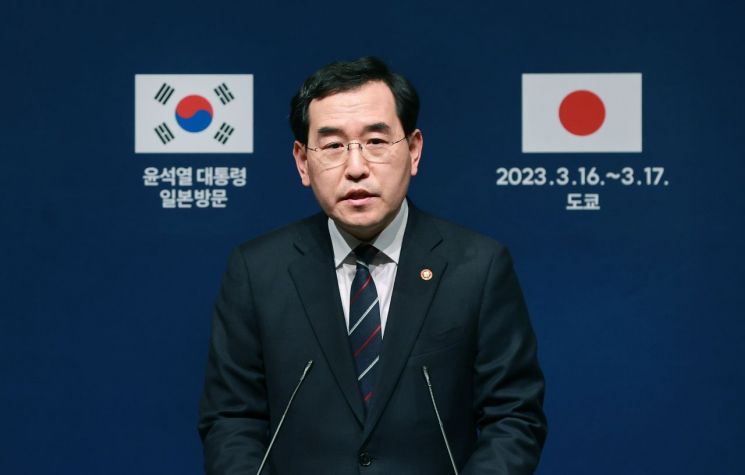
On the 22nd, Lee Chang-yang, Minister of Trade, Industry and Energy, explained the outcomes of President Yoon Suk-yeol’s two-day visit to Japan starting on the 16th during a press briefing at the Government Complex Sejong. Minister Lee stated, "The lifting of export restrictions on the three items by Japan and South Korea’s withdrawal of the WTO complaint are expected to be finalized within this week. Our government will initiate revisions to the strategic goods export-import notification, including administrative notice, within this week and will pursue consultations with Japan for the prompt restoration of the whitelist."
From the 14th for three days, the Ministry of Trade, Industry and Energy held the 9th Export Control Policy Dialogue with Japan’s Ministry of Economy, Trade and Industry, announcing the resolution of Japan’s export restrictions that began in July 2019. The Japanese government shifted the export licensing for hydrogen fluoride, fluorinated polyimide, and photoresist?essential for semiconductor and display production?from individual permits to a special general comprehensive license. Following the lifting of Japan’s export restrictions, South Korea withdrew the dispute settlement procedure at the WTO, which had been filed in September 2019, citing Japan’s export restrictions as retaliatory measures. As consultations regarding Japan’s whitelist designation are ongoing, the plan is to promote a swift restoration through close dialogue with Japan.
To build a future-oriented economic cooperation relationship between South Korea and Japan, Japanese 소재·부품·장비 (Sobu-jang; materials, parts, and equipment) companies will be attracted to the Yongin semiconductor cluster. The plan is for domestic companies with strengths in semiconductor manufacturing to establish a stable supply chain with Japanese Sobu-jang companies to create synergy. For energy security, both countries will jointly respond to resource weaponization. Cooperation in the liquefied natural gas (LNG) sector will be pursued, including efforts to secure LNG ship orders, and joint research and development (R&D) projects will be expanded in future eco-friendly ships and hydrogen reduction steelmaking. Discussions will also be held on joint entry by Korean and Japanese companies into construction, energy infrastructure, and smart city projects, and both countries plan to respond together to the Indo-Pacific Economic Framework (IPEF).
Cooperation channels between the two countries will also be strengthened. Communication channels that had been suspended in steel, energy, and shipbuilding sectors will be resumed, and new cooperation channels will be established in semiconductors, supply chains, hydrogen, and industrial policy fields. Minister Lee said, "Japan has lifted export restrictions on the three items, and both countries will promote close dialogue for the prompt restoration of mutual whitelist measures. This marks the first step in building trust and will serve as a cornerstone for economic cooperation and global supply chain stabilization between South Korea and Japan."
© The Asia Business Daily(www.asiae.co.kr). All rights reserved.

















