Kishida to Hold Talks with Zelensky on 21st
Promises Defense Equipment Support to Ukraine
Analysis of Moves Considering China's Mediation Diplomacy
Japanese Prime Minister Fumio Kishida met with Ukrainian President Volodymyr Zelensky on the 21st (local time) and announced additional support of $30 million (39.183 billion KRW) worth of equipment for Ukraine. Prime Minister Kishida defined the diplomatic relationship with Ukraine as a "special global partnership" and took steps to further strengthen the anti-Russian coalition centered around the Group of Seven (G7).
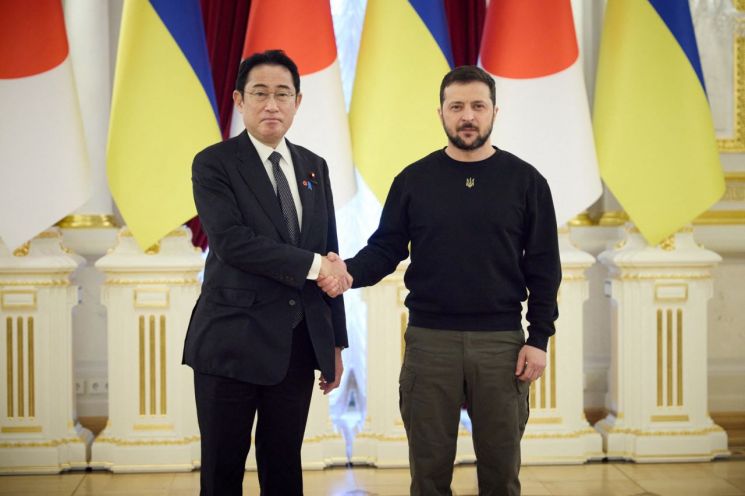 Japanese Prime Minister Fumio Kishida (left) and Ukrainian President Volodymyr Zelenskyy shake hands on the 21st (local time) in Kyiv, the capital of Ukraine.
 [Image source=Yonhap News]
On the day, Prime Minister Kishida met President Zelensky in Kyiv, the capital of Ukraine, and stated, "Russia's invasion of Ukraine is an outrage that shakes the foundation of the international order," expressing strong solidarity with Ukraine. This marks the first time a Japanese prime minister has visited a conflict zone since World War II.
During the talks, Kishida also mentioned specific support policies to aid Ukraine against Russia. First, Kishida promised to provide $300 billion worth of non-lethal equipment to Ukraine through NATO funds. Under Japan's current Self-Defense Forces law, lethal weapons such as ammunition cannot be provided, so Japan has supplied defense equipment like drones and bulletproof vests to Ukraine. Additionally, he pledged $470 million in energy-related support.
Throughout this schedule, Prime Minister Kishida appeared focused on demonstrating to the international community that Japan is actively participating in the anti-Russian front. Before the meeting, Kishida visited Bucha, a northern Ukrainian city where Russian forces committed mass civilian killings, and strongly criticized Russia's invasion, saying, "I feel strong anger."
President Zelensky responded, "I am very pleased that Prime Minister Kishida's visit was realized while Japan is serving as the chair country of the G7 and as a non-permanent member of the United Nations Security Council," and expressed gratitude for Japan's leadership in upholding the international order. He also indicated his intention to attend the G7 summit chaired by Japan via video conference.
Prime Minister Kishida's emphasis on strong solidarity during his visit to Ukraine is interpreted as a strategic move to strengthen ties with Western countries participating in the anti-Russian front and to expand Japan's diplomatic influence. Moreover, Kishida's visit to Kyiv is notable for coinciding with Chinese President Xi Jinping's visit to Moscow, Russia.
Chinese President Xi Jinping, who visited Russia, positioned himself as a mediator between Ukraine and Russia, showcasing his influence on the international stage while clearly signaling his stance alongside countries opposing the United States.
In response, Prime Minister Kishida visited Ukraine to counter China's mediation diplomacy and to demonstrate that Japan shares the same strategic values of the anti-Russian front with the United States and other G7 countries.
The Nihon Keizai Shimbun analyzed, "Japan, as the chair country of the G7, judged that it must appeal to the international community about the importance of rule-based order under international law," adding, "This visit also aims to counter China's mediation diplomacy."
On the 22nd, Prime Minister Kishida plans to visit Poland to hold a summit with Polish Prime Minister Mateusz Morawiecki to discuss the Ukraine situation, and then return to Japan on the 23rd.
© The Asia Business Daily(www.asiae.co.kr). All rights reserved.

















