Guroda Sankei Editorial Writer, YTN Radio Interview
"Not a discussion, but a principled statement from the Japanese side"
"It is also true that the Korean side said they did not make such a statement"
Katsuhiko Kuroda, guest editorial writer for the Sankei Shimbun, analyzed that although the Japanese side likely brought up Dokdo and the comfort women issue during the Korea-Japan summit, the Korean side probably ignored it.
Earlier, Japanese media including NHK reported that Japanese Prime Minister Fumio Kishida "requested the Korean side to faithfully implement the past bilateral agreement on the comfort women issue during the (talks with President Yoon)." It was also reported that Chief Cabinet Secretary Seiji Kihara said in a briefing after the summit that "the Dokdo issue was included." The Korean government stated that there was no discussion on Dokdo or comfort women, leading to a dispute over the truth in the political sphere.
Regarding this, Kuroda explained in an interview on June 22 with YTN Radio's 'News King Park Ji-hoon' that "the Japanese side made principled remarks, and it is also true that the Korean side said 'we did not talk about that.'"
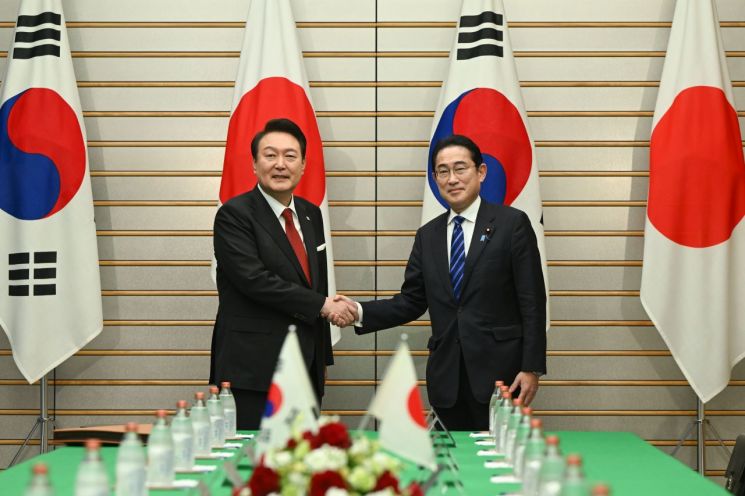 President Yoon Suk-yeol and Japanese Prime Minister Fumio Kishida shake hands while posing for a commemorative photo ahead of the expanded Korea-Japan summit held at the Prime Minister's Official Residence in Tokyo on the afternoon of the 16th.
 [Image source=Yonhap News]
He said, "After the summit, reporters conduct informal interviews asking about 'the atmosphere' and so on. Since it was the first summit in a while, it is natural to ask whether issues like Dokdo, comfort women, and GSOMIA were mentioned, and it seems the Korean side did not respond to such questions."
In particular, Kuroda analyzed, "Although it was not a discussion, Japan probably brought up the issues. From the Korean side, President Yoon likely simply ignored what Japan said."
Regarding the domestic controversy over whether the comfort women and Dokdo issues were mentioned at the summit, he said, "In diplomacy, it is customary to formally express one's position. There is no need to interpret it as something particularly significant, and territorial issues like Dokdo were not the focus of this summit."
He also commented on the domestic political situation, saying, "The opposition party is strong, and there seems to be a domestic political circumstance aiming to criticize the Yoon Seok-yeol administration. The issue is not big, but it seems to be causing controversy in Korea as if it were a major problem."
When asked about the Sankei Shimbun's report mentioning comfort women, he added, "Sankei is also a conservative media outlet and keeps in mind Japanese public opinion and national sentiment. Since diplomacy naturally involves expressing each other's positions, there is no need to be provoked."
© The Asia Business Daily(www.asiae.co.kr). All rights reserved.
![Clutching a Stolen Dior Bag, Saying "I Hate Being Poor but Real"... The Grotesque Con of a "Human Knockoff" [Slate]](https://cwcontent.asiae.co.kr/asiaresize/183/2026021902243444107_1771435474.jpg)
















