People Power Party Regulatory Reform Promotion Team Policy Debate
Government and Ruling Party Proposal to Improve Industrial Complex Location Regulations Unveiled
"Support for Rapid Development of 15 National Industrial Complexes"
"One-Year Reduction Through Establishment of Negative Zones and Mixed-Use Sites"
"Strengthened Verification of Actual Demand Can Advance Timeline by 2 Years"
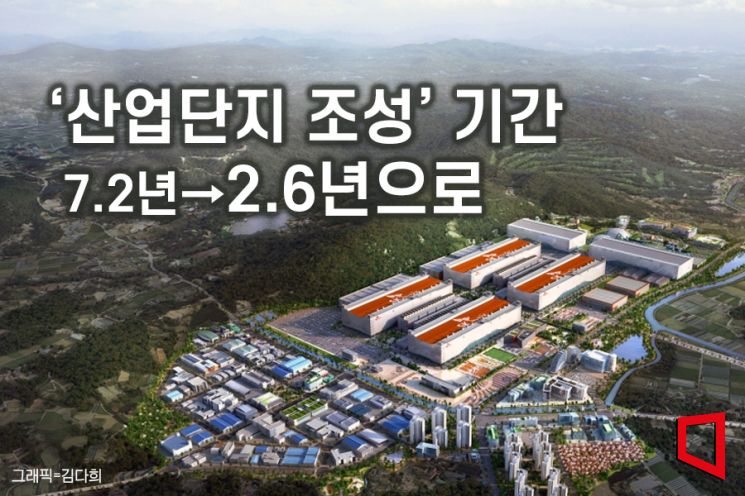
The ruling party and government are pushing to shorten the industrial complex development period, which currently takes over seven years, to two years and six months. With the government recently deciding to establish advanced industrial complexes in 15 regions nationwide to foster the semiconductor industry, related legislation is expected to accelerate.
On the afternoon of the 22nd, the People Power Party's Regulatory Reform Promotion Team will unveil the "Regulatory Reform Promotion Plan for Revitalizing Industrial Complexes" at a policy discussion on improving industrial complex location regulations held at the National Assembly, and will begin gathering public opinion. Jang Cheol-soon, Honorary Commissioner of the Korea Research Institute for Human Settlements (KRHIS), who is in charge of the presentation, will propose measures to shorten the average domestic industrial complex development period of about seven years by approximately four years and six months.
Industrial Complex Development Period Reduced from 7 Years 2 Months to 2 Years 6 Months through System Improvements
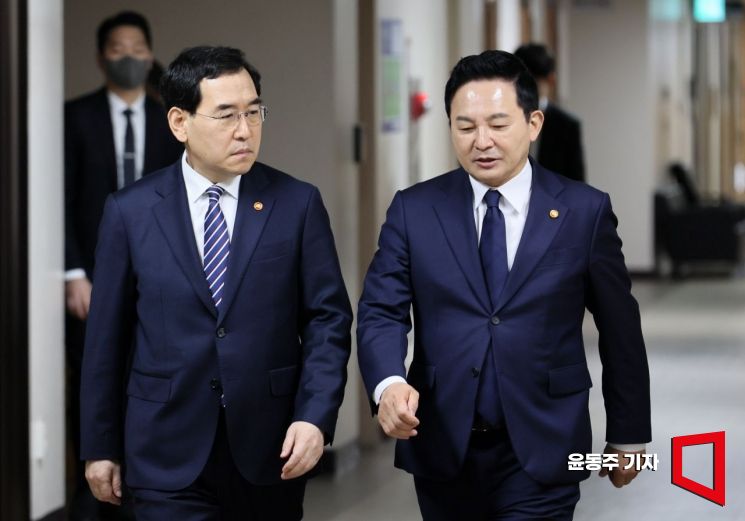 Minister of Land, Infrastructure and Transport Won Hee-ryong and Minister of Trade, Industry and Energy Lee Chang-yang are entering the press conference room on the 15th at the Government Seoul Office in Jongno-gu, Seoul to announce the "National Advanced Industry Development Strategy (including candidate sites for national industrial complexes)." Photo by Dongju Yoon doso7@
First, actively utilizing negative zones can shorten the sales completion period by six months. Negative zones are areas where restrictions on industries that can enter the industrial complex are lifted. Introduced in May 2020 in response to criticisms that restricting industries in industrial complexes hindered the fostering of new industries, expanding these zones is expected to promote industrial clustering and sales activation. Commissioner Jang predicted, "Expanding areas without restrictions on industries to be attracted will contribute to promoting industrial clustering and revitalizing sales."
Additionally, allowing the establishment of small-scale mixed-use sites within the industrial complex without changing the development plan can reduce the development period by six months. Furthermore, by preparing a planned supply plan for utilities such as electricity and gas when developing the industrial complex, the development period can be further shortened by six months.
Most importantly, securing candidate sites that can be developed in advance can reduce the development period by about one year, and strengthening real demand verification during the development stage can shorten it by two years. Since changing land use plans takes a considerable amount of time, timely supply is difficult. However, if the supply scale and location are designated in advance during the urban basic plan stage, the development procedures can be reduced, enabling early supply. Also, strengthening the real demand verification conducted by national and local governments before establishing the industrial complex development plan significantly reduces the land acquisition and farmland consultation period. Commissioner Jang cited examples such as raising the land acquisition ratio standard to over 30% and including more than 30% agricultural promotion areas. Removing such regulations is expected to shorten the total development period by about four years and six months.
The Korea Research Institute for Human Settlements is a government-funded research institute under the Ministry of Land, Infrastructure and Transport. The content announced on this day is effectively the government's ruling party's plan to improve industrial complex location regulations. Previously, the government announced plans to establish the world's largest semiconductor mega cluster in Yongin, Gyeonggi Province, and advanced industrial complexes in 15 regions nationwide, with the ruling party supporting this initiative. A representative from the office of Representative Hong Seok-jun, who hosted the discussion, said, "We have consulted with the Ministry of Land, Infrastructure and Transport and the Ministry of Trade, Industry and Energy, and most of the measures address issues pointed out by the industry. Since both ruling and opposition parties agree on fostering the semiconductor industry, we will expedite the passage of legislation so that it can be applied to the semiconductor cluster."
Environmental Impact Assessment for Yongin Semiconductor Cluster Takes 21 Months
According to KRHIS, the industrial complex development process involves the government establishing and designating a development plan, followed by preparing and approving an implementation plan, then developing and selling the industrial complex. Currently, 1,276 industrial complexes are designated nationwide. Of these, 942 have been completed, 264 are under development, 28 are preparing compensation, and 41 are undergoing compensation.
On average, it takes 7 years and 2 months from designation to completion for these industrial complexes. For 33 national industrial complexes, it took as long as 15 years and 9 months from designation to completion, while complexes designated by local governments took 6 years and 8 months. Urban high-tech complexes and private industrial complexes took 5 years and 2 months and 6 years and 1 month, respectively.
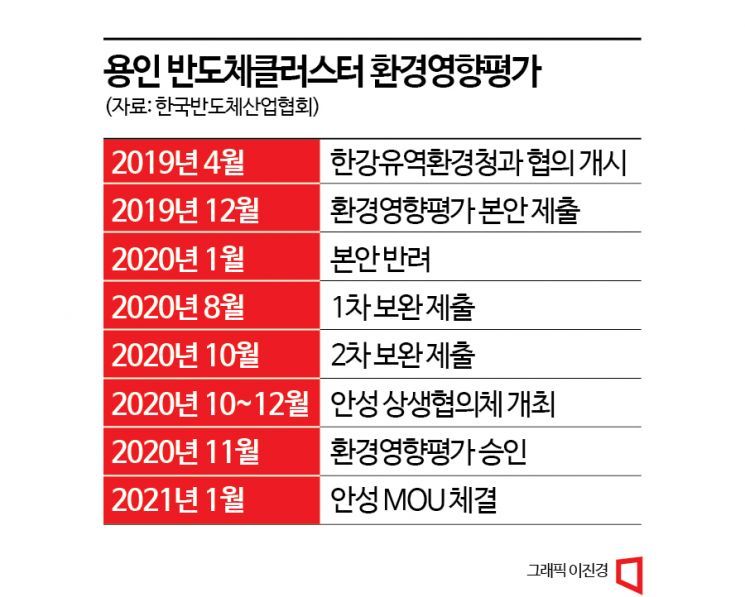
The lengthy time required for industrial complex development is due to delays starting from preliminary administrative procedures. For example, the environmental impact assessment for the Yongin semiconductor cluster took 21 months because wastewater and transmission lines passed through the nearby city of Anseong, which opposed the project, leading to local conflicts. The conflict was resolved when SK, an industrial complex tenant, improved the quality of discharged water, SK Construction developed the industrial complex in Anseong, and they promised compensation if damage occurred due to discharged water.
The land compensation negotiation period for the Yongin semiconductor cluster was also delayed by 12 months. The land compensation process proceeds in the order of site selection, land and fixture survey, compensation plan announcement, appraisal, and compensation negotiation. After site selection in 2019, most residents initially refused the fixture survey but began cooperating from September 2021. As a result, 12% compensation was achieved in February last year, 59.9% in March, leading to submission of the construction start plan, and about 99% of land compensation was completed last month.
It also took 18 months to reach an agreement on water supply. After concluding the environmental impact assessment, the project implementer applied for approval to install water supply facilities in Yongin City, but the process was delayed due to a request for a win-win cooperation plan from Yeoju City, which manages the water intake point. This agreement was reached on the condition that if Gyeonggi Province develops an industrial complex in Yeoju, SK Hynix would attract its partner companies and operate community contribution programs such as promoting Yeoju rice consumption. SK Hynix's Yongin cluster is expected to begin construction in 2025, six years after site selection in 2019, and start operation in 2027.
In contrast, in Japan, when Taiwanese semiconductor company TSMC built its Kumamoto plant, it announced the construction plan in October 2021 and started construction just six months later in April 2022. Samsung Electronics' Austin, Texas plant was selected and started construction by the U.S. government in 1996 and began operation in 1997. Samsung Electronics' Xi'an plant in China also began operation in 2014 after site selection and construction announcement in 2012. Commissioner Jang said in a phone interview, "The difference between foreign countries and Korea lies in preliminary administrative procedures. Environmental impact assessments, consultations with related ministries, and opposition from local residents consume most of the time. If we create measures to simplify these procedures, we expect to shorten the period by at least two years."
Will the Opposition Cross the Threshold?…Opposition Welcomes National Industrial Complexes
Representative Hong plans to submit a bill focused on improving industrial complex regulations in the first half of this year after gathering opinions at the discussion. Legislation is expected to accelerate thereafter. Since the next general election is approaching, there is no disagreement between ruling and opposition parties on supporting industrial complexes that involve local constituency interests. After President Yoon Suk-yeol announced on the 15th of this month the establishment of national advanced industrial complexes in 15 regions nationwide and a private-led investment of 550 trillion won, some opposition party lawmakers expressed their welcome in succession. The government-designated national industrial complexes will be established in 15 regions nationwide, including the Gyeonggi, Chungcheong, Honam, Gangwon, Daegu-Gyeongbuk, and Busan-Gyeongnam areas, with Daejeon, Cheonan, and Cheongju in Chungcheong, and Gwangju, Goheung, Iksan, and Wanju in Honam selected as candidate sites.
Accordingly, Kim Seung-nam of the Democratic Party, representing Goheung, Boseong, Jangheung, and Gangjin in Jeollanam-do; Han Byung-do of the Democratic Party from Iksan, Jeollabuk-do; independent Park Wan-joo (Cheonan Eul); and Kang Hoon-sik of the Democratic Party from Asan Eul, Chungnam, introduced the government's announced semiconductor cluster and stated, "We will immediately begin seeking support measures at the National Assembly level."
© The Asia Business Daily(www.asiae.co.kr). All rights reserved.



















