Increasing the Number of National Assembly Members? Struggling to Quell Criticism
Lee Tan-hee Proposes 'Cut Salaries by Half'
May Escalate to Immunity from Arrest Issues
The controversy over 'expanding the number of lawmakers,' which arose during discussions on electoral system reform, has shifted to the lawmakers' representative privilege of 'salary.' This shift occurred as Lee Tan-hee, a member of the Democratic Party of Korea, raised his voice to cut the salary, which amounts to hundreds of millions of won, in half and then discuss the issue of increasing the number of lawmakers.
Following the arrest consent motion for Ha Young-je of the People Power Party, another parliamentary privilege, the 'immunity from arrest,' is also expected to come under scrutiny.
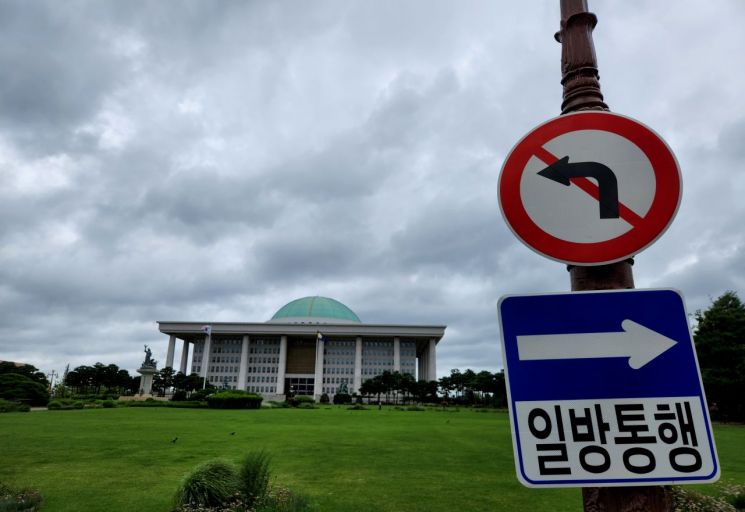
Lawmakers Receive 'Hundreds of Millions in Annual Salary' Even in Prison... Self-Increase Also Under Fire
On the 21st, Lee posted on his social media (SNS), "The average household income in South Korea is 64.14 million won per year, but the salary of a lawmaker is about 155 million won," and urged, "Let's align the salary with the average household income." He added, "Let's become lawmakers who resemble the people, see the world through the eyes of the people, and conduct legislative activities with a sense of the people's daily lives," and said, "Let's first promise the public to cut the salary in half, and then start discussing the number of lawmakers. Only then can we open the hearts of the people and have productive discussions."
Lee's proposal goes one step further than Speaker Kim Jin-pyo, who suggested expanding the number of lawmakers on the premise of a five-year 'salary freeze.' To discuss expanding the number of lawmakers, lawmakers must first show that they are willing to give up their privileges so that the public can accept it. The public is not favorable to increasing the number of lawmakers. In a recent survey by the Special Committee on Political Reform, 57.7% opposed it, which is twice the 29.1% in favor.
The salary, which reaches hundreds of millions of won, is one of the issues frequently mentioned when discussing lawmakers' privileges. Unlike the majority of ordinary citizens who must work to earn their wages, lawmakers receive their salary regularly even if they do not fulfill their duties as lawmakers.
Lawmakers receive their salary even when the National Assembly is paralyzed or stalled due to the confrontation between the two major parties, and even when they are detained. It is newsworthy when lawmakers like Jung Sung-ho of the Democratic Party and Cho Eun-hee of the People Power Party declare, "I will return my salary because I did not work."
The 'self-increase of salary' also raises eyebrows. Unlike ordinary citizens whose companies determine their annual salary, lawmakers can decide their own salary. This is because the salary is determined from the national budget. There is even a joke that lawmakers, who engage in extreme confrontations almost daily, unite in spirit when it comes to this matter.
Will 'Immunity from Arrest' Also Come Under Fire? Ha Young-je's Arrest Consent Motion Soon
Along with the hundreds of millions in salary, the 'immunity from arrest,' another privilege of lawmakers, is expected to become a hot issue. There was already controversy over lawmakers' immunity from arrest during the process of handling the arrest consent motion for Lee Jae-myung, leader of the Democratic Party. The People Power Party, which urged Lee to give up his immunity from arrest, is now on the test bench.
Lee Jeong-mi, leader of the Justice Party, said on BBS's 'Jeon Young-shin's Morning Journal' that "The prosecution requested an arrest warrant for Ha last night, and the arrest consent motion is soon to be submitted to the National Assembly," and added, "(The Justice Party) believes there is no reason for lawmakers to avoid the procedural process of substantive review by the court just because they are lawmakers; that is precisely a privilege. We have been saying this, so we will vote according to that policy."
Previously, the People Power Party urged Lee to give up immunity from arrest and undergo a warrant review, and with Ha's detention as a trigger, the arrest consent motion is expected to be sent to the National Assembly soon, drawing attention to the People Power Party's response. For now, the People Power Party is effectively making 'giving up immunity from arrest' its party stance regarding Ha's arrest consent motion. Joo Ho-young, floor leader of the People Power Party, told reporters, "Lawmakers will make autonomous judgments as constitutional institutions, but since we have repeatedly said we would give up immunity from arrest, I think a decision will be made in that context."
In particular, Kim Ki-hyun, the party leader, visited Lee the day before and said, "We can coordinate well with the Justice Party on abolishing lawmakers' privileges, including immunity from arrest and hiding behind parliamentary immunity." Lee responded, "Giving up privileges starts with oneself," and said, "Regarding this matter, it might be a good opportunity for us to discuss together whether the People Power Party's judgment and Kim leader's sincerity are genuine."
Meanwhile, both ruling and opposition parties, aware of the negative public opinion on expanding the number of lawmakers, are expected to propose an amendment to maintain the current 300-seat quota. Speaker Kim also stated that "the idea of increasing by 50 members is a misunderstanding," and that a realistic increase would be about 10 seats.
© The Asia Business Daily(www.asiae.co.kr). All rights reserved.
![Clutching a Stolen Dior Bag, Saying "I Hate Being Poor but Real"... The Grotesque Con of a "Human Knockoff" [Slate]](https://cwcontent.asiae.co.kr/asiaresize/183/2026021902243444107_1771435474.jpg)
















