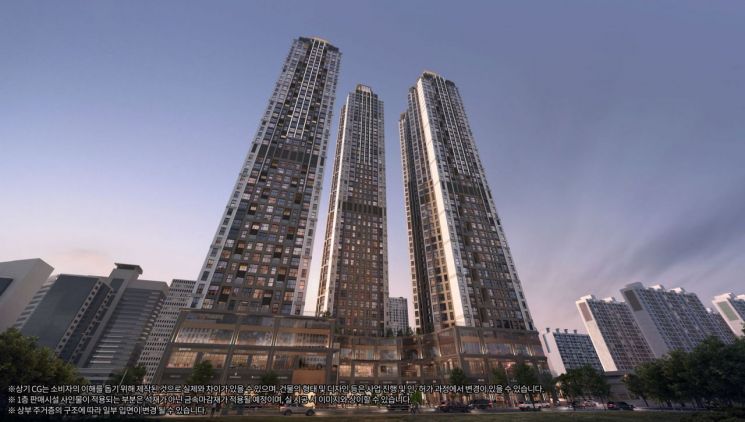
Officetels are evolving to suit the times and circumstances. Industry experts classify officetels into three generations: the 1st generation officetel, primarily small-sized units intended for investment; the 2nd generation officetel, with exclusive areas of 84㎡ where both investment and actual residence purposes emerged; and the 3rd generation officetel, built with exclusive areas of 119㎡ or larger, focusing mainly on actual residence.
Although officetels first appeared before 1990, they were often used as a loophole to avoid housing laws and subscription regulations by being constructed similarly to apartments. Classified as quasi-housing, they could be located in business districts, allowing excellent locations to be utilized for residential purposes.
In this context, a regulation enacted in 2004 restricted floor heating and bathtub installation only to officetels under 50㎡ exclusive area, resulting in supply limited to small types for single-person households. This led to the emergence of the 1st generation officetel, which is commonly associated with officetels today.
Most buyers purchased these units as investments aiming for monthly rental income rather than actual residence, intending short-term profit and quick recovery.
However, as regulations gradually eased, by 2010 officetels under 85㎡ exclusive area began to be classified as residential, allowing floor heating and bathtub installation, which opened the market for 2nd generation officetels.
While short-term investment purposes remained like the 1st generation, demand from those seeking actual residence started to turn to officetels. The marketing term used at the time was 'Apartel,' referring to officetels with apartment-level floor plans.
A key reason officetels began to be used for residence is that, unlike apartments, officetels can be built on commercial land such as right in front of subway stations. They can be located in central commercial districts where residential land use is not permitted, and residents can enjoy the fully developed infrastructure of commercial zones.
However, officetels had limitations such as smaller unit counts and complex sizes compared to apartments, making it difficult to establish community facilities, and area restrictions causing inconvenience depending on the number of residents. Recently, these drawbacks have been addressed by adopting a premium strategy with mid-to-large sized units and large complexes that leverage locational advantages while also enjoying the benefits of apartments, leading to the emergence of 3rd generation officetels.
The 3rd generation officetels consist of large complexes and large floor plans, offsetting the shortcomings of previous officetels. They combine the advantages of officetels and apartments. Since they are not subject to housing regulations applied to apartments, their housing composition is flexible, making premium development easier.
With the emergence of these 3rd generation premium officetels capturing the attention of the 'super-rich (SVIP),' Miraein, a real estate developer leading the high-end residential market by successfully selling Le Pied Munjeong and Le Pied Gangnam in Gangnam, has introduced the 3rd generation officetel 'Grand Le Pied' in Daejeon.
Grand Le Pied is constructed by Daewoo E&C and developed by Miraein, consisting of five buildings with a total of 832 units, exclusive areas of 119㎡ and 169㎡, and reaching the highest height of 47 floors in the Dunsan area. It is set to become a regional landmark in the prime location of Dunsan-dong, Daejeon's representative affluent neighborhood.
Grand Le Pied, as a 3rd generation officetel in Daejeon, boasts community facilities introduced for the first time not only in the nearby area but also in Daejeon, including the indoor swimming pool 'Pied Pool' with three 20-meter lanes and a sunbed lounge zone, and the 'Spa Club' with sauna facilities within the complex. Additionally, various community facilities such as a golf club and fitness club will be established.
It also offers lifestyle convenience services. A hotel-grade concierge service will operate to assist with convenient use of facilities, and an MOU has been signed with Shinsegae Food to provide Daejeon's first premium breakfast service. Notably, this marks Shinsegae Food's first expansion outside the Seoul metropolitan area, adding greater significance.
Grand Le Pied, equipped with luxury amenities spanning approximately 3,600㎡ (about 1,100 pyeong), which are rare even in the metropolitan area, is being built in Dunsan-dong where no other supply is planned, further enhancing its value. It is expected to establish itself as a landmark complex representing the area.
© The Asia Business Daily(www.asiae.co.kr). All rights reserved.
![Clutching a Stolen Dior Bag, Saying "I Hate Being Poor but Real"... The Grotesque Con of a "Human Knockoff" [Slate]](https://cwcontent.asiae.co.kr/asiaresize/183/2026021902243444107_1771435474.jpg)
















