"Why Isn't This Working?" Grandmother Urgently Shouts
Teen Grandson Dies Together, Criminal Investigation Launched
"Responsibility Should Be More on the Manufacturer"
In December last year, a 60-year-old driver, Mr. A, who lost his 12-year-old grandson in a suspected sudden unintended acceleration accident in Gangneung, Gangwon Province, was investigated by the police on the 20th for homicide charges under the Special Act on Traffic Accident Handling. Mr. A claims that the brake pedal did not work at all despite pressing it at the time of the accident. The black box footage from the time captured Mr. A’s panicked voice saying, "Why isn’t this working?"
Although it is suspected that the vehicle’s brakes failed to engage, there are virtually no cases officially recognized as sudden unintended acceleration accidents. This is because it is difficult to identify the cause of sudden unintended acceleration or any vehicle defects. Victims are urging that 'the manufacturer must prove the vehicle defect.'
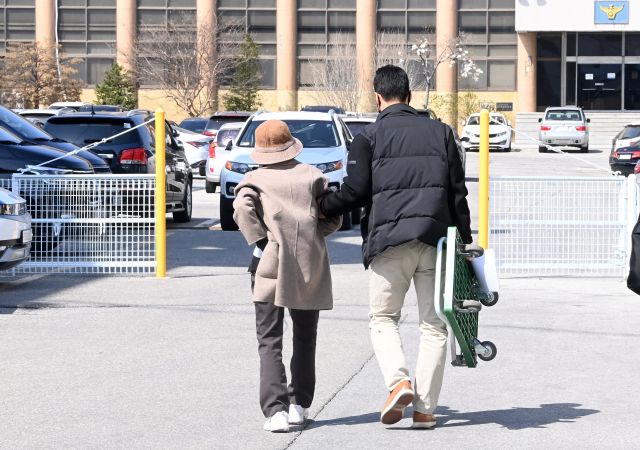 A woman in her 60s, who was booked by the police on suspicion of sudden unintended acceleration in Gangneung, is leaving the police station after completing the investigation on the 20th.
 [Photo by Yonhap News]
In December last year, the sports utility vehicle (SUV) driven by Mr. A with his grandson, Lee Mo, suddenly started to roar and emit smoke as it sped off. After Mr. A’s vehicle collided with the car in front while waiting at a signal, it ran another 600 meters before crashing into an underground passage after crossing a four-lane road, finally coming to a stop. The grandson died in the accident, and Mr. A was also seriously injured.
The black box footage from the accident shows Mr. A shouting in a panicked voice, "Why isn’t this working?" while urgently calling his grandson’s name. It was reported that Mr. A testified during the police investigation that the brakes did not work at all at the time of the accident.
However, the National Forensic Service (NFS) reportedly found no defects in the vehicle body after conducting a detailed inspection. Mr. A’s lawyer criticized the investigation before the police inquiry, saying, "The NFS is trying to blame the grandmother through a sloppy investigation that only inspects hardware without analyzing the software defects that the NFS must investigate, while giving a clean bill of health to the car manufacturer."
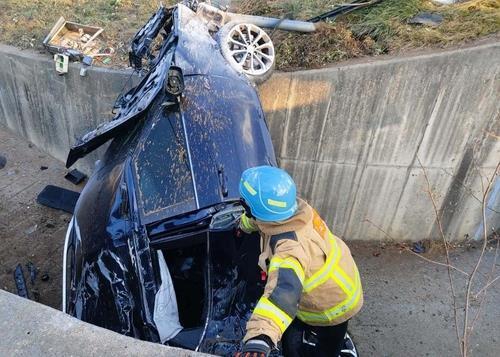 Vehicle suspected of sudden unintended acceleration accident in Gangneung. / Provided by Gangneung Fire Station
He added, "Sudden unintended acceleration accidents occur due to defects in the electronic control unit (ECU) software, which is the car’s main computer and equivalent to the human brain, but the NFS did not analyze this at all and only analyzed the event data recorder (EDR). The software must be analyzed again." If the ECU malfunctions and issues an acceleration command, the connected EDR wrongly records that the driver did not press the brake pedal at all, even though the driver actually pressed it.
Sudden unintended acceleration accidents suspected to be life-threatening occur several times a year. According to the sudden unintended acceleration report status from the Korea Transportation Safety Authority’s Vehicle Recall Center under the Ministry of Land, Infrastructure and Transport, 201 suspected sudden unintended acceleration cases have been reported over the past six years since 2017. However, there has not been a single case where a vehicle defect was recognized. Most suspected sudden unintended acceleration accidents are concluded to be the driver’s fault.
It is difficult to recognize sudden unintended acceleration accidents because it is hard to prove the phenomenon itself. Professor Kwon Yong-ju of the Department of Automotive Design at Kookmin University explained in an interview with YTN The News, "(To prove the accident) the phenomenon of sudden unintended acceleration itself must be reproduced. However, the scientific cause is still unknown," adding, "From the consumer’s perspective, they have no choice but to go to court, but the court also finds it difficult to recognize it due to lack of evidence of sudden unintended acceleration."
Professor Kwon also pointed out that the current law, which requires consumers to prove vehicle defects, should be amended. The current Product Liability Act (Article 3-2) stipulates that the victim must prove the defect in the product and the damage caused by the defect.
Professor Kwon said, "In countries like the United States, manufacturers bear more responsibility for the cause, but in Korea, there is a tendency to recognize fewer defects of manufacturers," and added, "from a consumer protection standpoint, it would be appropriate to hold manufacturers more accountable. At the same time, since manufacturers have not yet identified the cause, the government should step in to invest significant research and time into identifying the cause."
© The Asia Business Daily(www.asiae.co.kr). All rights reserved.
![Clutching a Stolen Dior Bag, Saying "I Hate Being Poor but Real"... The Grotesque Con of a "Human Knockoff" [Slate]](https://cwcontent.asiae.co.kr/asiaresize/183/2026021902243444107_1771435474.jpg)

















