Exports from the beginning of this month until the 20th decreased by 17.4% compared to the same period last year. The trade deficit is likely to continue for the 13th consecutive month as exports of the main item, semiconductors, plummeted by more than 40%.
According to the Korea Customs Service on the 21st, the export amount from March 1 to 20 (provisional customs clearance basis) was $30.945 billion, down 17.4% from the same period last year, and imports were $37.269 billion, down 5.7%. The number of working days during this period was 14.5 days, one day more than the 13.5 days in the same period last year. Considering the number of working days, the average daily export amount was $2.13 billion, a decrease of 23.1%.
Exports have been declining for six consecutive months from October last year to this month. Although imports decreased, the larger decline in exports caused the trade deficit to reach $6.323 billion as of the 20th of this month.
The cumulative annual export amount this year is $127.441 billion, and imports are $151.544 billion, down 13.4% and 1.3%, respectively, compared to the same period last year. Accordingly, the annual trade balance for this year recorded a deficit of $24.03 billion. If the trade deficit continues until the end of this month, it will mark 13 consecutive months since March last year.
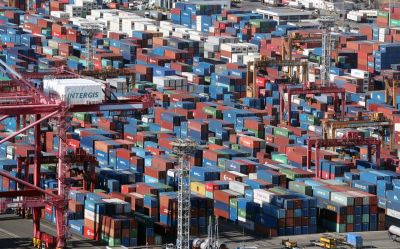
By item, exports of the main item, semiconductors, sharply declined by 44.7% compared to the same period last year until the 20th of this month, marking eight consecutive months of decline. During the same period, exports of passenger cars increased by 69.6%, but there were clear declines in items such as petroleum products (-10.6%), wireless communication devices (-40.8%), and precision instruments (-26.0%). By region, exports to the United States increased by 4.6%, while exports to China (-36.2%), the European Union (EU, -8.9%), Vietnam (-28.3%), Japan (-8.7%), and India (-3.1%) decreased.
Semiconductor exports are likely to remain sluggish in the second quarter due to weak demand for memory semiconductors such as DRAM and NAND and accumulated inventory. In the 'Export Industry Business Survey Index (EBSI),' an indicator showing companies' export business outlook, the semiconductor sector has continued to decline this year. After exceeding 100 in the third quarter (114.3) and fourth quarter (112.0) of last year following the second quarter (88.1), it sharply dropped in the first quarter (73.5) and second quarter (52.0) of this year. The EBSI uses 100 as a baseline, and the lower the number, the more negative the companies' outlook.
During the same period, imports increased for coal (19.4%) and passenger cars (24.5%) compared to the same period last year, but imports of crude oil (-10.3%) and gas (-23.1%), two of the three major energy sources, decreased as the winter season ended. Imports from regions such as China (9.1%) and Taiwan (14.1%) increased, while imports from the United States (-13.9%), the European Union (-2.9%), Japan (-13.9%), and Australia (-24.7%) decreased.
© The Asia Business Daily(www.asiae.co.kr). All rights reserved.

















