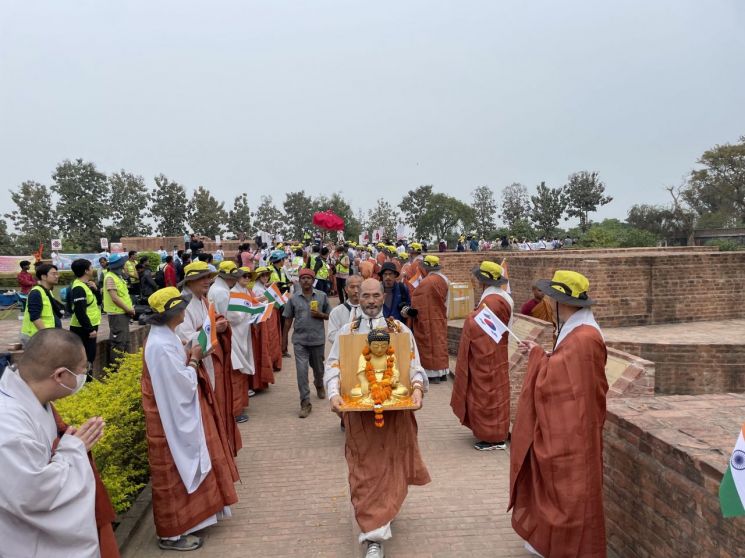
The Sangwol Gyeolsa pilgrimage in India concluded its 43-day grand journey. At 9 a.m. (local time in India), the closing ceremony was held at the Giwon Jeongsa (monastery) in Shravasti, Uttar Pradesh, marking the end of the 1,167 km walking pilgrimage across eight major Buddhist sacred sites in India and Nepal.
According to Sangwol Gyeolsa, Giwon Jeongsa is the place where Buddha Shakyamuni spent the most time in retreat and is also where the teachings of the Diamond Sutra, the minor scripture of the Jogye Order, were expounded. To reflect on this significance, the pilgrimage group enshrined a Korean version of the Diamond Sutra in the building where Buddha resided, called ‘Gandakuti,’ and held a Dharma assembly.
Jinwoo Sunim, the Chief Executive of the Jogye Order, conveyed through the reading by the Chairman of the General Assembly, Jukyung Sunim, “On behalf of all the monks and laypeople of Korean Buddhism, we sincerely respect and thank the Sangwol Gyeolsa pilgrimage group for completing this historic practice that will be etched in the history of our order.” He added, “We pray that the merit of the pilgrimage’s practice spreads throughout the world, bringing a true peaceful world free from war and conflict.” Originally, Jinwoo Sunim was scheduled to attend the Dharma assembly, but it was canceled, and Chairman Jukyung Sunim delivered his congratulatory remarks instead.
Jaseung Sunim, former Chief Executive of the Jogye Order and leader of Sangwol Gyeolsa, said, “Although the path was arduous, we practiced with faith and determination to convey the hope of Buddhism and a new practice and vow,” and described it as “the achievement of all monks, laypeople, and sentient beings.”
The event was attended by Assemblyman Jo Myung-hee of the People Power Party and Assemblyman Kim Young-bae of the Democratic Party of Korea, among others.
The pilgrimage began last month on the 11th at Sarnath in Uttar Pradesh, where Buddha Shakyamuni gave his first sermon. The group then visited the eight major sacred sites, including Bodh Gaya where Buddha attained enlightenment, Lumbini in Nepal where he was born, and Kushinagar where he entered nirvana, concluding the pilgrimage with a closing Dharma assembly at Giwon Jeongsa. The group traveled mostly on foot for the 1,167 km journey.
After safely completing the schedule, the pilgrimage group will travel by car to Lucknow, the capital of Uttar Pradesh, on the 21st, then pass through New Delhi and return to Korea on the 23rd. On the afternoon of the 23rd, a large-scale closing ceremony will be held in front of the Daeungjeon Hall at Jogyesa Temple in Seoul, with a celebratory concert attended by over 15,000 monks and laypeople.
Coinciding with the end of the pilgrimage, a cultural exchange event commemorating the 50th anniversary of Korea-India diplomatic relations will be held in New Delhi from the 22nd to the 25th. The Jogye Order plans to introduce Korean Buddhist culture, including temple food, traditional lanterns used in the Lotus Lantern Festival, Gwaebul (large hanging Buddha paintings), and templestay programs.
© The Asia Business Daily(www.asiae.co.kr). All rights reserved.

















