Comprehensive Tactical Nuclear Training by North Korea... Airburst at 800m Altitude
North Korea has conducted comprehensive tactical nuclear exercises over the past two days, intensifying interest surrounding nuclear war scenarios. The exercises included a drill in which a tactical ballistic missile equipped with a mock nuclear warhead was detonated in the air at an altitude of 800 meters above a target in the East Sea, set at a range of 800 km.
The government stated that there are "some exaggerated parts" in North Korea's announcement, but voices calling for "additional THAAD deployment" are already emerging in the political sphere. Academia predicts that if North Korea's nuclear capabilities increase, it could threaten through various means, including preemptive strikes.
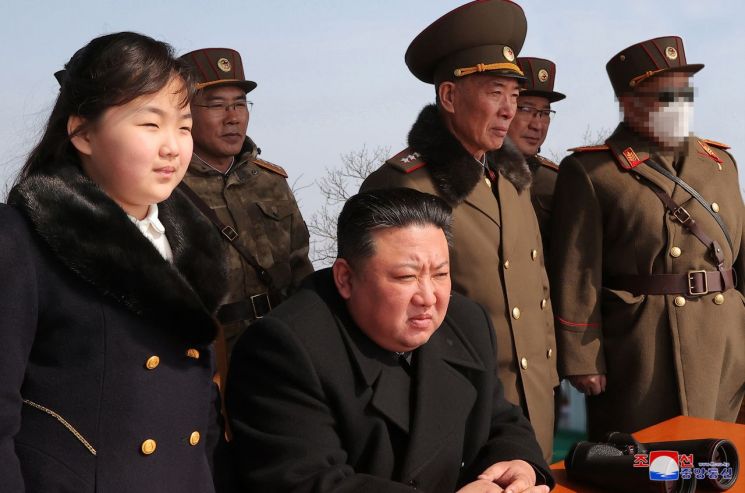
Government: "Some Exaggeration"... Ruling Party Voices Call for "Additional THAAD Deployment"
On the 20th, Shin Beom-chul, Deputy Minister of National Defense, said on SBS's 'Kim Tae-hyun's Political Show,' "According to North Korea's announcement, they claim to have 'completed the detonation test' and later tested the detonation device that explodes nuclear weapons by mounting it on missiles." He added, "Looking at North Korea's recent actions, we confirmed that the propaganda media is reporting somewhat exaggerated information that differs from the facts." This means that the content announced by the propaganda media is somewhat exaggerated compared to what the Ministry of National Defense has identified.
However, Tae Yong-ho, a member of the People Power Party and former North Korean diplomat, emphasized through social media (SNS) on the same day, "If North Korea succeeds in an air nuclear explosion and detonates an EMP bomb over our airspace, not only will our economic sectors be affected, but the radar, aircraft, air defense systems, fighter jets, and fleets of South Korea and the U.S. will instantly lose control functions, causing crashes or disabling defense capabilities." He stressed, "We need to seriously reconsider the additional THAAD deployment plan that President Yoon Seok-yeol mentioned during his candidacy."
North Korea's nuclear threat is gradually becoming more sophisticated. In particular, the simulated tactical nuclear explosion at an altitude of 800 meters, which North Korea claims to have succeeded in during this exercise, can be seen as targeting major domestic cities. Analyses suggest that detonating a tactical nuclear weapon with a yield of 5 to 7 kilotons at an altitude of 800 meters could cause damage over a radius of several kilometers. Nuclear weapons have different effects depending on whether they explode on the ground, near the surface, or underground, with ground-level low-altitude explosions considered the most lethal.
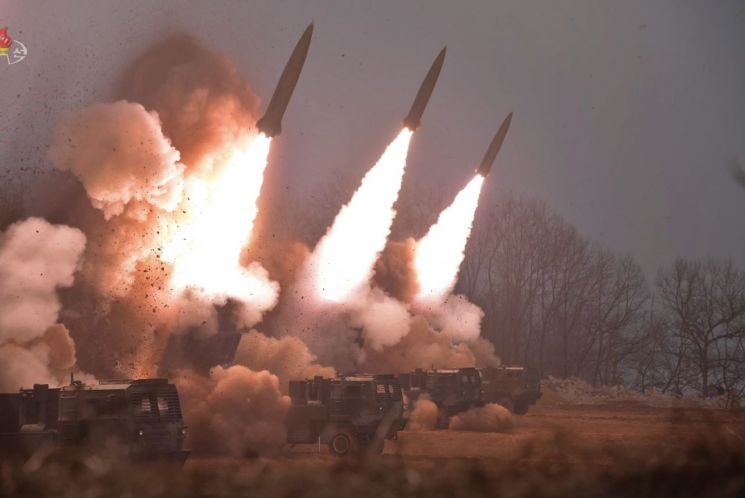
Preemptive Strikes with Dozens of Nuclear Warheads... Major Cities Held Hostage
According to the 'nuclear tactical scenario' estimated by academia, North Korea's nuclear tactics have so far focused on "deterrence through retaliatory strikes" and "alliance disruption," but as nuclear capabilities increase, the possibility of preemptive attacks also rises. The U.S. RAND Corporation and the Asan Institute presented five North Korean nuclear threat scenarios, including preemptive strikes, in a 2021 report.
The first scenario involves provocations such as crossing the Northern Limit Line (NLL) and occupying five islands in the West Sea, followed by nuclear threats when South Korea and the U.S. attempt to respond. The second scenario involves making Seoul and other major South Korean cities "nuclear hostages" and breaking the will of South Korea and the U.S. to respond by conducting nuclear attacks on several cities. If South Korea and the U.S. do not cease counterattacks, North Korea could threaten attacks on U.S. military bases in the Asia-Pacific region, Japan, or even the U.S. mainland.
The third scenario involves using 40 to 60 nuclear weapons early in the war to strike South Korea's political and military key targets, as well as naval and air force command and control facilities, to force South Korea to surrender. The fourth scenario aims to disrupt South Korea-U.S. relations by threatening the U.S. mainland, thereby undermining the U.S.'s "extended deterrence" commitment. The final scenario is "nuclear proliferation," involving the large-scale sale of nuclear warheads overseas.
At a 'North Korean Nuclear Crisis Response Seminar' held last October by the People Power Party's North Korean Nuclear Crisis Response Special Committee and the Korea Advanced Institute for National Unification, Professor Park Hwi-rak of Kookmin University also presented three scenarios of North Korean provocations using nuclear weapons.
The first is similar to the 2010 Cheonan sinking incident, where North Korea attacks South Korean warships or launches a surprise attack to occupy the five northwestern islands, including Baengnyeongdo, threatening to use nuclear weapons. This is similar to the first scenario in the Asan-RAND report. Notably, the five northwestern islands are not managed by the United Nations Command or the ROK-U.S. Combined Forces Command, making it difficult for U.S. forces to intervene.
In the second scenario, Professor Park predicted that North Korea might threaten nuclear weapon use while carrying out limited attacks on Seoul. Seoul is only 40 km from the Demilitarized Zone, so North Korean forces could advance to Seoul overnight if they choose.
The final scenario involves preemptively dropping nuclear weapons on major South Korean cities to paralyze or neutralize power plants, substations, computer network hubs, water supply systems, logistics and transportation centers, and important military facilities, thereby initiating full-scale war.
© The Asia Business Daily(www.asiae.co.kr). All rights reserved.
![User Who Sold Erroneously Deposited Bitcoins to Repay Debt and Fund Entertainment... What Did the Supreme Court Decide in 2021? [Legal Issue Check]](https://cwcontent.asiae.co.kr/asiaresize/183/2026020910431234020_1770601391.png)

















