Bando Construction announced on the 20th that it has conducted the first-ever on-site construction in Korea using a robot-based ‘3D printer’.
On the 9th, Bando Construction deployed a robot-based 3D printer to construct sculptural wall structures at the ‘Seodaegu Station Bando Yubora Centum’ apartment construction site located in Pyeongni-dong, Seo-gu, Daegu. This ‘3D printing’ construction, carried out in collaboration with Hysis, is the first of its kind in Korea and is a rare case globally, attracting attention from the construction industry.
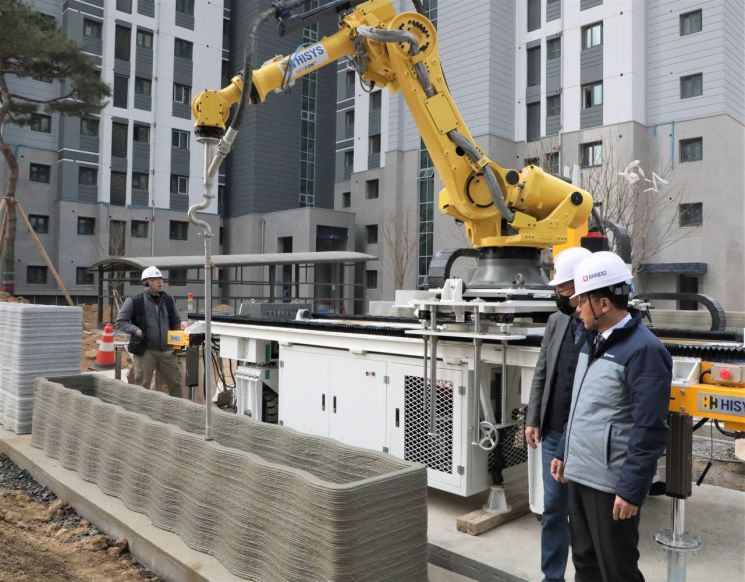
Architectural 3D printing technology is one of the core technologies of smart construction, offering more than 20% cost savings and over 30% reduction in construction time compared to traditional construction methods, thereby enhancing productivity at construction sites. Additionally, it is emerging as an alternative to address labor shortages and aging workforce issues in construction sites, reduces various safety accidents, and is an eco-friendly method that can reduce construction waste by more than 90% since it does not require formwork.
In particular, 3D printing technology offers high flexibility in architectural design. While traditional construction methods faced structural constraints due to construction techniques, making it difficult to realize complex and unique designs, 3D printing technology allows for easy implementation of complex and unique designs, greatly contributing to enhancing the value and individuality of buildings.
Due to these advantages, the global construction 3D printing market is rapidly growing. According to the 2020 report by Allied Market Research, the architectural 3D printing industry is expected to maintain steady growth with a compound annual growth rate (CAGR) of 100% from 2022 to 2027, and is projected to reach an annual total market size of 40 billion US dollars by 2027.
Bando Construction plans to expand the application of 3D printing techniques not only to the sculptural wall structures constructed this time but also to various elements within the apartment complex such as flower beds, benches, and recycling centers. Through this, they aim to standardize world-class smart construction methods and further accelerate ESG management.
Lee Jeong-ryeol, Head of the Construction Division at Bando Construction, stated, “By introducing advanced 3D printing technology, we expect to break away from conventional and uniform buildings and present differentiated designs, thereby enhancing the product competitiveness of ‘Bando Yubora.’ Through joint technology development with our partner Hysis, we will lead the field of ‘architectural 3D printing’ in the future.”
© The Asia Business Daily(www.asiae.co.kr). All rights reserved.

















