Credit Suisse (CS), which once rivaled the world's top investment bank JP Morgan, has disappeared into history after being forcibly merged with its competitor UBS. The fatal mistake was doubling down on risk exposure in the investment banking (IB) sector after the global financial crisis, under the motto "no risk, no reward."
On the 19th (local time), The Wall Street Journal (WSJ) analyzed that CS's downfall has its roots in how it escaped the 2008 global financial crisis. During the 2008 crisis triggered by the bankruptcy of the giant financial group Lehman Brothers, one of the four major U.S. investment banks, renowned global investment banks such as JP Morgan, Morgan Stanley, and Deutsche Bank faced a life-or-death crisis. These banks posted astronomical losses that year, leading to a great recession and sparking all economic crises. Even amid this worst financial crisis, CS recovered relatively quickly, and the reason was its explosive growth in the IB sector.
Founded in 1856 as a Swiss railway business lender, CS entered personal finance in 1900, and in the 1990s, it transformed into an investment bank through active M&A starting with the acquisition of First Boston, expanding its business. When the financial system froze in 2008, CS introduced a new business model combining wealth management (WM) for global high-net-worth individuals and IB services, which was highly successful. The success was largely due to targeting high-income super-rich clients, as the financial crisis caused by the real estate bubble primarily affected low-income and credit-impaired individuals. WSJ reported that CS was reborn at the time as a "bank for billionaires."
The once sound CS turned to crisis because of the IB division. It suffered a $1.7 billion (about 2.22 trillion KRW) loss when the UK financial firm Greensill Capital, in which it had invested $10 billion (about 13 trillion KRW), went bankrupt due to risky trades and accounting fraud. Within less than a month, it faced a $5.5 billion (about 7.17 trillion KRW) loss as funds were trapped in the margin call incident of the U.S. hedge fund Archegos Capital. While JP Morgan and Morgan Stanley minimized losses by selling stocks held as collateral, CS neglected risk management and incurred the largest losses among major global investment banks, causing market trust to plummet.
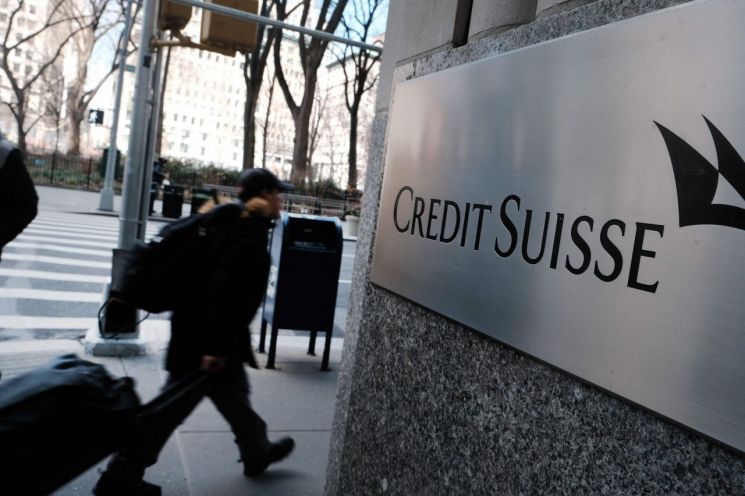
Amid this, news of the largest shareholder cutting losses spread, and market panic escalated uncontrollably. Financial concerns intensified after a recent business report revealed "significant deficiencies" in accounting due to inadequate internal controls. Saudi National Bank Chairman Amar Al-Khudairi announced there would be "no additional liquidity support plans," leading to continued capital outflows. CS's credit default swap (CDS) premium, an indicator of default risk, surged to an all-time high, peaking fears of bankruptcy.
Subsequently, WSJ pointed out that CS was involved in various scandals, including bribery deals in Mozambique, money laundering for Bulgarian drug dealers, tax evasion related to over 50,000 accounts across Europe, and other fraud and illegal transactions. Between 2020 and 2022 alone, fines and compensation payments reached $4 billion (about 5.22 trillion KRW). WSJ added that CS disclosed 12 pages of government investigations and lawsuits in its recent annual report.
Ultimately, the expansion of the IB business became the root cause of deteriorating profits, branding CS as an "out-of-control institution" to investors and pushing it to the brink of bankruptcy, ending in a "Pyrrhic victory" (a victory with devastating cost). Giovanni Baron Adessi, a finance professor at an Italian university, noted, "The greatest asset in financial markets is trust. Once a financial firm starts losing trust, everything collapses."
The IB sector's poor performance is expected to be an obstacle in the integration process with UBS. With UBS's acquisition of CS finalized, UBS is expected to downsize CS's IB division to near dismantlement as anticipated. The Swiss Finance Ministry's decision to provide a government guarantee of 9 billion Swiss francs to cover potential losses or legal costs arising from the merger is reportedly in consideration of this IB division dismantling. Andreas Benditti of Swiss investment bank Pictet said, "(CS) boasted of themselves as winners of the financial crisis, but their strategy has inflicted severe wounds on many investors."
© The Asia Business Daily(www.asiae.co.kr). All rights reserved.

















