North Korea "Missile Simulating Nuclear Strike on Key Enemy Targets"
Protests Against ROK-US Joint Exercises... Provocation Level Expected to Rise
ICBM Launch at Normal Trajectory Aimed at "US Mainland" Anticipated
Kim Jong-un, Chairman of the State Affairs Commission of North Korea, has intensified nuclear threats targeting the South. North Korea has recently continued military demonstrations in response to the joint South Korea-U.S. exercises, and there are expectations that it may carry out high-intensity provocations such as an intercontinental ballistic missile (ICBM) launch at normal trajectory targeting the U.S. mainland or a seventh nuclear test.
According to the Korean Central News Agency (KCNA) on the 20th, North Korea conducted a "comprehensive tactical exercise simulating nuclear counterattack by tactical nuclear operation units" over two days from the 18th to 19th. The North described this exercise as "to substantially strengthen war deterrence and nuclear counterattack capabilities and to train the relevant units in the procedures and processes of performing tactical nuclear attack missions." The use of the term "training" is interpreted as a demonstration of practical nuclear attack capabilities.
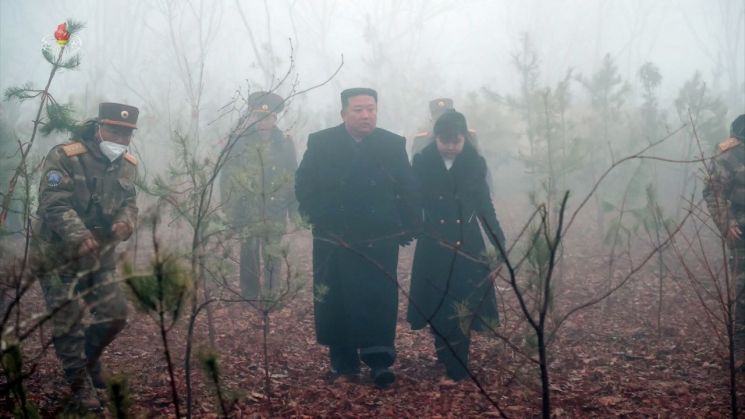 North Korea's Kim Jong-un observes 'simulated nuclear counterattack drill' with daughter Ju-ae [Image source=Yonhap News]
The agency explained that the short-range ballistic missile launched by North Korea into the East Sea the previous morning was a "tactical ballistic missile firing exercise simulating a nuclear strike on major enemy (South Korean) targets." This missile was assessed as the KN-23, known as the "North Korean version of Iskander." In particular, North Korea claimed that "the tactical ballistic missile launched from Cholsan County, North Pyongan Province, exploded precisely in the air at 800 meters above the target area set 800 km away over the East Sea of Korea." This is analyzed as a demonstration of the 'airburst' capability to maximize lethality aimed at South Korean urban centers.
Chairman Kim Jong-un observed the exercise together with his daughter 'Juae' and emphasized, "Only when the nuclear attack posture, which can be swiftly and accurately activated as a means to strike the enemy and make the enemy fearful at any time, is fully established, can the critical strategic mission of war deterrence be fulfilled." The agency further noted that Kim presented "strategic tasks for war preparation," although specific details were not disclosed. It is possible that the plan includes high-intensity provocations such as the seventh nuclear test and an ICBM launch at normal trajectory.
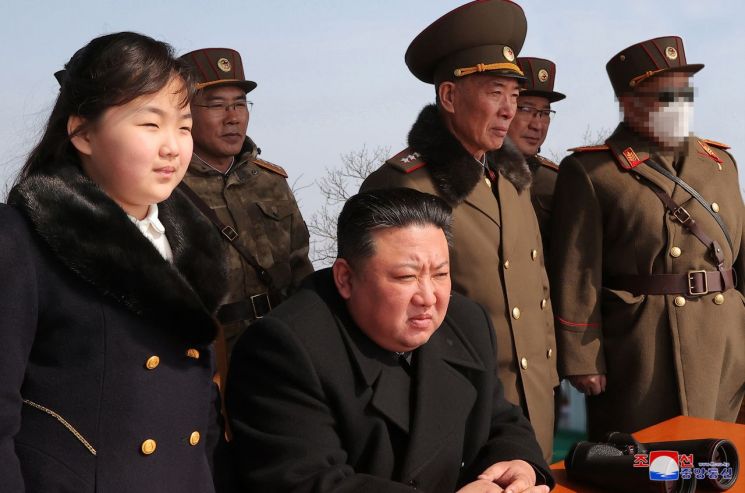 North Korea "Comprehensive Tactical Exercise Simulating Nuclear Retaliation on the 18th-19th"
 [Image Source=Yonhap News]
North Korea had already launched two submarine-launched cruise missiles on the 12th of this month, a day before the South Korea-U.S. joint exercises, followed by a short-range ballistic missile on the 14th and a high-angle launch of the ICBM 'Hwasong-17' on the 16th. Moreover, provocations have continued at intervals of 2 to 3 days, including the KN-23 missile launch the day before. Notably, North Korea is conducting blatant military demonstrations, such as launching an ICBM timed with the South Korea-Japan summit or firing ballistic missiles into the East Sea just before the U.S. B-1B strategic bomber entered the Korean Peninsula operational area.
Starting today, the 'Ssangryong Exercise,' a large-scale joint amphibious landing exercise by the South Korea-U.S. Marine Corps that had been suspended during the Moon Jae-in administration, has been revived and expanded to a division-level exercise after five years. Given that North Korea has labeled the joint exercises as 'war exercises' or 'north invasion exercises' and has hinted at practical nuclear threats, there are prospects that it may carry out high-intensity provocations depending on the deployment of U.S. strategic assets. Possibilities include the launch of a new solid-fuel ICBM, an ICBM launch at normal trajectory, and the launch of a military reconnaissance satellite, which was scheduled for completion in April, as well as the potential for a seventh nuclear test.
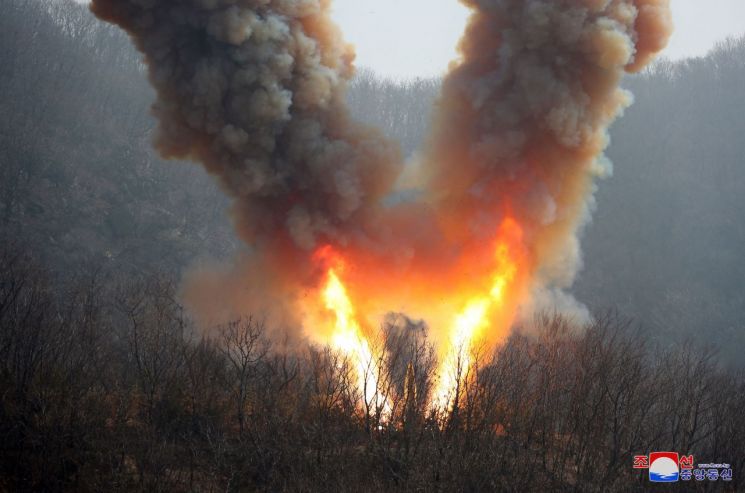 North Korea "Comprehensive Tactical Exercise Simulating Nuclear Retaliation on the 18th-19th"
 [Image Source=Yonhap News]
Yang Moo-jin, President of the University of North Korean Studies, stated, "Based on the success of this 'tactical nuclear ballistic missile launch exercise,' North Korea is expected to proceed with steps such as reconnaissance satellite and ICBM normal trajectory launches. In particular, an ICBM launch with a shortened range into the Pacific is anticipated in April, and there is also a possibility that accidental clashes due to accumulated fatigue among South and North Korean soldiers amid rising tensions could escalate into localized warfare."
Professor Lim Eul-chul of the Institute of Far Eastern Studies at Kyungnam University expressed concern, saying, "Kim Jong-un has openly warned that nuclear weapons can be used at any time if necessary to fulfill the mission of nuclear force, and that they can be used preemptively if an escalation occurs. The Korean Peninsula is rapidly becoming the region with the highest potential for an imminent nuclear war."
There are also perspectives focusing on changes in North Korea's nuclear posture. Yang Wook, a research fellow at the Asan Institute for Policy Studies, analyzed, "This KN-23 missile appears to have been launched from a silo (hangar), not from the mobile launcher vehicle (TEL) that North Korea has used so far, which is evidence that North Korea's nuclear posture is becoming more realistic. It is highly likely that larger missiles in the future, especially the ICBM 'Hwasong-17,' will be operated from silos."
© The Asia Business Daily(www.asiae.co.kr). All rights reserved.



















