Government to Send Official Notice for GSOMIA Normalization Early Next Week
Restoration of Whitelist Also a Matter of Time... "Virtually Agreed"
Currency Swap Cooperation Expected Following Financial and Foreign Exchange Collaboration
The government has officially begun follow-up measures after the Korea-Japan summit. With President Yoon Suk-yeol’s 1-night, 2-day visit to Japan restoring the first shuttle diplomacy between the two countries in 12 years, the strategy is to achieve results mainly in the security and economic sectors to calm domestic negative public opinion. There is also an expectation that the Korean government has secured a favorable position in Korea-Japan relations through this summit. After returning home, President Yoon also instructed his aides to make thorough preparations for follow-up measures.
According to government ministries on the 20th, the government plans to send a diplomatic note to the Japanese government early this week to normalize the Korea-Japan General Security of Military Information Agreement (GSOMIA). This follows the official mention of GSOMIA normalization at the Korea-Japan summit on the 16th, after which the Ministry of National Defense sent a formal request to the Ministry of Foreign Affairs to proceed with follow-up measures.
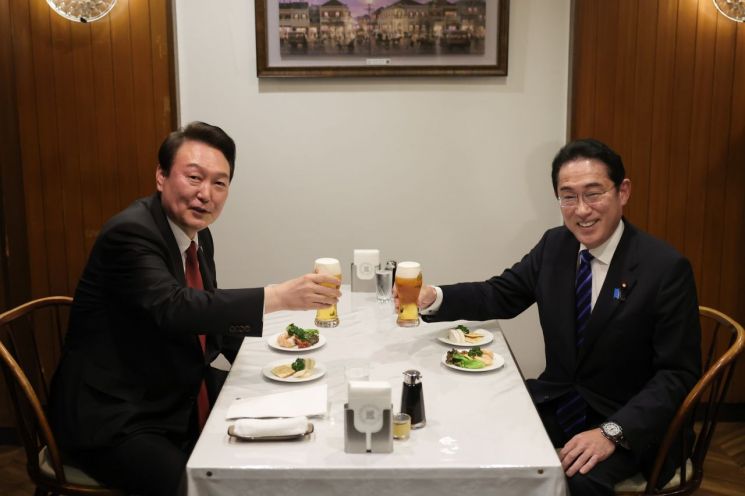
Procedurally, once the Ministry of Foreign Affairs sends the relevant note and the Japanese government either raises no objections or responds with an agreement, normalization will be immediately realized. The government’s position is that immediate information exchange will not occur right after GSOMIA normalization, but it is expected to send a strong warning message to North Korea. This is because it could significantly improve intelligence-gathering capabilities regarding North Korea’s missile and submarine activities. A presidential office official described this measure as the "de facto first substantial achievement" following the summit, adding, "Since the most important pillar of Korea-Japan security relations is taking immediate normalization steps, discussions on expanding cooperation to various fields such as economy and culture are expected to proceed promptly."
The presidential office plans to promptly inform the public of the results of the follow-up measures on GSOMIA normalization and intends to expand the military cooperation will between Korea and Japan into the economic sector. Accordingly, economic-related ministries such as the Ministry of Trade, Industry and Energy are preparing exchanges in various fields, and the industrial sector has begun establishing concrete cooperation procedures centered on semiconductors, batteries, and electric vehicles. Specifically, discussions on supply chains for new economic security communities such as the Indo-Pacific Economic Framework (IPEF) are expected.
Discussions on the Korea-Japan currency swap, which had been suspended, are also among the cooperation issues being considered. With the two leaders mentioning cooperation in finance and foreign exchange sectors, the business community is actively raising the necessity of a currency swap. A currency swap is a contract that allows each country to deposit its own currency with the other and borrow the other’s currency or dollars in emergencies such as a foreign exchange crisis.
Korea and Japan began a currency swap worth $2 billion in July 2001 and expanded it to $70 billion (91.665 trillion won) by October 2011. However, relations between the two countries began to deteriorate following President Lee Myung-bak’s visit to Dokdo in August 2012, and the swap agreement ended in 2015. A government official explained, "Although we are not currently in a crisis with declining foreign exchange reserves, given the increasing uncertainty in global financial markets, it is necessary to prepare as a safety measure against a foreign exchange crisis."
Preparations to restore the whitelist (export control preferential countries) status have also begun immediately. This follows the mutual agreement between the two countries to restore the whitelist status. While the Japanese government approves the ordinance equivalent to our presidential decree at the cabinet meeting, our government issues it as a notification from the relevant ministry, making adjustments relatively easier. A government official said, "The failure to finalize the whitelist during this visit was due to insufficient consultations among working-level officials, but the willingness to resolve it between the two countries has already been confirmed," adding, "This too will lead to quick results."
The government also plans to listen to negative public opinion regarding this visit to Japan. It intends to meticulously support the payment procedures for court-ordered compensation and is discussing direct communication with victims and their families regarding solutions for forced labor. In connection with this, it is known that the presidential office is preparing to strengthen policy communication channels internally. This is based on the judgment that communication between policy and the public was insufficient during the government’s announcement of the forced labor solution and the ‘69-hour workweek’ discussion process.
© The Asia Business Daily(www.asiae.co.kr). All rights reserved.
![From Bar Hostess to Organ Seller to High Society... The Grotesque Con of a "Human Counterfeit" [Slate]](https://cwcontent.asiae.co.kr/asiaresize/183/2026021902243444107_1771435474.jpg)
















