"The Fed will do whatever it takes to tame inflation." This was the statement made by Jerome Powell, Chairman of the U.S. Federal Reserve (Fed), when he raised the benchmark interest rate for the first time in 3 years and 3 months at the Federal Open Market Committee (FOMC) meeting in March last year. And now, one year after resuming rate hikes, the Fed stands at a crossroads again. The recent collapse of Silicon Valley Bank (SVB), which has thrown the financial markets into a 'systemic crisis' panic, has pushed the Fed into a complex crisis of 'price stability' and 'financial system stability.' With the fight against inflation still ongoing, there are even assessments that the Fed is effectively handcuffed.
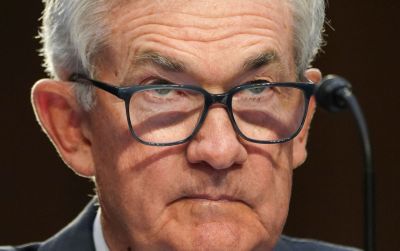
According to financial sources on the 19th (local time), the market is abuzz with debate as it awaits the March FOMC meeting scheduled for the 21st-22nd. Due to the sudden SVB collapse and heightened financial risks, the initially expected big step (a 0.5 percentage point increase in the benchmark interest rate) has been shelved. The key question is whether the Fed will opt for a baby step (a 0.25 percentage point increase) or a temporary pause. Additionally, the future interest rate path and economic outlook to be revealed through the March dot plot are also major points of market interest. Bloomberg Economics evaluated that "the Fed will have to make the most difficult policy decision at the March FOMC."
Considering persistently high inflation and the Fed's credibility, opinions lean toward continuing a modest rate hike. Mohamed El-Erian, former CEO of PIMCO?the world's largest bond manager?and chief economic advisor at Allianz, appeared on Fox News Sunday that day and supported a 0.25 percentage point hike in March, stating, "Because inflation remains an issue, a 0.25 percentage point increase is necessary." He also pointed out that "the Fed has separate policy tools to address inflation and financial stability" and warned against confusing the two. A 0.25 percentage point increase is the conventional rate hike size.
The interest rate futures market also places more weight on a baby step. According to the Chicago Mercantile Exchange (CME) FedWatch tool, as of that afternoon, the federal funds futures market reflected more than a 62% probability that the Fed will raise rates by 0.25 percentage points at the March FOMC. The probability of a rate pause was 38%, and the chance of a big step was 0%.
Voices calling for a pause have also continued since the SVB incident. Jason Bloom, head of bond and ETF strategy at Invesco, said, "The Fed is handcuffed," and pointed out, "It is time to pause briefly and assess how much damage the tightening has caused." For the Fed, which has the policy goal of financial system stability, it cannot ignore the repercussions of choosing further tightening while the SVB-induced financial risks have not been fully resolved. The Washington Post (WP), in an editorial that day, argued, "The Fed should give the financial system time to adapt to the new reality" and "should not raise rates on March 22." The outlet added, "The Fed's ultimate mission is risk management, and the current heightened risks are harming financial stability."
Lloyd Blankfein, former CEO of Goldman Sachs, appeared on CNN the same day and supported a pause, saying, "Personally, I think it is okay to stop here." He predicted that lending standards would tighten due to increased financial risk concerns following the SVB collapse and said, "In some ways, this situation will have a tightening effect similar to a rate hike." Investment banks Barclays and Goldman Sachs also expect the Fed to pause rate hikes in March. Nomura, which initially anticipated a big step, has even suggested the possibility of a 0.25 percentage point rate cut. Many investors now foresee year-end rates falling below 5%.
However, even if the Fed opts for a pause in March, this is seen as a temporary halt due to heightened financial risk concerns, and there are diagnoses that tightening could actually prolong. This is why the future interest rate path to be presented through the dot plot is attracting more attention. The market will also focus on Chairman Powell's press conference immediately following the FOMC. Christiane Baumeister, a professor at the University of Notre Dame, said, "The Fed is truly trapped," explaining, "It has to continue fighting inflation, but it must do so amid increased banking sector stress." Starting from the March FOMC last year, the Fed has raised rates by 4.5 percentage points over one year, but it has yet to end its fight against inflation and now faces a new turning point.
The Fed's interest rate path, as the leader of global monetary policy, inevitably impacts other countries. This week, more than 12 central banks, including those of the UK, Switzerland, Norway, and the Philippines, will also make interest rate decisions.
© The Asia Business Daily(www.asiae.co.kr). All rights reserved.
![Clutching a Stolen Dior Bag, Saying "I Hate Being Poor but Real"... The Grotesque Con of a "Human Knockoff" [Slate]](https://cwcontent.asiae.co.kr/asiaresize/183/2026021902243444107_1771435474.jpg)
















