Recreating the 18th-Century Geobukseon Based on Historical Texts
Cover Only in the Center, Cannons on the Third Deck Too
The Geobukseon (Turtle Ship) served as a guardian deity for our people during the Imjin War, but no one knew its true appearance because no paintings or blueprints were found. However, a domestic scientist has recreated the appearance of the 18th-century Geobukseon through research on ancient documents. It has drawn more attention as it was designed in the same way as the one Admiral Yi Sun-sin actually built to fight against the Japanese forces at the end of the 16th century during the Imjin War, according to historical records.
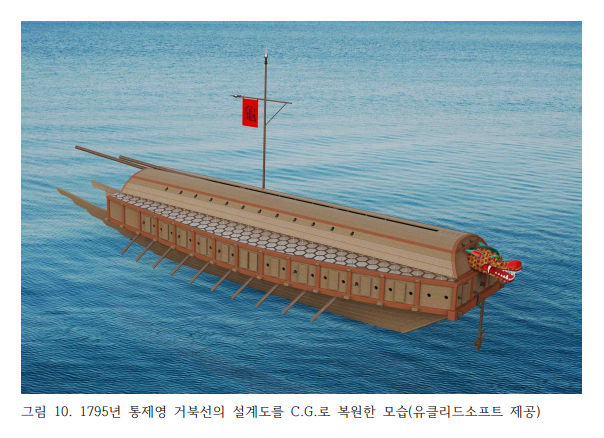
On the 19th, Chae Yeon-seok, Chairman of the Aviation and Railway Accident Investigation Board, announced that he confirmed the fact that the 'Gwiseondo-seol' (Turtle Ship Design Theory) in the Yi Chungmugong Jeonseo (Complete Works of Admiral Yi Sun-sin), compiled by royal decree in 1795, was used as design material for the actual construction of the Geobukseon. Based on this, he recreated the appearance of the 18th-century Geobukseon using computer graphics for the first time in 228 years.
Chairman Chae obtained a crucial hint from a memorial submitted by Shin Dae-hyun (who served as the Commander of the Three Naval Provinces from 1793 to 1794), which was included in the Bibyeonsa Deungnok (Records of the State Council). In April 1809, the 9th year of King Sunjo’s reign, Shin Dae-hyun appealed to the king, saying, "The Geobukseon is being made arbitrarily and has become a mess," and added, "The diagrams are detailed in the Chungmugong Jeonseo, so one can understand them just by looking once."
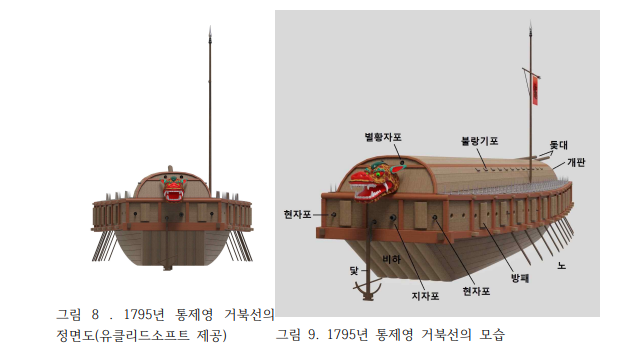
Based on this, Chairman Chae judged that the Gwiseondo-seol included in the Yi Chungmugong Jeonseo, which King Jeongjo ordered his officials to compile, was actually used in the construction of the Geobukseon. He explained, "It was confirmed that the 'Gwiseondo-seol' in the Yi Chungmugong Jeonseo was used as the basic design material when constructing the Geobukseon after 1809," and added, "'Gwiseondo-seol' being the actual design material used for building the Geobukseon means that if you build according to this material, you can restore the 1795 Tongjeyeong Geobukseon."
The Gwiseondo-seol describes two types of Geobukseon from 1795: the Tongjeyeong Geobukseon and the Jeolla Left Naval Command Geobukseon. Among these, the Tongjeyeong Geobukseon, whose specifications and structure are detailed, was referenced to restore it using computer graphics.
The most distinctive feature of this Geobukseon is that the roof (gaepan) was not a fully rounded cover over the entire ship but rather planks were erected only in the central part of the three-story deck, and a roof was placed there. There had been much debate about whether cannons were installed on the left and right sides of the third-floor roof or if only matchlocks or bows were used, but the research team found evidence supporting the use of cannons. They confirmed from an ancient document held by the National Museum of Korea, the Tongjeyeong Haeyu Munseo (1894), that cannons were placed on the left and right sides of the second and third floors as well as the front and rear. They also found the specifications of the 1795 Tongjeyeong Geobukseon’s upper deck: length 85 cheok (26.6m), width 32 cheok (10m). It is notable that the upper deck was wider than previously known Geobukseon.
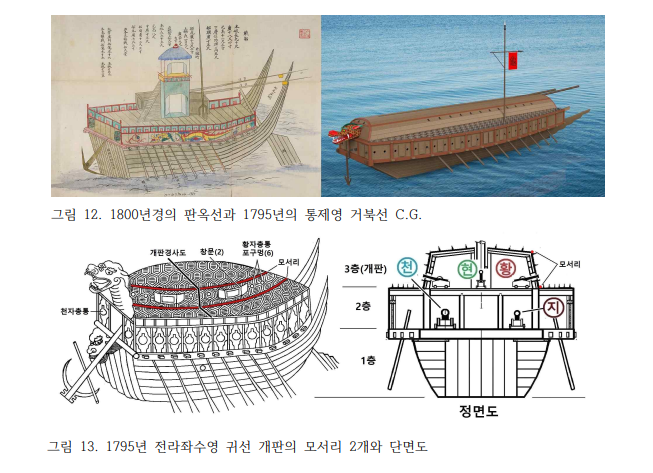
It was also found that 182 people boarded the Geobukseon, including 6 officers, 19 instructors, 10 artillery chiefs, 24 gunners, 4 loaders, and 120 soldiers. The first-floor warehouse stored 61 seok of military provisions for the navy to use for one month, including 52 seok of rice for military rations, 6 seok of steamed rice, and 3 seok of misutgaru (grain powder). The second floor’s center was arranged as a resting area for the navy personnel.
These research results were published in the 9th issue of "Chungmugong Yi Sun-sin and Korean Maritime" (Naval Academy Maritime Research Institute) in December last year. The title of the paper is "A Study on the Structure, Scale, Appearance, and Cannon Arrangement of the Tongjeyeong Geobukseon in the 18th Century Based on the Gwiseondo-seol in the Yi Chungmugong Jeonseo."
© The Asia Business Daily(www.asiae.co.kr). All rights reserved.



















